


Best States to Register a Dropshipping Business in the USA
See how state filing costs and income tax rules cut into your margins. Pick the registration state that keeps more of every sale in your pocket.
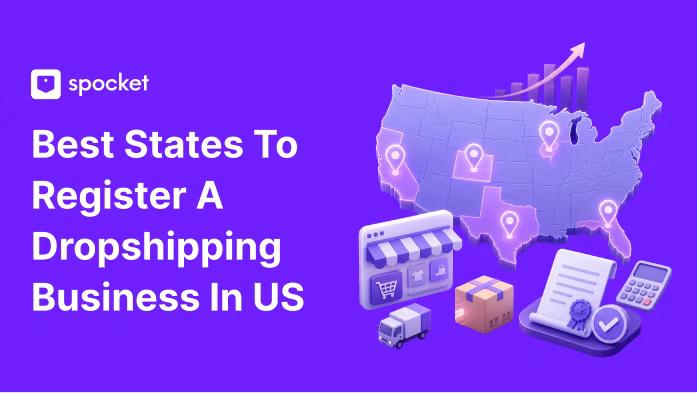

Picking the right state to register your dropshipping business is one of the most overlooked profit levers you have. Get it right and you keep more of every sale in your pocket. Get it wrong and you bleed money through unnecessary filings, franchise taxes, and compliance headaches that eat into your margins month after month. Most guides recycle the same three states and call it a day. You need a sharper breakdown—one that covers tax exposure, privacy rules, annual costs, and the sales tax triggers that trip up dropshippers who sell across state lines. This guide ranks the best states to register a dropshipping business based on what actually matters for your bottom line, not what sounds good in a brochure.
Best States to Register a Dropshipping Business
Here is a list of the best states to register a dropshipping business in the US in 2026:
1. Wyoming
Wyoming earns its spot at the top of the list for the best states to register a dropshipping business. The state charges no corporate income tax, no individual income tax, and no franchise tax. Your LLC files one annual report with a $60 fee, and that covers your entire year. Compare that to California, where the minimum franchise tax alone is $800 before you make a single sale.
Privacy is where Wyoming pulls ahead of almost every other state. The Secretary of State does not require you to list member names or addresses in public filings. Your registered agent's information shows up instead, which keeps your personal details out of searchable state databases. For dropshippers who run stores under brand names and prefer to keep ownership separate from the public-facing business, this matters.
Wyoming also offers charging order protection for single-member LLCs, which means creditors cannot easily seize your ownership interest if you face a lawsuit. The total first-year cost runs about $100 for the filing fee plus $50 to $125 for a registered agent, followed by the $60 annual report fee each year after. For dropshipping businesses that want lean operations, Wyoming delivers the best cost-to-benefit ratio.
You should know that some banks still ask extra questions for Wyoming LLCs during the account opening process. That friction has dropped significantly as more fintech banks and established institutions accept Wyoming entities, but you might need to provide additional documentation compared to a Delaware LLC.
2. Delaware
Delaware stands as the most recognized state for business registration in the US, and for dropshippers who plan to scale or eventually sell their business, it holds real advantages. The state offers a dedicated Court of Chancery that handles business disputes without juries, which creates a deep set of predictable case law. Payment processors like Stripe, PayPal, and major banks recognize Delaware LLCs instantly, which can speed up account approval.
The downside sits in the annual costs. Delaware charges a $300 minimum franchise tax every year for LLCs, plus the $90 formation fee upfront. Over five years, you will pay roughly $1,590 just in state fees, compared to $400 for a Wyoming LLC. Delaware also has no state sales tax and no corporate income tax on income earned outside the state, which dropshippers leverage since operations happen remotely.
If you plan to raise venture capital, attract investors, or eventually sell your dropshipping brand, Delaware's legal infrastructure makes due diligence smoother. For most solo dropshippers, though, the higher annual fees wipe out any advantage you get from the brand recognition alone. The best states to register a dropshipping business balance cost against utility, and Delaware leans toward the latter for specific growth-stage businesses.
3. New Mexico
New Mexico flies under the radar but deserves attention as one of the cheapest states to register a dropshipping business. The filing fee runs $50, and the state does not require an annual report for LLCs. That means no recurring state fees every year, which no other state on this list matches. New Mexico also allows anonymous LLC registration, meaning your name and address stay out of public filings when you use a registered agent.
The catch shows up when you try to open a business bank account or connect a payment processor. Some banks flag New Mexico LLCs for additional verification because the state's low disclosure requirements attract shell companies. You might face longer approval times or requests for extra documentation that a Delaware or Wyoming LLC would not trigger. If you already have an established banking relationship or use a fintech provider comfortable with New Mexico entities, this friction shrinks.
Sales tax considerations matter here too. New Mexico does impose a gross receipts tax instead of a traditional sales tax, and if you have any connection to the state beyond your LLC registration, you might owe taxes on your revenue. For dropshippers with no physical presence or employees in New Mexico, this rarely activates, but you should verify your specific situation.
4. Florida
Florida attracts dropshipping business registrations for reasons beyond the weather. The state charges no individual income tax, which means the profits that pass through from your LLC to your personal return stay untouched at the state level. Florida's business climate consistently ranks among the top in the nation, and the state recorded the highest number of new business registrations in 2026.
The annual report fee runs $138.75, which sits higher than Wyoming's $60 but far below Delaware's $300. Florida also added a Beneficial Ownership Information reporting requirement in 2025 that aligns with federal FinCEN rules, so your ownership details get filed but remain non-public. If you live in Florida or plan to base operations there, forming your LLC in Florida makes practical sense. The state's infrastructure, port access, and growing logistics network add value for dropshippers who might expand into warehousing or fulfillment later.
One wrinkle to note: Florida requires a registered agent with a physical address in the state, which adds roughly $50 to $150 per year through a commercial registered agent service. For dropshippers outside Florida, this cost eats into the tax savings compared to Wyoming.
5. Texas
Texas comes up frequently in discussions about the best states to register a dropshipping business because it imposes no individual income tax and no corporate income tax. The state also holds a massive economy with a business-friendly regulatory environment that appeals to founders who want to scale.
The detail most guides skip is the Texas franchise tax. If your dropshipping business generates annual revenue above approximately $2.47 million, you owe a margin tax that functions like a franchise tax on gross receipts. Most solo dropshippers or small teams will not hit that threshold, but if your store grows quickly, the tax can surprise you. The annual reporting requirements are also more involved than Wyoming or New Mexico, with both a Public Information Report and a franchise tax report due each year.
Texas does offer strong asset protection and a large banking network. If you live in Texas already, forming in Texas avoids the foreign qualification requirement in your home state and keeps compliance straightforward. For out-of-state dropshippers, the compliance load tilts the scale toward Wyoming or New Mexico unless you have a specific reason to establish a Texas presence.
6. Nevada
Nevada built its reputation on privacy and zero state income tax, which draws dropshippers who want anonymity. The state does not require you to list members or managers on public formation documents, and it has no information-sharing agreement with the IRS. For sellers who run multiple stores or value a clean separation between their personal identity and their business, Nevada delivers.
The costs have crept up over recent years. Nevada now charges an annual business license fee of $200 plus a $150 annual list fee, totaling $350 per year before you factor in registered agent costs. That puts Nevada at the higher end of maintenance costs among the best states to register a dropshipping business, especially when Wyoming offers comparable privacy for $60 per year. Nevada also imposes a Commerce Tax on businesses with gross revenue exceeding $4 million, though most dropshippers stay well below that line.
If privacy is your top concern and you are willing to pay a premium for the strongest legal protections, Nevada remains a solid choice. If you want privacy plus the lowest possible annual cost, Wyoming wins out.
Sales Tax Nexus: What Dropshippers Overlook
Most dropshippers focus heavily on income tax when choosing a registration state and skip past the sales tax piece. That gap can cost you. Sales tax obligations hinge on nexus, which is a connection to a state that requires you to collect and remit tax on sales to customers in that state. Physical nexus triggers when you have inventory, employees, or an office in a state. Economic nexus triggers when your sales into a state cross a threshold, typically $100,000 in revenue or 200 transactions per year.
Here is why this matters for your registration decision. If you register your LLC in Delaware but use a supplier with warehouses in California, Texas, and New Jersey, you might create physical nexus in those states through the supplier's inventory. Several states, including California and Texas, hold third-party drop shippers liable for sales tax if the retailer lacks nexus. Your choice of suppliers and their warehouse locations directly affect your sales tax exposure regardless of where your LLC is registered.
Five states have no state sales tax at all: Alaska, Delaware, Montana, New Hampshire, and Oregon. Registering in one of these states simplifies one layer of the compliance puzzle but does not exempt you from collecting sales tax in states where you have nexus. You will still need to track your sales volume by state and register for sales tax permits in states where you cross economic nexus thresholds. Marketplace facilitator laws add another layer. When you sell on Amazon, eBay, or Etsy, those platforms collect and remit sales tax on your behalf in most states, which reduces your direct compliance burden. If you sell through your own Shopify store, the responsibility falls entirely on you.
How to Form an LLC?
Forming an LLC in Wyoming while living and operating from another state triggers a requirement called foreign qualification. Your home state views your Wyoming LLC as a foreign entity doing business locally, and you must register it in your home state as a foreign LLC. That registration typically costs between $100 and $800 depending on the state, and it adds a second set of annual fees and reporting requirements.
If you live in a state with high fees like California, you might still save money by forming in Wyoming and paying both the Wyoming annual fee and the California foreign qualification fee, but you need to run the numbers. For many dropshippers who live in states with moderate or low compliance costs, forming in your home state and skipping the foreign qualification step simplifies the setup significantly.
You can avoid foreign qualification in some cases by structuring your business so your LLC does not technically operate in your home state. This requires careful legal advice and may not hold up under audit. The safest path is to assume you need foreign qualification if you run the business from a state different from your formation state.
Payment Processors and Banking: How Your State Affects Approvals
The state you choose for your dropshipping LLC affects how easily you open business bank accounts and connect payment processors. Stripe, PayPal, Shopify Payments, and major banks have internal risk models that flag certain states for extra review. Delaware LLCs pass through these checks the fastest because the state's corporate records are digitized, standardized, and widely recognized. Wyoming LLCs have caught up significantly, and most major banks now process them with minimal friction. New Mexico and, to a lesser extent, Nevada still face occasional delays.
If you plan to use Mercury, Brex, or other fintech banking platforms, check their current list of supported states before filing your formation documents. Each platform updates its eligibility criteria periodically, and a state that works today might face restrictions in six months.
How to Choose Which State to Dropship In?
Start with income tax: if your home state has high income tax and you want to minimize state-level taxes on your business profits, look at Wyoming, Nevada, or Texas. If privacy matters more to you than anything else, Wyoming and New Mexico offer the strongest protections at the lowest cost. If you plan to raise capital or sell your business within the next few years, Delaware's legal infrastructure gives you an edge during due diligence and transfer.
Next, check the total cost over five years. A Wyoming LLC costs roughly $400 over five years in state fees. Delaware costs about $1,590. Nevada runs about $1,750. New Mexico stays under $300 if you avoid the optional annual report. These numbers do not include registered agent fees, which add roughly $50 to $150 per year depending on the service you choose.
Factor in your payment processing needs. If you need your Stripe and bank accounts approved within days, Delaware and Wyoming give you the smoothest path. If you are willing to tolerate a slightly longer verification process to save on annual fees, New Mexico works.
Also, map your supplier warehouse locations against the sales tax rules in those states. If your main supplier stocks inventory in California, you will have California sales tax obligations regardless of where your LLC is registered.
States to Avoid for Dropshipping Registration
California tops the list of states to avoid. The $800 annual franchise tax applies regardless of revenue, and the state income tax rate reaches 13.3 percent, the highest in the country. New York imposes similarly high fees and a complex set of reporting requirements that make little sense for a low-overhead dropshipping business. Illinois, Massachusetts, and New Jersey also layer on annual fees and aggressive nexus enforcement that add compliance costs without any benefit to your dropshipping operation.
If you live in one of these states, you face a harder choice. Forming in your home state simplifies compliance but costs more every year. Forming out of state and paying foreign qualification fees might still save you money, but you need to calculate the difference before deciding.
Conclusion
Choosing among the best states to register a dropshipping business comes down to weighing tax savings, privacy, annual costs, and the friction you are willing to tolerate with banks and platforms. Wyoming delivers the strongest overall package for most dropshippers, combining low fees, zero state income tax, and privacy protections that keep your personal details off public records. New Mexico wins on pure cost. Delaware holds value if you plan to scale toward investment or an eventual sale. Run your decision through the checklist, map your supplier locations against sales tax rules, and make the call that keeps more revenue in your business. Start selling smarter with Spocket.
Start your dropshipping business today
Best States to Register a Dropshipping Business FAQs
What makes Wyoming the top state to register a dropshipping business?
Wyoming charges no corporate or individual income tax and requires only a $60 annual report fee for LLCs. Public filings do not list member names, so your personal information stays private. Most major banks now accept Wyoming entities without significant delays. First-year costs, including filing and registered agent fees, typically stay under $200.
How does New Mexico keep registration costs so low for dropshippers?
New Mexico charges a $50 formation fee and does not require LLCs to file an annual report. That eliminates ongoing state fees entirely. The Secretary of State also allows anonymous registration, keeping your name off public records. Expect some payment processors and banks to request extra verification during account setup because of the state’s low disclosure requirements.
If I register my LLC in a state with no sales tax, do I still collect from customers elsewhere?
Yes. Sales tax liability follows physical or economic nexus, not your LLC’s home state. If your supplier stores goods in a warehouse in California, you create physical nexus there. Economic nexus triggers when your sales into a state cross $100,000 or 200 transactions in a year. You must register and collect in those states.
Why should dropshippers avoid forming an LLC in California or New York?
California demands an $800 minimum franchise tax annually, even if you earn no revenue, and its top income tax rate reaches 13.3 percent. New York piles on high filing fees and complex reporting obligations. If you do not live or operate in these states, these fixed costs drain your profit without adding any operational benefit for a remote dropshipping business.


Launch your dropshipping business now!
Start free trial.avif)


Related blogs
Dropshipping Supplier Directory: Where to Find Vetted Suppliers
Browse our directory of vetted dropshipping suppliers across the US and EU, complete with niches, shipping speed, and pricing. Start your free trial today.

How to Negotiate With Dropshipping Suppliers: 9 Tactics That Actually Work
Learn how to negotiate with dropshipping suppliers on price, MOQs, and payment terms. Proven tactics and email scripts to boost your margins. Try Spocket free.

Best Clothing Dropshipping Suppliers: The 2026 Guide
Compare the best clothing dropshipping suppliers for 2026 — US/EU shipping speeds, pricing, and product quality — and find the right fit to launch your store.
