How to Stop Spending Money: A Beginner’s Guide to Breaking the Cycle
If you are tired of spending too much money, then here is a guide on how to stop spending. We walk you through everything, including some helpful apps that you can use.

You know that moment when you check your bank account and think, "Where did all my money go?" Yeah, that feeling. Most people hit it at some point—sometimes every month. The good news is that overspending isn't a character flaw or a permanent problem. It's a habit, and habits can be changed. This guide walks through exactly how, pulling from what actually works for people who've been in your shoes.
Why Do You Spend More Than You Intend?
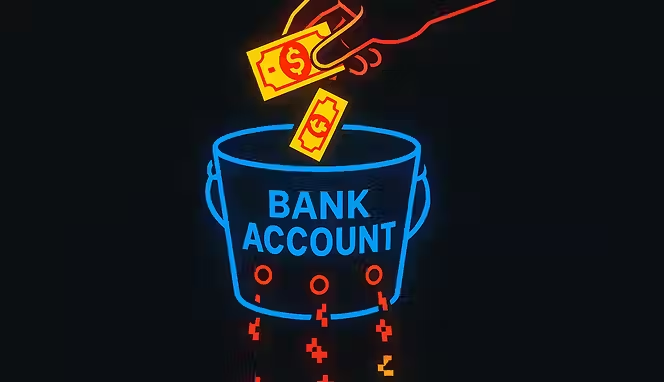
Before we talk about stopping, let's be honest about why you're spending in the first place. You're not doing it because you're bad with money. You're doing it because spending hits something inside you.
For some people, shopping is a hit of dopamine. The rush of getting something new, the temporary high when you unbox it, the feeling of control when money flows out of your account—all of that registers in your brain the same way a reward does. For others, spending is about managing feelings. Stressed? Buy something. Bored? Order from that restaurant. Lonely? A new hoodie seems like a friend.
Then there's the sneaky stuff: discount hunting, social media comparison, and the simple fact that buying things is easier than ever. One click and you own something. No friction.
The real issue isn't your self-control. It's that you haven't made spending harder or less appealing than whatever feeling it's supposed to fix.
Identify What Type of Spender You Are
Three main patterns show up over and over.
The Emotional Spender uses shopping to manage feelings—stress, boredom, sadness, even happiness. For you, shopping isn't about need. It's about mood management. The fix here isn't a budget. It's a replacement behavior. When the urge hits, you need something else that hits differently—a walk, calling someone, scrolling Reddit for 10 minutes, literally anything that interrupts the pattern.
The Convenience Spender shops because friction is low. You're not on some deep emotional journey. You just see something, it's right there, and you buy it. Scrolling Instagram at 11 p.m.? One-click checkout exists. You're at the mall? Why not go in the store? Your fix is adding friction deliberately. Uninstall shopping apps. Use browser extensions that block ads. Remove saved payment methods.
The Discount Spender thinks a deal means you need it. You'll spend $50 on something on sale that you wouldn't buy at full price, then convince yourself you saved money. For you, the problem isn't spending. It's the story you tell yourself about what spending is. The fix is learning to recognize the difference between a good deal and a decision that's good for you.
Most people are a mix, but you probably lean one direction.
How to Stop Spending Money for Good (And Have Fun Saving!)
We highly recommend following these tips and tricks. They will get you started. Soon enough you will know how to stop spending your money for good, or at least say goodbye to impulsive spending:
Build Your Budget From Zero

A budget isn't restrictive. It's directional. It tells your money where to go instead of wondering where it went.
Start simple. Write down what comes in each month. Then list everything that goes out: rent, utilities, food, car stuff, whatever. The goal is for income minus expenses to hit zero. Nothing left fuzzy or undefined. Every dollar has a job.
If you're thinking this sounds tedious, you're right. It is. Do it anyway. The first month of doing this is the hardest. After that, it's just updates.
Here's what to avoid: making a budget so tight that it breaks the moment life happens. If you leave yourself $20 for "fun" when you actually want to grab lunch with friends, you'll bail on the whole thing by week two. Be realistic.
Set One Goal That Matters
A budget without a goal is just restriction. A goal with a budget is a plan.
Pick something specific. Not "save more money." That's vague. Instead: "Save $1,500 for a trip in six months" or "Pay off $3,000 in credit card debt this year" or "Build a $2,000 emergency fund." Put a number on it and a timeframe.
Then visualize it. Print the photo of where you want to go. Write the number on a sticky note and put it somewhere you see it daily. The dopamine hit from seeing progress on something you actually want often beats the dopamine hit from impulse buying.
Track What You Actually Spend
If you don't know where your money goes, you can't control it. Tracking doesn't have to be complex. You can use an app, a spreadsheet, or even a note in your phone. Just pick something you'll actually check.
The magic of tracking isn't in the numbers themselves. It's that looking at what you spent forces you to reckon with it. When you see you spent $250 on delivery in a month, something shifts.
Some people use apps that track automatically by syncing to their bank account. Others prefer the friction of logging things manually—it makes you think twice. Experiment and see what you'll actually stick with.
Find One Person to Tell
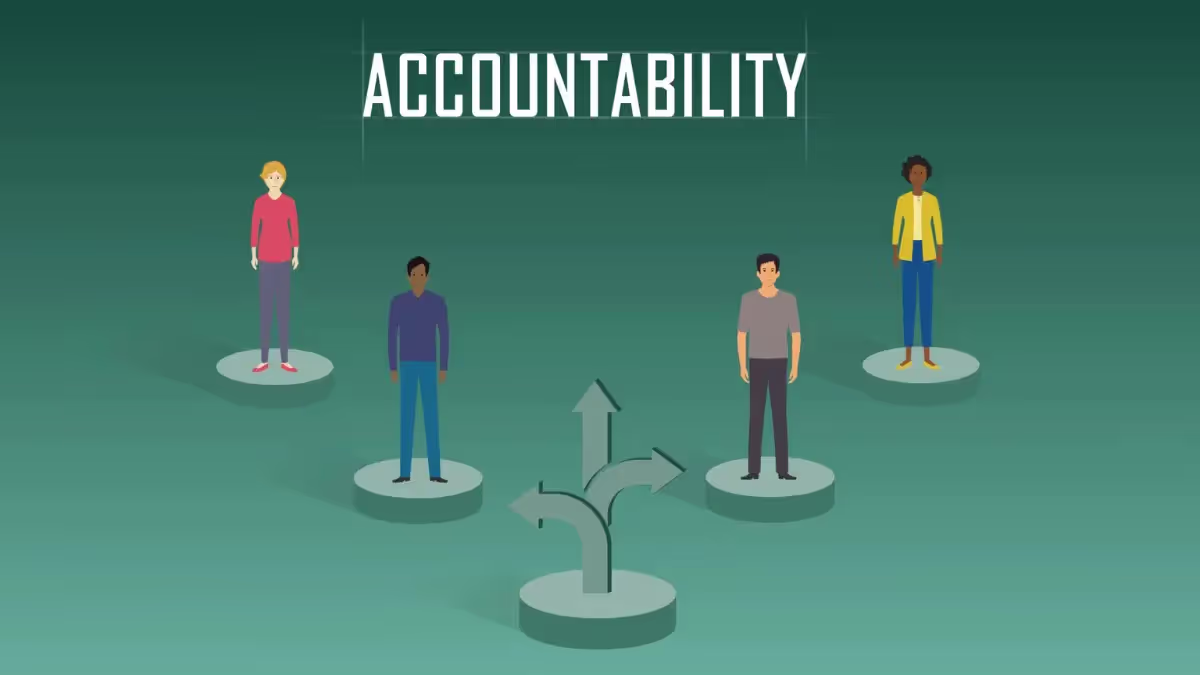
Accountability matters. Tell someone you know what you're doing. A friend, a partner, a family member. Check in weekly. Report what you didn't buy. Celebrate small wins.
The reason this works is simple: you don't want to have the awkward conversation where you admit you blew your budget. That social friction is often stronger than the shopping impulse.
Use the 24-Hour Rule for Everything
The moment you feel the urge to buy something is not the time to buy it. The impulse isn't your best friend. It's your brain looking for a hit.
Here's the rule: wait. For small stuff, 24 hours. For bigger purchases, a week or more. Open a note in your phone and list the thing you want to buy. Put the date. Then close it.
Most of the time, you'll open that note days later and think, "Why did I want this?" The impulse has lost its grip. If you still want it, great—budget for it next month. If not, you just saved yourself money.
Stop Using Restaurants as Comfort

Food is the biggest controllable leak in most budgets. Eating out five times a week? You're spending $75+ weekly. That's $300+ monthly. Over a year, it's close to $4,000.
You're not going to cut it to zero. That's unrealistic. But you can get smart about it.
Spend one evening planning meals for the week. Pick four or five simple recipes. Write a shopping list. Buy groceries. Spend an hour on Sunday prepping if you can, or just knowing what you're cooking for the week. Then when you're tired after work and want to order food, you have something ready.
The secondary benefit: you'll actually eat better and feel better. That matters more than the money sometimes.
Use Cash for Spending You Can't Control

Your brain treats cash differently than cards. When you see physical money leave your hand, something registers. With a card, especially a credit card, there's distance between you and the loss. That distance is dangerous.
Pull out cash for categories where you know you overspend. Put it in envelopes labeled "groceries," "coffee," "entertainment," whatever. When that envelope is empty, you're done. The envelope method is old-school, but it works because it's visual and final.
If you're mostly digital, use a debit card instead of credit. Same principle applies—you can see the balance drop.
Shop Only With a List
Stores are designed to make you buy things. The layout, the music, the placement of items—all of it's psychological. You go in for milk and leave with a basket full of stuff.
The fix: never shop without a list. Write it down. Stick to it. If it's not on the list, it doesn't go in the cart.
This removes the "browsing" part of shopping, where you're subconsciously exposed to everything the store wants you to buy. You walk in, you get what you came for, you leave. Five minutes instead of 45.
Ignore Sales
A sale doesn't make something a good buy. It makes it a discounted price for something you probably don't need.
Here's the truth: if you wouldn't buy something at full price, buying it on sale means you're spending 100 percent of money you shouldn't spend to save 25 percent of a price. You're still losing.
Sales are designed to create urgency. The scarcity is fake. There will be other sales. When you feel the pull of a great deal, remember that the best sale is the one you don't take.
Mute the Comparison Trap
Social media is designed to make you feel like you're missing out. Your friend's vacation, someone's new kitchen, an influencer's outfit—it all triggers the same feeling: "I need this too."
Comparison spending is real, and it's powerful. The fix is boring but works: unfollow accounts that make you want to shop. Mute notifications. Use an ad blocker. Turn off targeted ads in your settings.
Before you buy something because you saw it online, ask yourself: "Would I want this if nobody saw it?" Usually the answer is no.
Money Saving Apps That Actually Help
If you want support beyond willpower and spreadsheets, several apps can help.
- Stop Impulse Buying is built specifically for this. It works by letting you add items to a wishlist when you get the urge, then sends you a reminder after 30 days. The idea is that by then, the impulse has faded and you can decide rationally. It also tracks how much you saved by resisting urges and has a no-spend challenge tracker for motivation.
- Goodbudget uses the envelope system digitally. You allocate fixed amounts to categories and watch them deplete as you spend. It's good if you like visual control and knowing exactly where the money is.
- YNAB (You Need a Budget) is for people who want to be deliberate about every dollar. You assign purpose to each one—rent, groceries, savings—and the app keeps you accountable. It has a learning curve but works well if you're willing to engage with it.
- Rocket Money (formerly Truebill) finds subscriptions you've forgotten about and recurring charges hiding in your accounts. Even if you use nothing else, finding and cutting unused subscriptions is a fast win. Is Rocket Money safe? Yes.
- Money Manager is simpler. Just log expenses and watch the reports show where your money went. No fancy AI, no complex features. Sometimes simplicity is the point.
- SpendWise is another 30-day-rule app similar to Stop Impulse Buying but with a slightly different interface. Same concept: add items, wait, decide after a month.
If you're going to use an app, pick one and stick with it for at least a month. Changing apps constantly defeats the purpose. Also, note that some research suggests budgeting apps can backfire—if you see you have money left in your budget, you're more likely to spend it. So use apps for visibility, not as permission to spend.
Conclusion
None of this is about deprivation. It's about intention. The difference between someone who has money at the end of the month and someone who doesn't usually isn't income. It's that one group decides where their money goes, and the other group let impulses decide.
You're building a system. The first week is weird. The second week is normal. By the fourth week, it's just how you operate.
Start with the pause rule and a simple budget. Don't try everything at once. Add the cash envelope method. Then track your spending. Layer in the other stuff as you get comfortable.
Your goal isn't to never buy anything again. It's to make sure that when you buy something, you've actually decided to, not just react to an impulse or a feeling.
Start your dropshipping business today
How to Stop Spending Money FAQs
What's the fastest way to stop impulse spending?
The 24-hour pause rule. Before you buy anything, write it down and wait. Most urges lose their power after a day or two. This single change stops most impulse spending without requiring willpower—just friction.
How long does it take to break the spending habit?
Most behavioral change takes about 30 days to feel normal and 60 to 90 days to feel automatic. Don't expect overnight results, but expect noticeable shifts within a month if you're consistent with tracking and your pause rule.
Is using budgeting apps enough to stop overspending?
Apps help with visibility, but visibility alone doesn't always stop spending. You need the pause rule, a goal that matters, and a reason to want the money more than the purchase. Apps are the structure, not the solution.
Should I cut up my credit cards?
Only if you genuinely can't use them responsibly. For most people, using debit or cash instead solves the problem without the dramatic gesture. If you've tried other approaches and keep relapsing, then yes, cut them up.
How do I handle social pressure to spend when friends want to do expensive things?
Budget for social spending separately, or suggest cheaper alternatives. You don't have to say "I can't afford it." You can say "I'm watching my spending right now" or suggest coffee instead of lunch. True friends get it.
What do I do if I mess up and overspend one month?
You move on. One month doesn't reset everything. Just get back to the plan next month. Most people who successfully manage money aren't perfect—they're consistent. You'll have off months. The habit is getting back on track.


Launch your dropshipping business now!
Start free trial.avif)


Related blogs
Short Selling Explained: How It Works, Risks, and Real Examples
Learn what short selling is, how short selling works, real stock examples, risks, and how to short a stock step by step—explained simply.


Best Place to Sell Gold for Maximum Value
Looking for the best place to sell gold? Compare online buyers, jewelers, pawn shops, and dealers to get maximum value for gold jewelry, coins, and bars.

Federal Income Tax Brackets
Learn how federal income tax brackets work, current rates, standard deductions, and examples to calculate your federal income tax correctly.