Customer Journey Maps: How to Get Started for Beginners (2026 Guide)
Learn what a customer journey map is and what phases it entails. Our guide for beginners helps businesses improve user experiences.
.avif)

A customer journey map is a visual representation of every interaction a customer has with your brand from initial discovery through post-purchase engagement. It shows the steps customers take, the channels they use, the emotions they experience, and the pain points they encounter.
By mapping these journeys, businesses can identify gaps, optimize touchpoints, and create experiences that drive loyalty and revenue. In today's competitive landscape, understanding how your customers move through their journey isn't just helpful—it's essential for staying ahead.
What Is a Customer Journey Map?
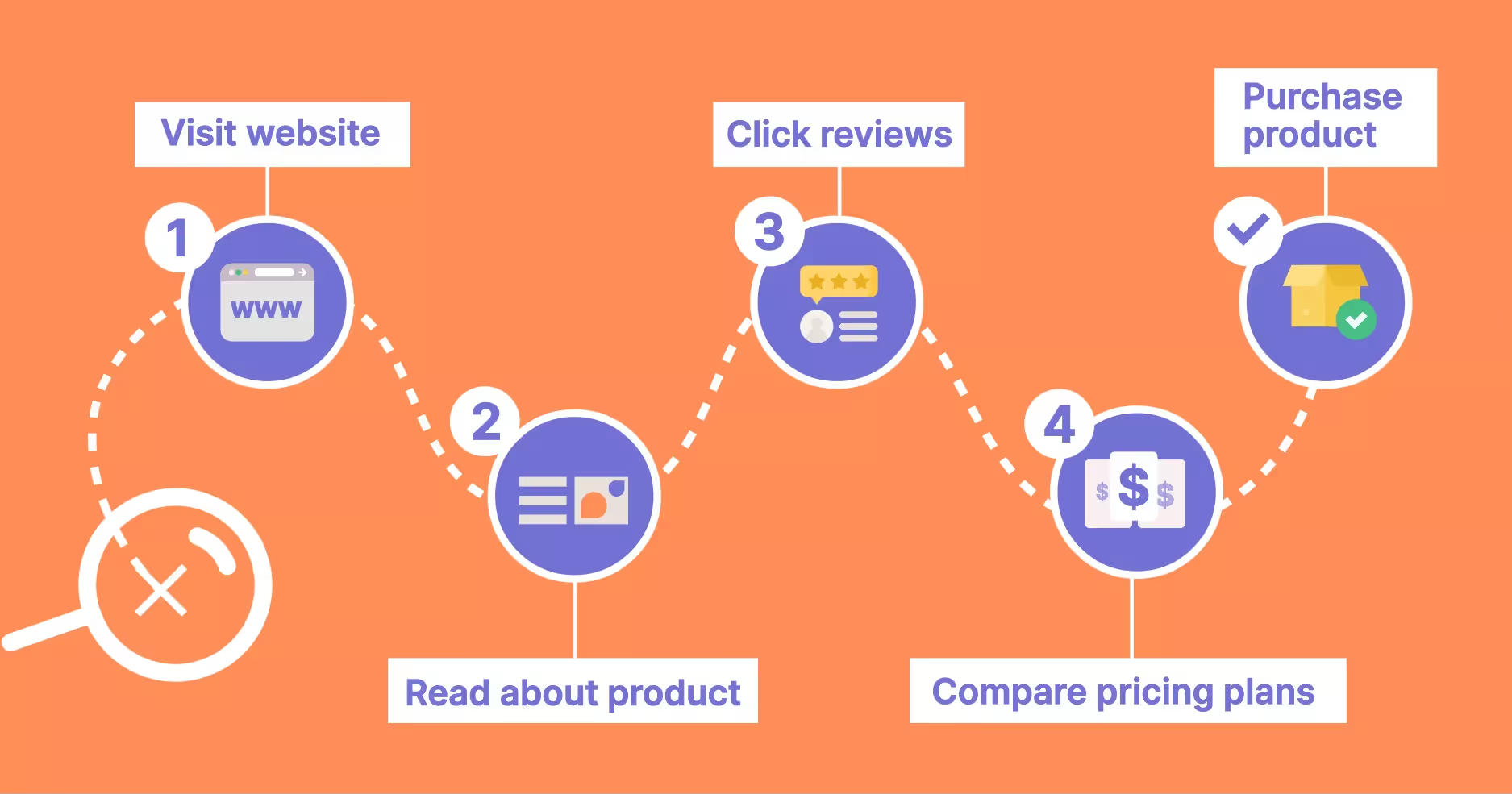
A customer journey map serves as a visual story of your customer's relationship with your brand. It goes beyond documenting simple transactions by capturing the complete narrative—from the moment someone realizes they have a need to long after they've made a purchase and become a repeat customer.
A customer journey map will help you shift your perspective from inside your company looking out, to standing in your customer's shoes looking in. This outside-in approach reveals what customers actually think, feel, and do at each moment they interact with your business. A well-crafted customer journey map documents not just actions but also emotions, motivations, and pain points that drive decision-making.
Unlike basic process maps that show internal workflows, a customer journey map captures both the visible touchpoints customers see and the invisible support systems that enable those experiences. It includes everything: website visits, phone calls, email communications, social media interactions, in-store visits, and customer service encounters. The map becomes a shared reference point that helps teams across marketing, sales, product, and customer service understand the customer experience from a unified perspective.
History and Evolution of Customer Journey Mapping
Customer journey mapping didn't emerge from marketing departments—it came from a real customer frustration. In 1985, a major telephone company was swamped with angry customer calls after residential phone outages. Ron Zemke and his team investigated by simply asking customers to describe what happened when they tried to get help. As customers explained their experience step-by-step, the team mapped it out on giant poster paper and plastered it across the boardroom wall. When the CEO walked through that story, he immediately understood why customers were furious. That visual representation of the customer's actual experience became the birth of modern customer journey mapping.
The concept remained largely confined to service industries until 1998, when OxfordSM, a UK management consulting firm, began applying journey mapping to other business models, most notably for Eurostar, the train service connecting the UK and Europe. From there, the practice spread globally, gaining particular momentum in Japan following the 2017 publication of Philip Kotler's "Marketing 4.0."
Over the decades, customer journey maps have evolved significantly. Early versions were static, linear diagrams focused primarily on transactional touchpoints. Today's maps are dynamic, data-driven, and increasingly powered by artificial intelligence. 71% of marketers believe traditional journey mapping approaches no longer meet customer expectations. This shift reflects the reality that modern customers move fluidly across channels, expect personalization, and demand seamless experiences.
Types of Customer Journey Maps
Different scenarios call for different map approaches. Understanding which type to create helps you focus on the insights you actually need.
Current State Maps
They visualize how customers actually experience your business right now. They capture the existing journey complete with all its friction points, inefficiencies, and moments of delight. These maps excel at identifying immediate problems and quick wins. By documenting the real experience, you see where customers struggle with login processes, how long they wait for responses, where they abandon carts, and which touchpoints frustrate them most. Current state maps ground you in reality rather than letting you operate on assumptions.
Future State Maps
They paint the picture of your ideal customer experience. These maps envision what you want the journey to look like once improvements are implemented. Rather than just documenting current pain, future state maps inspire action by showing what's possible. They serve as a north star that teams can work toward. Future state maps are particularly valuable for long-term strategic planning and identifying which innovations or process changes will have the biggest impact.
Day in the Life Maps
They zoom out to show how your product or service fits into your customer's broader daily routine. Rather than focusing narrowly on just buying or using your product, these maps reveal the context around your customer's interactions. A SaaS company might map how its project management tool fits into a busy project manager's day alongside email, meetings, and other tools they juggle.
Service Blueprints
They extend journey maps to include the back-end operations supporting the customer experience. These show not just what the customer sees but also the systems, staff, and processes behind the scenes that make that experience possible. Service blueprints help you connect customer-facing moments with internal operations.
Onboarding Maps
Onboarding customer journey maps focus specifically on new customer entry. They track the experience from purchase through the critical first weeks when customers are deciding if they made the right choice. Onboarding maps are essential for reducing early churn and ensuring customers quickly find value.
Key Components of a Customer Journey Map
An effective customer journey map requires several essential elements working together to tell a complete story.
Customer Personas
They form the foundation of a customer journey map. Rather than creating a vague "average customer," personas are detailed profiles representing different customer segments. A persona might be "Sarah, a 32-year-old marketing manager at a mid-size tech company" with specific goals, challenges, and preferences. Personas make the journey real and help teams stay focused on actual customer needs rather than company assumptions. Each persona may have a different journey, so you'll often create multiple maps for the same business.
Journey Stages
These break the experience into logical phases. Common stages include Awareness (customer recognizes a problem), Consideration (customer researches solutions), Purchase (customer makes a buying decision), Onboarding (customer learns to use the product), Engagement (customer uses the product regularly), and Advocacy (customer recommends the product). The specific stages depend on your business model.
Touchpoints
Touchpoints are every moment a customer interacts with your brand. These include obvious channels like your website, app, and customer service line, but also less obvious ones like social media mentions, product reviews, and word-of-mouth conversations. Identifying all touchpoints—not just the ones you control—gives you a complete picture of the experience.
Emotions and Feelings
Emotions and Feelings capture what customers are experiencing at each stage. Are they excited, confused, frustrated, or satisfied? Emotions reveal where you're losing customers and where you're creating delight. Many companies miss emotional insights entirely and focus only on functional steps, which is why they miss critical improvement opportunities.
Pain Points
Pain Points are the specific moments when customers encounter friction, confusion, or frustration. These aren't opinions—they're documented problems that prevent customers from moving forward smoothly. Pain points might include confusing navigation, slow load times, unhelpful support responses, or inconsistent messaging across channels. By identifying pain points explicitly, you can prioritize which ones to solve first.
Opportunities
Opportunities emerge directly from pain points. Each pain point represents a chance to improve and differentiate your business from competitors. When you see customers struggling with checkout, that's an opportunity to simplify it. When customers feel confused about next steps, that's an opportunity to add clarity.
Actions and Thoughts
Actions and Thoughts document what customers are actively doing and thinking at each stage. What are they searching for? What questions do they have? What are they comparing? What would convince them to move forward? These details inform your messaging and content strategy.
Business Goals
Business Goals define what you want to achieve through the experience. Are you trying to increase conversion rates, reduce customer service costs, improve retention, or drive referrals? Mapping your goals alongside the customer journey ensures the map translates to business results. Using the OKR framework helps track goals and measure business outcomes.
How Customer Journey Mapping Works
The process of creating a customer journey map follows a structured but flexible approach. You start by gathering real customer data rather than relying on assumptions. This might include customer interviews, surveys, website analytics, support tickets, and social media conversations. The more diverse your data sources, the more accurate your map will be.
According to recent research, 68% of organizations collect data but fail to leverage it effectively in mapping, which limits their ability to create truly personalized experiences.
So here is how you go about customer journey mapping well:
- Once you've gathered data, you identify and define your customer personas based on actual patterns you've observed. You don't invent personas—you discover them from customer research. This ensures your map represents real customers, not who you wish they were.
- Next, you plot the journey stages and map out every touchpoint for each stage. You consider multiple channels: digital (website, app, email, social), phone-based, and in-person. You document what's happening at each touchpoint from the customer's perspective.
- Then you layer in the emotional journey. Where are customers feeling confident? Where are they hesitant? Where do they feel frustrated or delighted? This emotional context is what separates useful maps from generic ones.
- You identify pain points and brainstorm opportunities for improvement. You document business goals and KPIs that you'll track to measure if your improvements actually work.
- Finally, you validate your map with real customers. Do they recognize themselves in the journey? Do they identify with the pain points? Does the map reveal the real issues they face? This validation step is critical because maps built on assumptions often miss the mark.
Customer Journey Maps vs. Buyer Journey Maps
These terms are often used interchangeably, but they represent different perspectives on the customer relationship.
A buyer journey map focuses on the path someone takes before becoming a customer. It covers Awareness (person realizes they have a need), Consideration (person researches solutions), and Decision (person chooses a product). The buyer journey is pre-purchase and is primarily about converting prospects into customers. Content on the buyer journey is educational and geared toward helping people evaluate options.
A customer journey map encompasses the entire relationship including and extending beyond the purchase. It includes Awareness, Consideration, Decision, but also continues with Onboarding (new customer learns to use the product), Engagement (customer regularly uses the product), Support (customer seeks help when needed), Retention (customer continues using the product), and Advocacy (customer recommends the product).
Metrics and Timelines
The key difference is scope and timeline. Buyer journeys are typically shorter, ranging from days to months. Customer journeys span years or the entire customer lifetime. Buyer journey content is product-focused and competitive. Customer journey content is customer-focused and supportive.
Buyer journeys use metrics like conversion rate and cost per acquisition. Customer journeys track metrics like customer satisfaction, retention rate, and lifetime value. The buyer journey answers: "How do we attract customers?" The customer journey answers: "How do we keep customers and grow them into advocates?"
Progressive companies map both because they serve different strategic purposes. The buyer journey optimizes for acquisition. The customer journey optimizes for retention and growth.
Steps for Creating a Customer Journey Map
Building a customer journey map that actually drives results requires following a systematic process, which is as follows:
- The first step is defining your objective. What specific problem are you trying to solve? Are you trying to reduce churn, increase conversion, improve customer service, or accelerate onboarding? A clear objective prevents you from creating a vague, unfocused map.
- The second step is conducting thorough research. Interview customers, survey them, analyze your website data, review customer service interactions, and listen to social media conversations. The goal is understanding how customers actually behave, not how you think they behave. Don't skip this step—maps built on assumptions are nearly worthless.
- The third step is creating personas based on your research. Group customers by shared characteristics, needs, and behaviors. Give each persona a name and detailed profile. Include demographics, goals, challenges, preferred channels, and other relevant information.
- The fourth step is mapping the journey stages. What are the major phases customers move through? Identify 5-8 stages depending on your business. For an e-commerce company, stages might be: Discovery, Research, Cart, Checkout, Delivery, Use, and Repeat Purchase. For a SaaS company: Awareness, Research, Trial, Onboarding, Adoption, Expansion, and Renewal.
- The fifth step is identifying all touchpoints for each stage. Where does your customer interact with your brand? Be comprehensive—include digital, phone, in-person, and even indirect touchpoints like reviews or competitor websites.
- The sixth step is documenting customer actions, thoughts, and emotions for each touchpoint. What is the customer doing? What are they thinking? How do they feel? Use customer quotes where possible to bring authenticity.
- The seventh step is identifying pain points and opportunities. Where do customers encounter friction? What would improve their experience?
- The eighth step is mapping business goals, channels, and processes to each stage. How do these align with your internal operations?
- The ninth step is visualizing the map. Some companies use digital tools, others use whiteboards or design software. The format matters less than the clarity and completeness.
- The tenth and final step is validating and refining the map. Test it with real customers. Does it match their actual experience? Adjust based on feedback.
Tools You Need for Customer Journey Mapping
Several software tools exist to simplify the mapping process. UXPressia offers 100+ templates, real-time collaboration, and AI-powered persona creation. Plans range from free to enterprise, starting at $16/month for the starter tier. Miro provides an AI-powered collaborative canvas with 160+ integrations and extensive templates, with pricing from free to $16/month per member. ClickUp combines journey mapping with project management, offering a free tier and paid plans starting at $7/month per user.
Smaply specializes in persona development and journey mapping with 70+ templates, pricing from free to €29/month. Lucidchart is a diagramming tool that works well for complex journeys with data integration, starting at affordable enterprise pricing. Whimsical offers a more visual, design-focused approach to journey mapping, appealing to teams that want aesthetically pleasing maps.
Google Analytics, Hotjar, and Fullstory provide the underlying data that informs your maps by showing how customers actually behave on your website. Salesforce, HubSpot, and Zendesk help organize customer data that feeds into journey mapping.
The right tool depends on your team size, budget, and technical comfort level. Some companies prefer simple tools like Canva or Miro for flexibility, while others choose specialized platforms like UXPressia for dedicated features. Starting with a free or low-cost tool to test the process before committing to an expensive platform is often smart.
Skills Required for Customer Journey Mapping
It's rare for one person to have all these skills, which is why the best journey mapping happens with diverse cross-functional teams.
Marketing brings understanding of customer acquisition and messaging. Product brings understanding of features and user behavior. Sales brings understanding of customer decision-making. Customer service brings understanding of pain points and support needs.
Operations brings understanding of what's actually feasible. When these perspectives combine, the resulting map is richer and more actionable. Here are some other skills you need:
- Creating an effective customer journey map requires a mix of skills across your team. Empathy is the first essential skill—the ability to genuinely understand and relate to customer experiences without imposing your own biases.
- Research skills are critical for gathering reliable customer data through interviews, surveys, and analytics.
- Facilitation skills help when running mapping workshops with cross-functional teams. Strategic thinking helps connect customer journeys to business objectives.
- Communication skills ensure the map actually gets used by teams across the organization.
- Technical skills matter too. You need basic data literacy to interpret analytics and understand customer behavior patterns.
- Design skills help visualize the map clearly. Project management skills keep the mapping initiative organized and on track. Most importantly, you need people who can think from the outside-in, always asking "what is the customer experiencing?" rather than "how do we make this easier for our team?"
Benefits of Customer Journey Mapping
When done well, customer journey mapping delivers concrete business benefits:
- It improves customer understanding. By mapping journeys, you move beyond assumptions to actual knowledge of customer behavior and needs.
- It identifies gaps and pain points that block customers from reaching their goals. These friction points represent opportunities for competitive differentiation.
- Customer journey maps help you personalize experiences at scale. When you understand different customer segments and what they need at each stage, you can tailor messaging, content, and offers accordingly. Companies that implement personalization based on journey mapping see significant improvement in conversion and loyalty.
- Mapping facilitates cross-departmental collaboration. When everyone sees the same customer journey, departments stop blaming each other and start solving problems together. Fifth, journey mapping improves ROI. Retaining existing customers is far cheaper than acquiring new ones, and journey mapping identifies the leverage points for retention.
- Customer journey maps help predict customer behavior. By understanding how customers typically move through your journey, you can forecast who's likely to convert, who's at risk of churn, and who might upgrade. Also, you improve organizational alignment. Instead of marketing, sales, and product pursuing conflicting strategies, everyone works toward the same customer-centric goals.
According to research, companies using AI-powered journey mapping see a 25% increase in customer satisfaction and a 15% increase in revenue. Another study found that 90% of businesses believe customer experience is a key differentiator, yet only 20% have a clear understanding of their customer journeys—revealing the competitive advantage available to those who map well.
Real-World Examples: Companies Using Customer Journey Mapping
Spotify provides one of the most well-documented examples of effective journey mapping. The streaming giant wanted to improve how users share music with friends. Rather than guessing, Spotify conducted extensive research and mapping to understand the emotional and behavioral journey of music sharing.
They discovered that users often feel nervous about sharing songs, fearing judgment from friends. Spotify's journey mapping also revealed optimal places to integrate sharing features and moments when users were most likely to engage.
The result: personalized recommendation engines like Discover Weekly now drive 30% of listening time, and Spotify Wrapped generates 1.5 billion impressions annually because it's perfectly positioned in the user journey. This demonstrates how understanding emotion—not just action—transforms the customer experience.
How Amazon and Netflix Use Customer Journey Mapping
Amazon approaches journey mapping with relentless focus on customer obsession. The company doesn't just document journeys; it uses mapping to ask "why" at every point. This has led to innovations like one-click purchasing, Prime membership, and anticipatory shipping. Amazon's journey maps are deeply data-driven and regularly tested against actual customer behavior. The company views journey mapping not as a one-time project but as an ongoing practice that continuously reveals opportunities for improvement.
Netflix uses journey mapping to optimize the entire entertainment experience across devices. The map includes how people discover shows, how they decide what to watch, how they navigate between devices, and how they decide whether to continue subscriptions. Netflix found that consistent experience across smartphones, tablets, and smart TVs is non-negotiable—if someone starts a show on their phone and can't smoothly resume on their TV, they get frustrated. Journey mapping revealed this friction point, leading to technology investments that now feel invisible to customers but are critical to satisfaction.
Challenges and Common Mistakes in Customer Journey Mapping
Many organizations attempt journey mapping but fail to get real value because they make preventable mistakes:
- The most common mistake is starting with internal perspective rather than customer perspective. When teams create maps focused on how their organization works rather than how customers experience the journey, the maps miss critical pain points and opportunities.
- Another frequent mistake is relying on assumptions instead of data. About 75% of companies approach journey mapping from an internal perspective rather than gathering actual customer insights first. This leads to maps that don't match reality. The solution is investing time in customer research before ever starting to map.
- Overcomplicating the map is another pitfall. Some teams try to include every possible interaction, data point, and detail until the map becomes overwhelming and unusable. Simple, focused maps that highlight critical moments are more valuable than comprehensive maps that confuse people. The goal is actionable insights, not documentation completeness.
- Many teams also fail with cross-functional collaboration. When marketing, sales, and product teams create separate maps without talking to each other, they build conflicting strategies. Journey mapping only works when you get diverse perspectives around the same table.
- Lack of updates is another common problem. Customer behavior evolves, technology changes, markets shift. Maps created in 2022 that haven't been revisited in 2025 are probably inaccurate. The best practice is reviewing and updating your maps at least quarterly.
2026 Customer Journey Mapping Trends
- AI integration is becoming standard, not optional. According to current research, 70% of companies are already using AI to improve customer journeys. AI enables real-time personalization, predictive analytics to anticipate customer needs, and automation of routine interactions.
- Real-time journey orchestration is increasingly popular. Static maps are becoming outdated. Forward-thinking companies are moving toward living dashboards that update based on real customer behavior as it happens, allowing teams to adjust strategies immediately rather than waiting for quarterly reviews.
- Emotional intelligence is gaining prominence. Early journey maps focused on functional steps—browse, click, buy. Now the best maps explicitly capture emotions and use sentiment analysis to understand how customers actually feel. Companies are discovering that emotion, not just action, drives loyalty.
- Privacy-first approaches are becoming essential. As regulations like GDPR continue evolving and customers care more about data privacy, journey mapping must incorporate ethical data practices. Companies successfully using journey mapping in 2026 are transparent about how they gather customer data and respectful about using it.
- Multi-channel integration is now table stakes. The average customer uses multiple channels during their shopping journey. Journey maps must show how customers move between channels and whether the experience feels seamless or disjointed.
For e-commerce businesses mapping customer journeys, Spocket provides integrated tools that simplify operations across touchpoints. With Spocket's vetted US and EU suppliers, automated inventory management, one-click product imports, and 24/7 customer support, merchants can focus on perfecting the customer journey rather than getting bogged down in fulfillment logistics. Spocket's integration with major platforms like WooCommerce, and Amazon means the operational backend supports the customer experience you're mapping—whether that's fast shipping times, branded unboxing, or seamless returns.
Conclusion
A customer journey map transforms how organizations understand and serve their customers. By visualizing every interaction from the customer's perspective, mapping emotions alongside actions, and identifying friction points, businesses create experiences that drive loyalty and growth. Whether you're just starting or refining existing maps, remember that the best maps are built on customer research, maintained with real data, and treated as living documents that evolve with your business. Start with one key persona and one critical journey, then expand as you see results. And use Spocket to dropship fast worldwide today!
Start your dropshipping business today
Customer Journey Mapping FAQs
What is the primary purpose of a customer journey map?
A customer journey map helps businesses visualize the complete experience customers have with their brand from initial awareness through post-purchase. The primary purpose is identifying friction points, understanding customer emotions, and discovering opportunities to improve experiences that drive satisfaction, retention, and revenue growth.
How often should a business update their customer journey map?
Updating frequency depends on how quickly your market and customer behavior change. For most businesses, quarterly reviews are recommended to incorporate new customer feedback, market shifts, and technology changes. Fast-moving industries might update more frequently, while stable industries might review semi-annually.
Can small businesses benefit from customer journey mapping?
Yes! Small businesses often have a competitive advantage because owners interact directly with customers. Journey mapping helps small teams focus limited resources on improvements that matter most. Even a simple one-page map highlighting three key customer touchpoints and pain points provides value. You don't need expensive tools or large teams—just a willingness to understand your customers better.
What's the difference between current state and future state journey maps?
Current state maps document how customers actually experience your business today, including all pain points and inefficiencies. Future state maps envision what the ideal experience could look like after improvements. Together, they show you where you are and where you want to go, helping teams understand what changes are needed.
Which industries benefit most from customer journey mapping?
All industries benefit, but some see faster ROI. E-commerce, SaaS, financial services, healthcare, and hospitality frequently cite significant improvements from journey mapping because these industries have complex journeys with multiple touchpoints and high switching costs. However, even simple businesses improve by understanding customer perspectives.
How do you validate that a customer journey map is accurate?
Validate by testing the map with real customers. Ask customers if they recognize themselves in the journey. Do the pain points match their actual experience? Does the emotional journey feel authentic? Incorporate their feedback before considering the map finalized. Also compare the map against actual behavior data from analytics—does where customers are dropping off match your predicted pain points?
How does customer journey mapping integrate with other business strategies?
Customer journey mapping serves as a bridge between customer experience strategy, marketing strategy, and product strategy. It provides the foundation that informs content marketing (creating messages for each stage), product development (identifying features customers need), sales strategies (understanding decision-making process), and customer service improvements (addressing pain points). When integrated properly, journey mapping aligns entire organizations around customer needs.
What role does data analytics play in customer journey mapping?
Data analytics is the foundation of accurate journey mapping. Analytics show where customers actually go, how long they spend at each step, where they drop off, and which touchpoints are most effective. Website analytics, funnel tracking, heat mapping, and customer behavior data prevent you from relying on assumptions. The best maps combine qualitative research (what customers say) with quantitative data (what customers do).
How can businesses handle customer journey maps with multiple personas?
Most businesses serve multiple customer segments with different journeys. Rather than one generic map, create separate maps for each major persona. This ensures the map accurately represents each audience's unique needs, preferences, and decision criteria. Once you have individual maps, you can identify common pain points across all personas (opportunities for broad improvements) and persona-specific pain points (requiring targeted solutions).
What's the connection between customer journey mapping and retention?
Retention is directly tied to journey mapping because maps reveal where customers most frequently disengage or feel dissatisfied. By addressing pain points revealed in the post-purchase journey—onboarding, early usage, support interactions—you dramatically improve retention. Companies that use journey mapping to optimize the first 90 days after purchase see significant improvements in customer lifetime value because early success sets the tone for the entire relationship.
How can businesses measure the success of their customer journey mapping efforts?
Success is measured through KPIs tied to your original objectives. If your goal was improving conversion, track conversion rate changes. If it was reducing churn, monitor customer retention metrics. If it was improving satisfaction, measure NPS or CSAT scores. Other key metrics include customer lifetime value, repeat purchase rate, time to onboarding completion, support ticket resolution time, and customer acquisition cost. The best approach is establishing baseline metrics before mapping, then measuring how they improve after implementing changes revealed by your map.


Launch your dropshipping business now!
Start free trial.avif)


Related blogs

Dropshipping Niche Research: Finding Low-Competition, High-Margin Products
Use dropshipping niche research to uncover low competition, high margin products. Cut guesswork and build a reliable brand from day one.


How Do I Research Market Trends for My Store?
Learn how to research market trends for your dropshipping store using powerful trend tools, data insights, and Spocket strategies to stay ahead of the competition.


How ReviewsPro.ai Helps You Build Instant Trust with Shoppers
Discover how ReviewsPro.ai, the AI reviews tool for e-commerce, helps you boost conversions, gain social proof, and build instant trust with shoppers.