Amazon Merch on Demand Guide
Learn how Amazon Merch on Demand works, how to apply, upload designs, earn royalties, and sell print-on-demand merch on Amazon with zero inventory.

.avif)

If you’ve ever seen a simple T-shirt on Amazon and wondered, “How are people selling this without a warehouse?”—this Amazon merch on demand guide is your answer. Amazon Merch on Demand (aka Merch by Amazon) lets you turn a design into a live Amazon listing in minutes: you upload the artwork, pick the product and colors, set your price, and Amazon prints only when it sells, ships it (often Prime), handles returns, and pays you royalties.
But the real game isn’t uploading—it’s getting approved, avoiding IP landmines, understanding tier limits, and writing titles/bullets that match how shoppers search for Amazon merch, print on demand Amazon, and Amazon POD. In this guide, you’ll see the exact workflow, the Amazon merch on demand application essentials, and the listing SEO that helps your merch get found—without guessing.
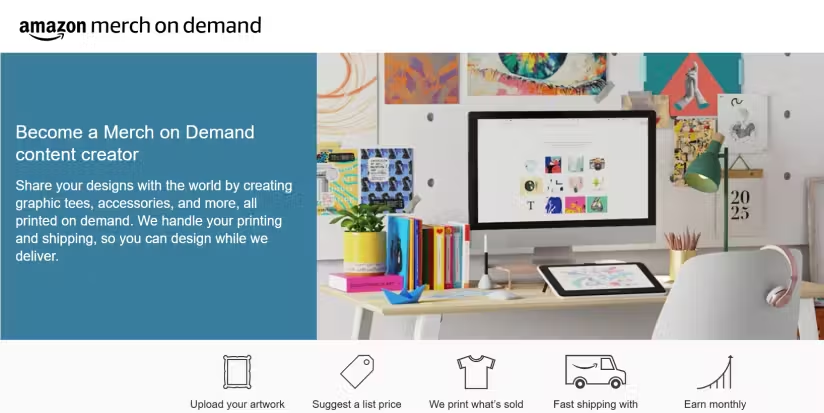
What Is Amazon Merch on Demand
Amazon Merch on Demand (often called Merch by Amazon or simply Amazon merch) is Amazon’s in-house Print on demand program that turns your design into a sellable Amazon product without you buying inventory or shipping anything. You upload your original artwork, choose the product type and available colors, and Amazon automatically creates the product detail page on Amazon.com. From there, Amazon handles the entire operational side—printing/production, order fulfillment, shipping (including Prime-eligible delivery where applicable), and customer logistics—so you’re not managing printers, warehouses, or returns workflows.
What can you sell? Most creators start with core apparel because it’s high-volume and easy to niche: t-shirts, hoodies, sweatshirts and other eligible merch options that vary by region and account access.
The key thing to understand: with Amazon POD, your real job is not fulfillment—it’s creating designs that match a searchable niche and publishing listings that shoppers can actually find. The rest is automated by Amazon.
How Amazon Merch on Demand Works Step by Step
If you want the “how does Amazon merch on demand work”, it’s this: you provide the design + listing info, Amazon does everything else (product page, printing, shipping, customer service), and you earn royalties per sale—the core Amazon print on demand model.
Step 1: Apply for Amazon Merch on Demand
Merch by Amazon is approval-based, so you can’t just start listing like a regular seller account—you must submit an Amazon merch on demand application first.
What Amazon typically looks for (based on how the program is positioned): a real creator or brand context and accurate account details—think professional info, clear intent to create branded merchandise, and the ability to promote (blog, social, community, or niche audience).
Practical tip: treat your application like a mini business profile—who you are, what you’ll design, and why customers would buy it.
Step 2: Upload Your Design
Once approved, your job is straightforward: upload your artwork, select a product type (most start with apparel), choose colors/variants, and add the listing text (title/description).
This is where many beginners lose sales: your design can be great, but if your metadata doesn’t match search intent (e.g., “funny hiking shirt” vs. vague branding), your Amazon merch won’t get discovered.
Step 3: Amazon Creates the Listing and Ships Orders
After you publish, Amazon creates the product page and, when a customer buys, Amazon handles production, shipping, and customer service—no inventory, no packing, no support inbox.
From the buyer’s perspective, it’s like purchasing any Amazon item—with familiar delivery expectations (including Prime benefits where offered).
Step 4: You Earn Royalties on Each Sale
Instead of “profit margins” like Shopify, you earn royalties per product sold. Amazon’s royalty is calculated from your offer price minus things like applicable taxes and Amazon’s costs (materials, production, fulfillment, customer service, returns, fraud prevention).
That’s why pricing + niche targeting matters: with print on demand Amazon, your upside comes from choosing designs people search for and publishing consistently—not negotiating shipping rates or sourcing inventory.
Amazon Merch on Demand Application and Eligibility
Here is a list of requirement checklist and tips to onboard on Amazon merch on demand
Requirements Checklist
Because Amazon Merch on Demand (aka Merch by Amazon) is approval-based, you start by applying—then completing the setup steps Amazon requires before you can publish designs.
Use this checklist to avoid the most common “stuck” points:
- Amazon account + accurate profile details: real identity/business info and a consistent creator/brand presence (website, blog, social, or community you’ll promote to). Amazon explicitly frames the program around creating and promoting branded merchandise.
- Tax interview completed: Amazon collects tax info through its interview flow to determine the right tax form/reporting (e.g., W-9 / W-8 and related reporting).
- Payment readiness: you’ll need payout details so Amazon can pay monthly royalties once you’re live.
- Brand fit and compliance: you’re expected to upload original, policy-compliant designs—violations slow approvals and can restrict publishing later.
Approval Tips That Actually Help
Here’s what actually strengthens an Amazon merch on demand application:
- Write your “Additional Information” like a merch plan, not a bio: 2–3 niches you’ll target (e.g., “pickleball humor,” “nurse shift sayings,” “trail running minimal”), and how your audience finds you (TikTok, YouTube, blog, newsletter). This matches Amazon’s own positioning: you promote, Amazon fulfills.
- Show proof you can create: link a simple portfolio (Behance/Dribbble/Google Drive) or a small brand page with 8–12 sample designs.
- Make compliance obvious: state “original artwork only, no trademarks/copyrighted phrases, no brand logos.” (This single line reduces risk signals.)
- Niche clarity beats “I’ll upload everything”: Amazon can’t evaluate “general designs,” but it can evaluate a focused creator with a clear merch identity.
Products You Can Sell With Amazon POD
Amazon’s print on demand catalog is designed around fast-selling merch categories—so you can make and sell merch without inventory while Amazon handles printing and shipping.
What You Can Sell with Amazon POD
- Apparel: graphic tees, sweatshirts, hoodies, long sleeves (availability depends on locale/account).
- Accessories and more: Amazon highlights “accessories, and more” as part of the program, with options expanding over time.
What tends to sell best
- Simple, niche-driven apparel wins first: tees/hoodies are the easiest entry because shoppers search them by phrase + identity (“funny x,” “gift for y,” “I love z”). That’s why most Amazon merch strategies start with apparel before branching into accessories.
Practical rule: if your design needs explaining, it won’t convert. If it reads instantly in a thumbnail, it can.
Merch by Amazon Tiers Explained
Merch by Amazon tiers are Amazon’s way of limiting how many unique designs you can have live at once—think of tiers as your publishing capacity. Amazon has confirmed a tier framework where design-based tiers determine how many designs you can publish, and one design can be applied across multiple product/locale options while counting once against your tier limit.
What Tiers Are and Why They Matter
- Your tier controls your ceiling: more tier capacity = more live designs = more “lottery tickets” for sales.
- Design-based tiers change how you scale: publish one strong design across available products/locales to expand reach without burning extra tier slots.
Simple Strategy to Tier Up Faster
Amazon doesn’t publicly list exact “tier up” thresholds for every level, so don’t build your plan around rumors. Instead, use a strategy that aligns with what Amazon clearly rewards: sales performance + clean compliance + consistent publishing.
Do this:
- Fill your tier slots with tightly themed designs (same niche, same buyer language).
- Publish in “mini-collections” (10 designs around one niche) so Amazon learns relevance faster.
- Apply each winning design across products/locales (where available) to increase surface area while keeping tier usage efficient.
- Keep your account spotless (no IP issues, no policy violations). Clean history is the easiest “silent advantage” in Merch on Demand.
Listing SEO That Helps You Rank on Amazon
Merch on Demand isn’t just “upload and hope.” On Amazon Merch on Demand (aka Merch by Amazon), your visibility is driven by the few fields you control—brand name, title, bullet points (key product features), and description—so those need to map cleanly to how shoppers search. Amazon also reviews your design and your listing text for policy compliance, so sloppy keyword stuffing can hurt twice: less trust + higher rejection risk.
Keyword Mapping
Use a simple, repeatable mapping that matches buyer language (not creator language). Here’s a safe template you can reuse for every design:
- Primary keyword (1): the exact niche phrase shoppers type
- Example: “funny pickleball shirt” / “nurse life t-shirt” / “dad fishing hoodie”
- Supporting phrase 1: who it’s for (gift recipient)
- “gift for pickleball player” / “gift for nurse”
- Supporting phrase 2: occasion/season
- “birthday gift” / “Christmas gift” / “Mother’s Day”
- Supporting phrase 3: style + tone
- “funny” / “vintage” / “retro” / “minimal”
- Supporting phrase 4: product type
- “t-shirt” / “hoodie” / “sweatshirt”
- Supporting phrase 5: micro-niche qualifier
- “tournament” / “ER nurse” / “fly fishing”
Where to place them (without keyword spam):
- Title: primary + product type + audience/occasion
- Bullet 1: who it’s for + occasion
- Bullet 2: use case (when they’ll wear it) + micro-niche
- Description: natural recap + gift intent
Title + Bullet Formula for Merch Listings
Merch title formula (clean, searchable, not spammy):
[Primary niche phrase] + [Product type] + [Gift/Who it’s for]
Examples (pattern you can copy):
- “Funny Pickleball Shirt Gift for Pickleball Players”
- “Nurse Life T-Shirt Gift for ER Nurses”
- “Fishing Hoodie Funny Gift for Dad Who Loves Fishing”
Bullet points formula (2 bullets that convert):
- Bullet 1 Gift clarity: “Perfect gift for [audience] who loves [niche]. Great for [occasion].”
- Bullet 2 Wear moment: “Wear it to [context: gym/shift/tournament/weekend]. [Tone/style] design that [benefit: gets laughs/shows pride].”
Why this beats competitor advice: most guides tell you to “add keywords.” This structure makes your listing instantly understandable to shoppers and aligns with how Amazon surfaces results: clear relevance signals, no fluff, no repetitive terms.
Buyer-Intent Keywords vs “Generic” Keywords to Avoid
Buyer-intent keywords (use these):
- “gift for…” “for men/women/kids…” “birthday…” “team…” “coach…” “fan…”
- These indicate a purchase reason and improve conversion (which helps rankings over time).
Generic keywords to avoid (or de-prioritize):
- “cool shirt” “awesome hoodie” “best merch” “trend” “viral”
- They’re vague, highly competitive, and don’t match how real shoppers filter.
Also avoid stuffing URLs, emails, phone numbers, or anything that looks like off-Amazon promotion—Merch policy explicitly flags that type of content.
Amazon POD Design Rules and IP Safety
The fastest way to lose momentum on Amazon merch on demand is getting designs rejected or removed for policy issues—because Amazon evaluates your artwork and your listing text (brand, title, bullets, description) for compliance. You don’t need to be a lawyer to stay safe, but you do need a process.
What Gets Designs Rejected
Amazon can reject (or later remove) listings that violate the Merch content policy, including illegal/infringing content and certain restricted content categories. The most common Merch-killers are:
- Trademarked phrases (even “normal” sayings can be trademarked in apparel categories)
- Copyrighted characters/logos (movies, bands, sports teams, brands)
- Infringing lookalikes (designs that are “too close” to a known brand identity)
- Prohibited content (e.g., pornography/profanity/illegal content) and including URLs, email addresses, phone numbers, or physical addresses in listing details
“Before You Upload” Checklist
Run this checklist every single time—seriously, it saves accounts:
- Text scan: Read your design text out loud. If it references a brand, celebrity, movie, team, or slogan—stop and rework.
- Trademark check: Search the exact phrase + close variants before you publish (especially short catchphrases).
- Listing text audit: Confirm your brand name, title, bullets, and description don’t include restricted items like URLs/emails/phone numbers.
- No medical/legal promises: Avoid claims that sound like guarantees (“cures,” “diagnoses,” “official,” etc.). Keep it as humor/identity, not advice.
- Thumbnail test: If a shopper can’t understand it in 2 seconds, simplify—confusing designs get ignored, and low conversion slows growth.
Is Amazon Merch on Demand Worth It
Is Amazon Merch on Demand worth it? It can be—if you treat it like a catalog game (many targeted designs + clean listing SEO), not a “one viral shirt” lottery ticket. Amazon Merch on Demand (aka Merch by Amazon) removes the hard parts of print on demand Amazon—inventory, printing, shipping, and customer operations—so your leverage comes from research, consistency, and compliance.
Pros
- No inventory risk (true POD): You don’t buy stock or ship orders. Amazon produces only after a sale and handles fulfillment end-to-end.
- Built-in Amazon traffic advantage: You’re listing inside the Amazon marketplace where customers are already searching for gifts, hobbies, jobs, and identity-based apparel—so you don’t need to “create demand” from scratch like many best print on demand sites that rely heavily on external traffic.
- Simple passive model (when you do it right): Once a design + listing is live, it can keep selling while you publish the next batch—this is why creators call Amazon POD “semi-passive.” The work shifts to upfront research + steady publishing.
Cons
- Approval required: You must submit an amazon merch on demand application before you can upload and sell.
- Tier limits early on: New accounts start with limited publishing capacity (“tiers”), and growth depends on sales performance—so you can’t flood Amazon with 500 designs on day one.
- Competitive niches + keyword battles: Broad markets like “funny shirts” or “gym t-shirt” are brutally saturated. Without a specific niche + buyer-intent keywords, your Amazon merch listings won’t surface.
Best Practices to Get Sales Faster
The fastest path to sales on Amazon merch on demand is to do fewer random designs and more repeatable, niche-based designs. Think: build small collections where every listing targets a clear search phrase.
Pick a Niche That’s Specific
Overly broad designs get buried. Instead of “funny dog shirt,” go narrower:
- Evergreen niches (steady demand): job roles (nurse, teacher, electrician), hobbies (pickleball, fishing, hiking), identity phrases (new dad, book lover).
- Seasonal spikes (short windows): holidays, graduation, teacher appreciation, sports seasons—great for rapid testing, but publish early.
A practical filter: choose niches where buyers often purchase as gifts. Gift intent is one of the strongest signals in print on demand products because it narrows keywords and boosts conversion.
Optimize Your Product Title + Keywords
Amazon rankings are driven by relevance + conversion. Your keywords must match what shoppers type and your listing must look trustworthy in search results.
Simple Amazon keyword logic (beginner-proof):
- Put the exact niche phrase in the title.
- Add “gift for” language in bullets.
- Repeat only when it reads naturally (no stuffing).
Keyword examples you can model:
- “gift for pickleball player”
- “funny nurse life shirt”
- “teacher appreciation gift”
- “dad fishing hoodie”
- “retro hiking t-shirt”
These are buyer-intent phrases that work better than vague terms like “cool shirt” or “awesome merch.”
Upload Consistently and Track What Works
On Merch by Amazon, consistency beats perfection because each new design is another chance to rank.
Do this:
- Upload in batches (e.g., 10 designs per niche) so Amazon can “understand” your relevance faster.
- Test variations without changing the core keyword:
- same idea, different phrase (humor vs minimal)
- different layout (stacked text vs centered)
- different product type (t-shirt vs hoodie)
Then double down on what sells: expand that winner into a mini-collection. That’s how small accounts tier up and scale on Amazon merch on demand without guessing.
Amazon Merch vs Other Print on Demand Platforms
If you’re comparing Amazon merch on demand to the best print on demand sites, the real difference is where the customer comes from and who controls the brand.
Amazon Merch on Demand = Marketplace + Amazon fulfillment
With Amazon Merch on Demand (aka Merch by Amazon), you’re publishing directly inside Amazon’s marketplace. You upload artwork, choose product options, and Amazon creates the product page; when it sells, Amazon handles production, shipping, and customer service with no upfront costs, and you earn royalties per sale.
This model is strongest when you want:
- Immediate access to Amazon shopping intent (gift buyers, hobby buyers, “I need it now” searches)
- Zero operations (you’re not choosing print providers, packaging rules, or shipping rates)
- A simpler “set it live and build a catalog” workflow for Amazon POD
Trade-off: you’re building within Amazon’s ecosystem. Your listing format is limited, and you don’t fully control customer data or the storefront experience (which matters if you’re building a long-term brand).
Other POD platforms = More control, but you drive the traffic
Platforms like Printify/Printful, Spocket are typically used to sell print on demand products through your own channels (Shopify store, Etsy, etc.). They focus on helping you create products, publish them to sales channels, and then their print partners handle fulfillment after you make a sale. This model is strongest when you want:
- Full brand control (site design, bundles, upsells, email capture, custom packaging options depending on provider)
- More flexibility across product categories and storefront strategy
- The ability to improve margins via pricing strategy (you set retail price and control marketing)
Trade-off: you’re responsible for demand. You’ll need SEO, ads, social, influencers, or email to generate consistent sales—so it’s less “marketplace-powered” than Amazon print on demand.
Which One Should You Choose
- Choose Amazon Merch if your goal is to sell merch on Amazon fast, with minimal setup, and you’re okay with royalty-based earnings and marketplace competition.
- Choose other POD platforms if you want to build a brand-owned asset (store + customer list) and you’re prepared to market consistently.
A smart hybrid many creators use: validate demand on Amazon (with Amazon merch) while building a branded store in parallel using a POD supplier—so you’re not dependent on a single channel.
Conclusion
Amazon Merch on Demand is one of the simplest ways to start selling amazon merch with zero inventory—because Amazon handles printing, shipping, and customer support while you focus on designs and listing SEO. The creators who win aren’t the ones chasing random trends, but the ones building niche collections, staying IP-safe, and uploading consistently. If you’re ready to expand beyond Merch by Amazon and build a store with more control over branding, product variety, and supplier options, Spocket makes it easier to launch and scale with high-quality dropshipping products. Start small, test what converts, and grow your catalog into a real ecommerce asset.
Start your dropshipping business today
Amazon Merch on Demand FAQs
Is Amazon merch on demand profitable?
Yes—Amazon Merch on Demand can be profitable if you publish niche designs consistently and optimize listings for buyer keywords. You earn royalties per sale while Amazon handles production, shipping, and customer service (no inventory risk).
What products can I sell on Amazon Merch on Demand?
With Amazon POD, you can sell print-on-demand merchandise like t-shirts, hoodies, sweatshirts and other eligible items that may expand over time by region/account. You choose the product type and colors, and Amazon fulfills orders.
How many times can you apply for Amazon merch on demand?
Amazon doesn’t publicly state a fixed number of attempts. If you’re not accepted, you can reapply when the invitation request is available—but approval is still discretionary, so improve your creator/brand profile and compliance signals before trying again.
Do I need a business license to sell on Amazon merch?
Usually, you don’t need a business license just to apply for Merch by Amazon, but you must complete required tax information and follow local laws. Licensing rules depend on your country/state and business setup.
How long does approval take?
Approval time varies widely—many applicants report anywhere from a few days to several weeks, depending on demand and account details. Treat it as variable and use the waiting period to prep niches, designs, and policy-safe listing text.
Can I use my own brand name?
Yes. Amazon Merch on Demand is positioned for creators to “create, promote and market” branded merchandise, so using your own brand identity is normal—just ensure your brand name and design content don’t infringe trademarks or restricted content rules.


Launch your dropshipping business now!
Start free trial


Related blogs
Top WordPress eCommerce Themes for 2026
Explore the best WordPress eCommerce themes for 2026. Compare WooCommerce themes by speed, design, features, and dropshipping potential.


Saba Mohebpour Didn't Stop at Spocket: His New $50M Fund, ILA Capital, Is Buying Up Shopify and Amazon Apps
After building Spocket into a major ecommerce platform, Saba Mohebpour is launching ILA Capital with a $50M strategy to acquire Shopify and Amazon apps powering modern ecommerce.

Top Trendsi Alternatives for Fashion Dropshipping
Explore the best Trendsi alternatives for fashion dropshipping, fast shipping, branding, Shopify integration, and reliable suppliers.