AliExpress Scams: 9 Common Tricks and How to Avoid Them
AliExpress scams explained: fake parcel emails, off-platform payments, dispute tricks and counterfeits, plus how to get your money back with Buyer Protection.


Most AliExpress scams don't come from AliExpress itself. They come from three places: a small share of dishonest sellers on the marketplace, fake emails and texts that borrow the AliExpress logo, and sellers who try to talk you out of the platform's Buyer Protection. If you know the nine tricks below and keep every payment and conversation inside the AliExpress app, you can shop or source products there with very little risk.
This guide is the scam field manual: what each trick looks like in your inbox or order page, the red flag that gives it away, and exactly what to do if it already happened. If your question is the broader one (is the platform itself trustworthy, and should you build a store on it), read our companion guide, Is AliExpress legit?, which covers ownership, regulation, customs costs and the dropshipping verdict.
Why AliExpress scams happen at all
AliExpress is an open marketplace. Hundreds of thousands of independent stores list products, and AliExpress handles payment, holds your money until delivery, and settles disputes. That model is what makes prices so low, and it's also where the gaps are. A store can open, collect a few weeks of orders and disappear. A listing can show one product in the photos and ship a cheaper one.
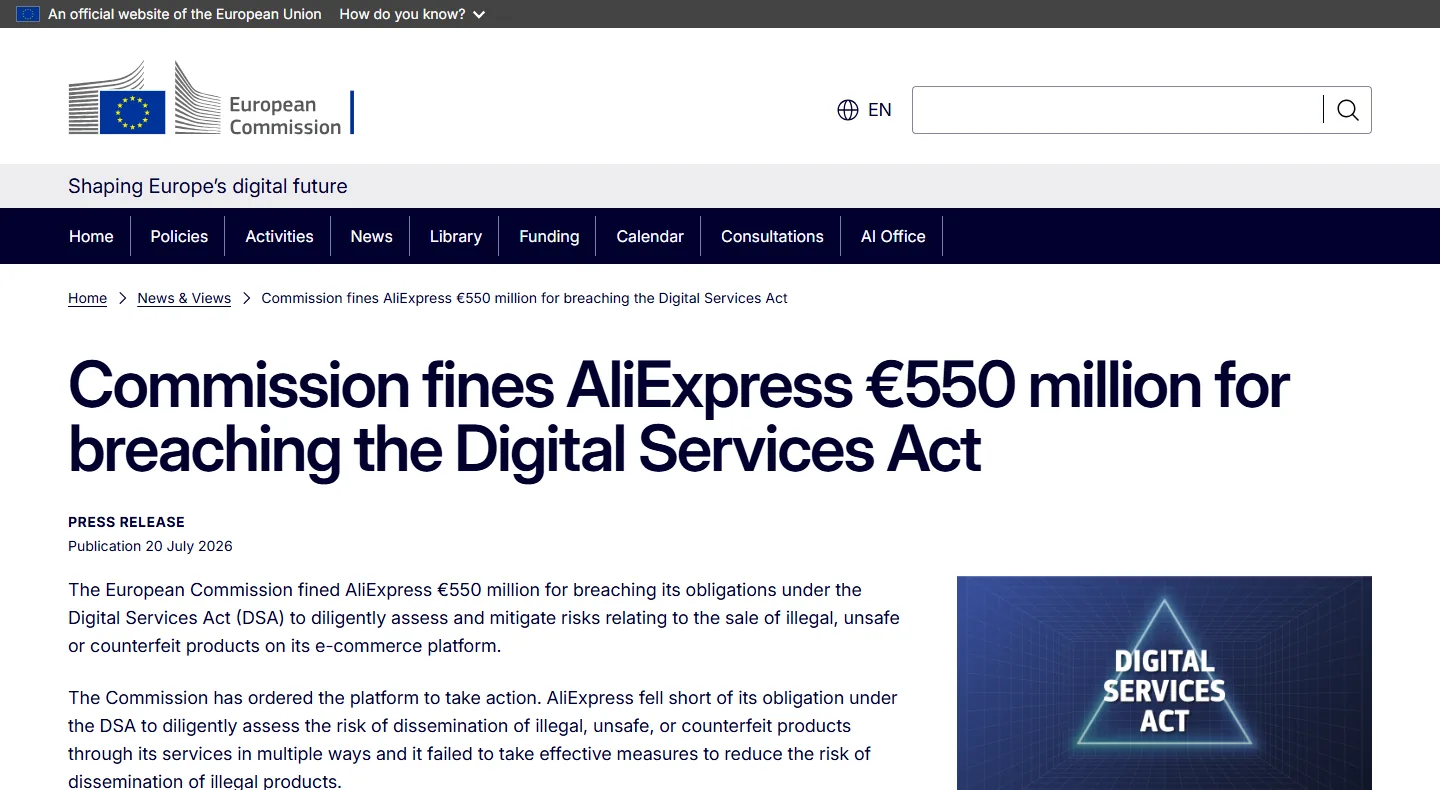
Regulators have pointed at the same gaps. On 20 July 2026, the European Commission fined AliExpress €550 million under the Digital Services Act, finding that it hadn't properly assessed or reduced the risk of illegal, unsafe and counterfeit products being sold through it. AliExpress has said it disagrees with the decision. Years earlier, the U.S. Trade Representative's 2021 Review of Notorious Markets listed AliExpress for the first time over counterfeit concerns.
None of that means every order is a gamble. It means the platform's own filters miss things, so your habits matter more than they would at a single-brand store.
The 9 most common AliExpress scams in 2026
Here's the quick version. Each one is explained in detail below, with the tell-tale sign and the fix.
| Scam | Red flag | What to do |
|---|---|---|
| Fake AliExpress emails and texts | A link asking you to pay a small fee or "confirm" card details | Never click; open the app yourself and check the order |
| Off-platform payment | Seller offers a discount for PayPal, bank transfer or a payment app | Refuse; pay only through AliExpress checkout |
| "Close the dispute" pressure | Seller promises a resend or refund if you close the case first | Keep the dispute open until money or goods arrive |
| Refund sent outside the platform | "I refunded you on PayPal, now cancel your dispute" | Only accept refunds processed through the dispute |
| Fake or recycled tracking | Tracking shows delivered in another city, or never updates | Check the carrier site; dispute before protection ends |
| Bait-and-switch variants | Headline price only applies to a cable, case or "1 piece" option | Read every variant before adding to cart |
| Counterfeit branded goods | Big-brand logo at a fraction of retail, no brand store badge | Skip it; buy brands from official stores |
| Fake capacity electronics | "2TB" flash drive or power bank for a few dollars | Test on arrival; dispute with test screenshots |
| Review manipulation | Hundreds of five-star reviews with no photos and copy-paste wording | Filter for photo reviews and read the 1–3 star ones |
1. Fake AliExpress emails and text messages
This is the scam that reaches people who have never ordered anything. A message arrives that looks like an AliExpress parcel notice: your package couldn't be delivered, pay a small customs or redelivery fee to release it. The link goes to a copycat page that collects your name, address and card number.
In July 2026 the Zurich cantonal police warned about exactly this. According to Netzwoche's report on the warning, the emails claimed an uncollected AliExpress parcel was waiting, asked for a 1.95 Swiss franc shipping fee, and then showed a fake error so victims would type their card details a second time.

Red flag: any message that asks for a payment or card details outside your order page. In the EU, UK and several other markets, import VAT is added at AliExpress checkout; a surprise fee by text or email is a scam sign. Fix: close the email, open the AliExpress app directly, and check the order there. If you already entered card details, call your bank and cancel the card today.
2. Off-platform payment requests
A seller messages you: "Pay me by PayPal friends and family or bank transfer and I'll take 20% off." Sometimes it shows up on social media, where a "supplier" claims to be the same store you found on AliExpress. Once you pay outside checkout, you have no escrow, no dispute and no Buyer Protection. You'd be relying on a stranger's goodwill.
Fix: never move a payment off the platform, no matter how good the discount. A legitimate seller has no reason to avoid AliExpress checkout, because it's how they get paid.
3. The "please close the dispute" request
You open a dispute because the item never came. Within hours the seller replies, friendly and apologetic: they'll resend the item for free, or add a gift, if you close the case first. Once you close it, the messages stop. On many orders you can't reopen a closed dispute, and by the time you realise, the protection window may be gone.
Fix: it's fine to accept a resend, but leave the dispute open until the replacement is actually in your hands. If the seller is honest, an open case costs them nothing.
4. The refund that isn't really a refund
A variation on number 3. The seller says they've already refunded you through PayPal or another app, and asks you to cancel the dispute. Sometimes the money really appears. The catch: on many payment apps, money sent to you this way is a new payment, not a refund, and the sender can later file a claim to pull it back. You end up with no item, no money and no AliExpress dispute.
Fix: the only refund that counts is the one processed inside the AliExpress dispute, back to your original payment method or AliExpress balance.
5. Fake or recycled tracking numbers
Your order shows "shipped" with a tracking number, but the number shows nothing on the carrier's site, never updates, or shows a delivery to a different city. Some sellers do this to run out the clock on your protection period, because a "shipped" order looks fine at a glance.
Fix: paste the number into the actual carrier's tracking page, not only the AliExpress page. If nothing moves for a week or the destination is wrong, message the seller and note the date. Then open a dispute before the guaranteed delivery date on your order page passes, not after.
6. Bait-and-switch variants
You search for wireless earbuds and see a $2.49 listing. The photo shows the earbuds; the $2.49 option is the charging cable, or "1 ear tip", or a phone case "compatible with" the product. The earbuds themselves are $18 once you pick the right variant. This is legal enough to survive on the marketplace, but it's built to mislead, and some buyers do check out with the wrong variant.
Fix: open the variant list before adding to cart, and look at the item name in the cart, not the photo. If the cheapest option has a different name than the product, that's the trick.
7. Counterfeit branded products
Fake brand-name sneakers, watches, bags and phone accessories are the oldest problem on the platform, and the reason for the EU and USTR findings above. Counterfeits are also a legal problem: customs can seize them, and in many countries importing fakes for resale is illegal.
Fix: buy branded goods only from a brand's official store on AliExpress, or not at all. A "Nike" or "Apple" product at 15% of retail from a store with no brand badge is not a bargain.
8. Fake-capacity electronics
A 2TB flash drive for $9, a "30,000mAh" power bank that weighs as much as a phone. These products are rewired to report more storage or charge than they hold. Files you save past the real capacity get corrupted, and cheap batteries can be a fire risk.
Fix: test capacity as soon as the product arrives (a free tool like H2testw on Windows checks flash storage). If it fails, screenshot the result and open a "not as described" dispute within the window.
9. Review manipulation
Thousands of five-star reviews look reassuring, but watch for repeated phrases, reviews about a different product, and stores with high star counts but almost no photo reviews. Some listings also merge reviews from an older, better product into a new one.
Fix: filter for reviews with photos and read the one to three star reviews first. Look at the store's age and positive feedback rate on the store page as well as the product rating.
How to get your money back if you've been scammed on AliExpress
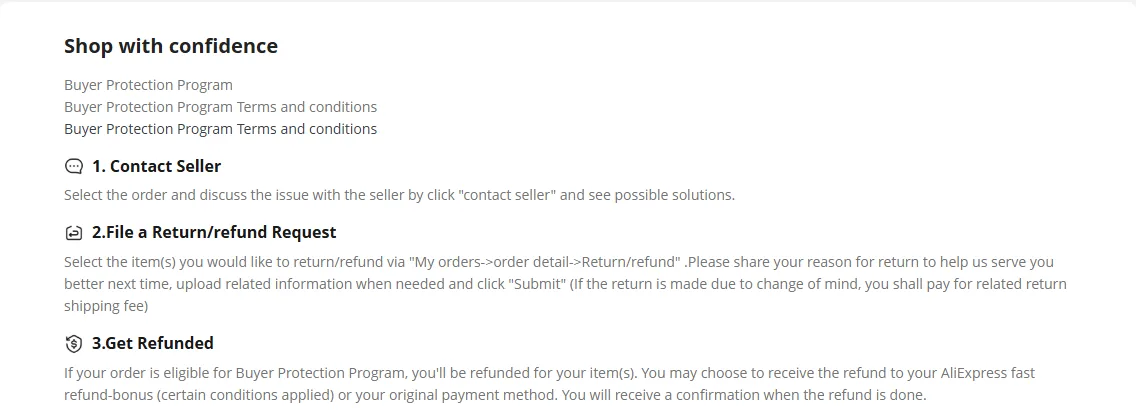
If the scam happened on an AliExpress order, Buyer Protection is your main tool. According to AliExpress's Buyer Protection page, you can get a refund if your item doesn't match its description or photos, or arrives damaged or short, within 15 days of receiving it, or if it didn't arrive within the guaranteed delivery window shown on your order details.
- Collect evidence first. Take photos of the item, the label and the packaging. For anything expensive, film the unboxing in one take. For electronics, screenshot test results.
- Message the seller through AliExpress. Keep it short and factual: what's wrong, what you want. Don't share an email address or phone number.
- Open a return or refund request. Go to Account, then My Orders, open the order details, and choose Return/refund. Pick the reason, describe the issue and upload your evidence.
- Decide between a full refund with return or a partial refund. For cheap items, a partial refund where you keep the product is often faster. For anything that's fake or unsafe, push for the full refund.
- Escalate if the seller refuses. If you can't agree, AliExpress steps in and decides. Answer its requests quickly; cases can close if you go quiet.
- Use your card issuer as a last resort. If the dispute fails and you paid by credit card, ask your bank about a chargeback. Banks usually want proof you tried the merchant's process first, so keep screenshots.
If the scam happened outside the platform (a phishing page, a fake supplier on social media), AliExpress can't help. Call your bank, then report it. In the US, file a report with the FTC at ReportFraud.ftc.gov; other countries have similar national fraud centres. Reports don't usually return money, but they feed the cases that shut these operations down.
AliExpress scams that target dropshippers
Most guides stop at personal shopping. If you're sourcing AliExpress products for a store, the same tricks cost more, because your customer has already paid you and your store gets the complaint.
- The quiet product swap. Your sample was great. Three months later the same listing ships a thinner material or a different charger. Your customers notice before you do. Re-order a test unit every few months on your best sellers.
- Tracking that marks "delivered" too early. If a tracking number shows delivered to the wrong city, your customer opens a chargeback with you, not AliExpress. That's a fee and a mark on your payment account. Our guide to dropshipping chargebacks covers the evidence to keep.
- The vanishing store. A supplier with great prices and a new store closes overnight, and your product page now points to nothing. Keep a backup supplier for every product that sells more than a few units a week.
- Counterfeits under your brand. If you list a knock-off, payment processors and marketplaces hold you responsible, not the factory. Avoid anything with a brand logo you don't own.
- Your protection window doesn't match your customer's. Your customer may get 30 days to return; your AliExpress protection runs from when the parcel was delivered. Check orders early, not when the customer emails.
This is where using AliExpress through a tool, or adding suppliers closer to your customers, starts to make sense. Spocket's AliExpress dropshipping integration lets you import AliExpress products alongside US and EU suppliers who ship in 2–7 days, so a slow or disputed order isn't your only option. You can try it with a 7-day trial if you want to compare.
A 60-second pre-purchase check
Run this before any order over about $20, or any product you plan to sell:
- Is the store at least a year old, with a positive feedback rate in the mid-90s or higher?
- Do the photo reviews show the same product as the listing photos?
- Does the variant you've selected match the item name in your cart?
- Is there a brand logo on the product? If yes, is this the brand's official store?
- Is the price wildly below every other listing for the same item? Compare at least three.
- Will you pay inside AliExpress checkout, with no outside payment request?
If you answer "no" to the first four or "yes" to the fifth, move on. There are always other sellers. For a deeper sourcing checklist, see our guide on avoiding dropshipping scams.
Is it still worth buying from AliExpress?
For low-cost, unbranded items you're happy to wait a couple of weeks for, yes. Most orders arrive as described, and Buyer Protection works when you use it on time. The risk climbs with brand names, high prices, electronics with big capacity claims, and anything a seller tries to move off the platform.
For a store, the calculation is different. You're carrying the risk for your customers, and faster, more predictable delivery is worth paying for on your best sellers. If you're weighing that switch, our list of AliExpress alternatives for dropshipping compares the main options side by side, and Spocket's trending products page shows what US and EU suppliers are selling now.
Ready to add suppliers closer to your customers? Start your 7-day Spocket trial; plans start at $39.99/month.
Start your dropshipping business today
AliExpress Scams FAQs
What is the most common AliExpress scam?
Fake parcel emails and texts that use the AliExpress logo are the most widespread, because they reach people who never ordered anything. On the marketplace itself, the most common problems are bait-and-switch variants, counterfeit branded goods and sellers pressuring buyers to close disputes. All of them are avoidable if you pay only through AliExpress checkout and keep disputes open until the issue is fixed.
How do I know if an AliExpress email is real?
Treat any email or text that asks you to pay a fee or re-enter card details as fake. Don't click the link. Open the AliExpress app or type the address yourself and check the order page. Real order updates appear there too. If you've already entered card details on a suspicious page, call your bank and cancel the card straight away.
Will AliExpress refund me if I get scammed?
If the problem is on an AliExpress order, usually yes. Buyer Protection covers items that don't arrive within the guaranteed delivery window, and items that are damaged or not as described if you report them within 15 days of receiving them. Payments made outside AliExpress checkout, or losses from phishing sites, aren't covered.
Should I close a dispute if the seller promises to resend the item?
No. Accept the resend if you like, but leave the dispute open until the replacement is in your hands. A common trick is promising a resend or a refund through another app, then going silent once the case is closed. An honest seller loses nothing when the dispute stays open, so pressure to close it is a red flag.
Are cheap branded items on AliExpress fake?
Almost always, unless they come from the brand's official store on AliExpress. A big-name product at a fraction of its retail price from a store without a brand badge is very likely counterfeit. Customs can seize fakes, and reselling them can get your store or payment account shut down, so dropshippers should avoid branded goods they don't have rights to sell.
Where do I report an AliExpress scam?
Report scam sellers to AliExpress through the order page or store page, and keep your dispute evidence. For phishing or off-platform fraud, contact your bank first, then file a report with your national fraud authority. In the US that's the FTC at ReportFraud.ftc.gov. Reports rarely return money but help authorities take scam operations down.
Can dropshippers get scammed by AliExpress suppliers?
Yes, mostly through quiet product swaps, tracking numbers that show early or wrong deliveries, and stores that disappear. Your customer blames your store, and chargebacks land on your payment account. Re-order test units of best sellers, keep a backup supplier for each product, and consider suppliers closer to your customers for items where delivery speed matters.


Launch your dropshipping business now!
Start free trial


Related blogs
Dropshipping Supplier Directory: Where to Find Vetted Suppliers
Browse our directory of vetted dropshipping suppliers across the US and EU, complete with niches, shipping speed, and pricing. Start your free trial today.

How to Negotiate With Dropshipping Suppliers: 9 Tactics That Actually Work
Learn how to negotiate with dropshipping suppliers on price, MOQs, and payment terms. Proven tactics and email scripts to boost your margins. Try Spocket free.

Is AliExpress Legit? A Safety Check for Buyers and Dropshippers
Is AliExpress legit? Yes, but sellers vary. See how Buyer Protection works, what the EU's 2026 fine means, customs costs, and whether it's safe for dropshipping.