Dropshipping Branded Packing Slips and Inserts: What You Can Control
Learn which parts of a dropshipped parcel you can brand, from packing slips to insert cards, plus a break-even check and six questions to ask suppliers first.
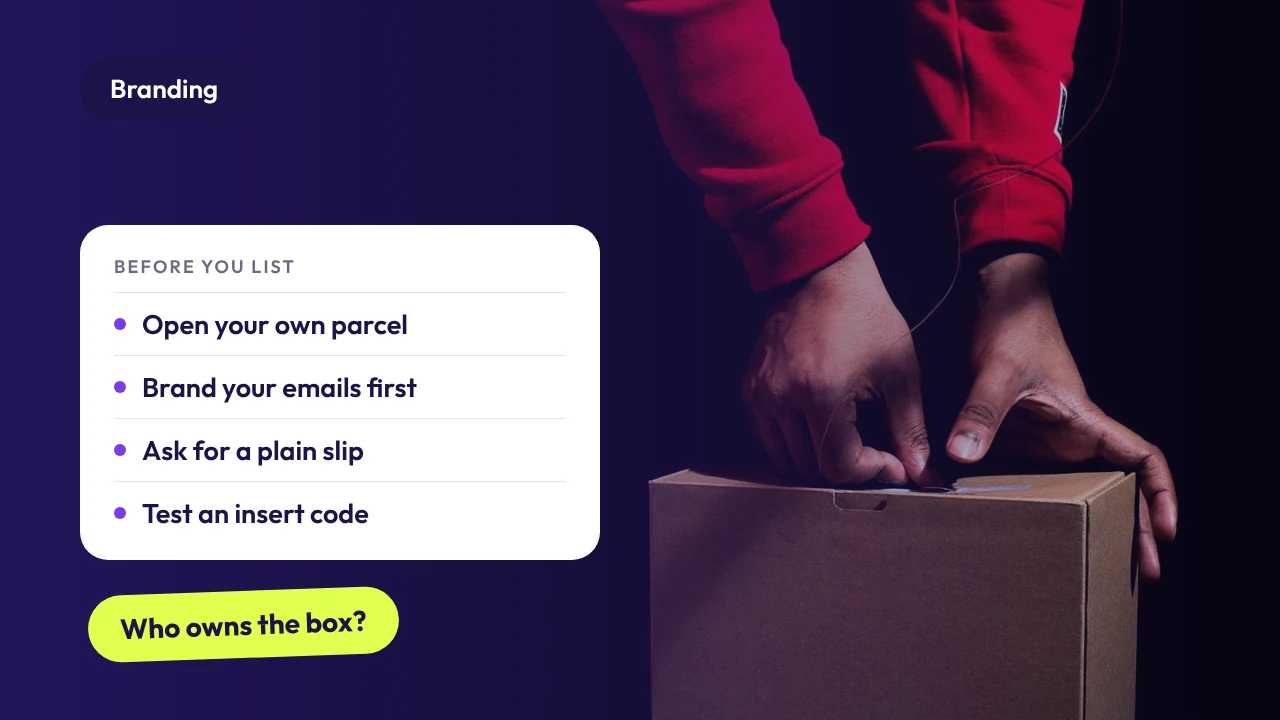


The box is the one part of your store a customer can hold, and in dropshipping you never see it. Someone in a supplier warehouse packs it, tapes it and drops a slip inside. If that paper carries another company's name, or none at all, you do not have a branded packing slip, and the customer's first physical impression of your shop belongs to a stranger. This guide sorts out which parts of a dropshipped parcel you can brand, which ones you can only ask for, and how to find out before you list a product.
Open your own parcel first
Order one of your own products to a home address and open it the way a customer would. Write down four things: whose name is on the label, whether a slip or invoice is inside, whether that paper shows prices, and whether a leaflet or sticker points to the supplier. Those notes tell you which options below you already have and which you will have to ask for.
Most of what you find depends on the supplier, not on your store. Shopify's Help Center says your documents come from order document templates in Settings, then Shipping and delivery, and that you change packing slips with code. That helps when your own templates are what gets printed, for example if you pack orders yourself or use a warehouse that prints your slips. When a supplier packs a dropshipped order, they often print their own document, which your test parcel will show, so your template may never reach the box.
Repeat the test with every supplier you plan to rely on, not only your first. Packing can change from one order to the next, so a second sample a few weeks later is a cheap way to confirm the first parcel was typical. Photograph the open box, the paper and the label, and keep the pictures with your notes.
Four levels of branding and what each one needs
Each step puts your name in front of the customer more clearly, and each one needs more cooperation from someone other than you.
| Level | Customer sees | Needed from supplier |
|---|---|---|
| 1. Store emails | Your name on order and shipping emails | Nothing |
| 2. Slip or invoice | Your logo and a short message on the paper | A plain slip, or your logo printed |
| 3. Insert card | A thank you card or offer in the parcel | An extra packing step |
| 4. Box or mailer | Your design on the outside | Private label or warehouse deal |
Most stores that sell low-priced items should be comfortable stopping at level two or three. Level four is a different business model, and it only makes sense once a product sells steadily and carries enough profit per order to fund it.
Levels one and two: the parts you can control
Your own emails are the one touchpoint that never depends on a supplier. Shopify lists the order and shipping messages your store sends on its customer notifications page. Read each one as a customer would: does the sender name match your store, does the wording sound like you, and does the tracking link work? Fix those before spending a cent on paper.
The packing slip is the next step. If a warehouse prints your slips from your Shopify templates, the packing slip customization guide explains the main edits. You upload the logo on the Files page and swap the store name code for the logo code, and the file name in the code has to match the Files page exactly or the logo will not print. You can also change the address, remove product images and adjust fonts. For a supplier that packs for you, the same idea applies, but the supplier has to agree to print your logo and message. If your supplier platform offers a branded invoice option, our guide to branded invoicing covers the setup.

Keep the message short and honest. A line such as "Thanks for ordering from us, reply to your shipping email if anything looks wrong" does more than a paragraph of brand story. Avoid claims that the item was made or packed by you if it was not.
Check the tone of the whole sequence together. The order email, the shipping email and the slip should sound as if one person wrote them. If the email says "Hey there!" and the slip says "Dear Valued Customer", that mismatch is more noticeable than a missing logo.
Level three: an insert card, and when it pays back
A card in the parcel works best when it asks for one thing: a reorder, a review, or a reply to the shipping email. The cost is small, so the arithmetic is simple. It is also where most stores guess instead of calculating.
Say a printed card costs $0.40 once it is delivered to the supplier and added to each parcel. Your average order is $30 and leaves $11 after the product, shipping and fees. The card carries a code for 10% off the next order, which costs $3 on a $30 basket and leaves $8 of profit on a repeat sale. Across 100 parcels the cards cost $40, and $40 divided by $8 is 5 repeat orders. So about 5 customers in 100 have to come back before the cards stop costing you money. That counts only if the card caused the reorder, since someone who would have returned anyway does not pay for it.
| Cost per card | Cost per 100 parcels | Repeat orders needed |
|---|---|---|
| $0.40 | $40 | 5 |
| $0.90 | $90 | 12 |
| $1.50 | $150 | 19 |
Treat five in a hundred as a target to test, not a promise. Send 200 parcels with a card and the cards cost $80, which needs 10 reorders to break even. If only 3 come in, the card is losing money, so stop or change the offer. Cards also add weight and a packing step, so ask the supplier whether either affects the price or the dispatch time before you commit.

Use a code you can limit. Shopify's discount code settings let you set the dates the code is valid, a total number of uses, and one use per customer. A card with a code that works forever, for everyone, quickly turns into a public coupon.
Level four: custom boxes and mailers
Custom packaging changes the first thing a customer sees, and it also changes your costs most. A branded mailer that adds $1.20 per order eats about 11% of the $11 profit in our example. On an item that leaves $4, the same mailer eats 30%. That is why this level suits products with healthy margins, steady volume, or both.

There is a cheaper half step. A branded sticker or tape strip on a plain carton gives a hint of identity without a full redesign, if the supplier will apply it. Labels that carriers or customs need must stay untouched, so ask which parts of the outside you are allowed to change. Anything beyond that, such as printed boxes, usually means a minimum order, a warehouse you contract, or a private label arrangement.
A contracted warehouse changes the picture because it prints your slips and packs your branding, but you then buy stock in advance, which is a different risk from dropshipping. Make that call with sales numbers in front of you, not because a printed box looked good on social media.
Six questions to ask before you list
These are the questions that sort suppliers quickly. Ask them by message, in writing, so the answers sit in one thread you can refer to later.
| Ask | Good answer | Red flag |
|---|---|---|
| Can you ship without your own invoice or price list? | Yes, a plain or blank slip | Their invoice always goes in |
| Can you print my logo and a short message? | Yes, with file size and format | No, and no alternative |
| Will you add a card I send you? | Yes, for a small fee per piece | Only in bulk batches |
| Whose name is on the shipping label? | A neutral or store name | A supplier brand customers can search |
| Do you add flyers or stickers of your own? | No | Always, with no way to opt out |
| Can I order a sample to my own address? | Yes, same box as customers get | No way to see what ships |
Here is a message you can paste and adjust: "Before I list your products, can you tell me: 1) can orders ship without your own invoice or price list; 2) can you print my logo and a short message on the slip, and in what file format; 3) will you add a card I supply, and what does it cost per piece; 4) whose name appears on the shipping label; 5) do you add your own flyers or stickers; 6) can I order a sample to my address?"
Pay attention to how the answer arrives as well as what it says. A specific reply is easy to act on. A vague one often means the person answering does not know what the warehouse does, so ask for a sample before you list anything.
When the supplier's paperwork ships anyway
Sometimes the product is great and the supplier will not change anything. That leaves three options. Put more effort into level one, including a clear shipping email and a short follow-up message after delivery. Ask whether the supplier can leave out the invoice and send a plain slip. Or find another supplier for the same product type and run the six questions on them.
Make returns easy to understand, because a supplier's slip may point to an address that is not yours. Your return policy page and shipping email should say where a customer should send a return request, which is usually a message to you first. Our guide to a package returned to sender shows what to do when a parcel comes back for any reason.
If your current supplier fails most of the six questions, compare a few others before your next order. You can start the 7-day free trial and browse US and EU suppliers who ship in 2 to 7 days, then send them the same questions from the table above. Keep the shortlist in a simple sheet with the date and the answer to each question, so you are comparing facts later and not memories.
Start your dropshipping business today
Packing Slip and Insert FAQs
Should a packing slip show the price the customer paid?
Not always. If the order might be a gift, some sellers leave prices off the slip, and it is worth asking whether your supplier can do that. If you would rather give customers a receipt in the box, make sure it shows what they paid and not your supplier's cost.
Is it worth branding the parcel for cheap products?
Usually only up to level two or three. On an item that leaves a few dollars of profit, a card or custom mailer takes a large share of each sale. Put the effort into your emails and your follow-up message instead.
Can an insert card slow down dispatch?
It can, because it adds one packing step. Ask the supplier whether it changes handling time, then order a sample and compare the delivery date with an order that has no card. If it adds a day or more, test whether the extra reorders are worth the wait.
What if the supplier refuses to change the slip?
You still have your own emails, your return policy page and any message you send after delivery. If the supplier's paper is the weak spot, shortlist alternatives and ask them the six questions before you move products across.


Launch your dropshipping business now!
Start free trial


Related blogs

WooCommerce Shipping Classes for Dropshipping With Several Suppliers
Set up WooCommerce shipping zones and classes for dropshipping with several suppliers, price each class per zone and test a mixed cart before launch.

Dropshipping Package Returned to Sender: Refund, Reship or Charge?
Package returned to sender? Work out who caused it, compare refund and reship costs on a $34 order, and set a fee rule that protects your margin and your customer.

Dropshipping Damaged Package or Lost Parcel: Who Pays and How to Recover It
A parcel arrived broken or never showed up. Sort the cause, make the customer whole within 48 hours, then recover the cost with an evidence pack and a supplier email.