Looking for Easy Profits? Try Spocket today and access thousands of winning products! Explore Products 🚀
The direct-to-consumer (D2C) revolution isn’t slowing down—it’s accelerating. In 2025, digital-first brands are rewriting the rules of growth with bold storytelling, faster fulfillment, and stronger community loyalty than ever before. From clean beauty startups to functional beverage disruptors, the fastest-growing D2C brands are turning clicks into cult followings—and sales into sustainable empires.
This list ranks the top D2C players worldwide based on measurable momentum—traffic, purchase data, social growth, and expansion signals.
Explore how these global disruptors are reshaping ecommerce—and how Spocket empowers the next generation of D2C founders to scale just as fast.
Here’s SEO-optimized content for your “Global Snapshot” section, with credible data and links to validate the claims:
The global direct-to-consumer (D2C) market is seeing a substantial inflection point. According to one recent estimate, the direct-to-consumer (D2C) e-commerce market was valued at USD 583.48 billion in 2024 and is projected to reach USD 2.75 trillion by 2033, representing a robust compound annual growth rate (CAGR) of approximately 17.3 % from 2025–2033.
Another research report projects a value of USD 200 billion in 2024 for the global D2C e-commerce market, rising to USD 217 billion in 2025, with further expansion toward USD 420 billion by 2033 (though this estimate is more conservative).
In broader context, the total global e-commerce market is expected to hit around USD 6.56 trillion in 2025, growing at about 7.8 %.
What these numbers tell us is clear: while D2C still constitutes a subset of overall e-commerce, it is growing faster and is gaining share as brands bypass traditional wholesale and retail channels. That shift is enabling digital-native and direct brands to punch above their weight.
One of the most telling phenomena within this growth story is the rise of so-called “insurgent brands” — smaller, digitally-native brands that break into established categories and outperform legacy incumbents. According to Bain & Company’s 2025 review of insurgent brands, 120 high-growth consumer products brands captured nearly 39 % of category growth in the US, despite representing a small share of overall market.
These insurgent brands (many of which operate with D2C or hybrid models) are rewriting the growth playbook. They prioritise strong brand identity, direct customer relationships, agile operations and digital-first channels — traits that legacy players often struggle to replicate. As one summary notes:
In this global landscape, therefore:
For operators and brands looking to scale, this means the opportunity to tap global D2C expansion is very real — but only if the model adapts to acquisition + retention dynamics, cross-border logistics, and evolving consumer expectations.
Here is list of top 10 fastest growing direct to consumer(D2C) brands with their growth and revenue statistics
Austin-born prebiotic soda founded by Allison & Stephen Ellsworth (launched 2018; rebranded from “Mother”) that blends fruit juice, ACV and prebiotics into low-sugar cans. Riding a wave of gut-health demand, Poppi was acquired by PepsiCo in March 2025 in a deal valued around $1.95–$2.0B, after reportedly surpassing $500M in annual revenue—making it one of the fastest consumer upstarts to scale from DTC to mass. It also landed on Numerator’s 2025 “Brands to Watch,” underscoring purchase-growth momentum.

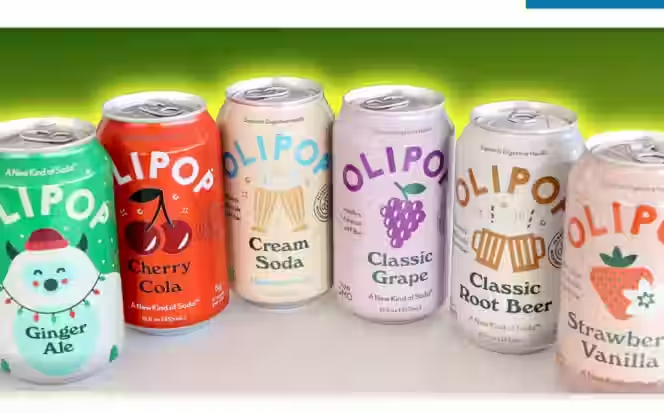
Founded in 2018 by Ben Goodwin and David Lester (HQ: Bay Area), OLIPOP positions itself as a “new-school soda” with prebiotic fiber. OLIPOP doubled topline to ~$400M in 2024 and notched 2,128% revenue growth over 3 years; its latest raise implied a $1.85B valuation as it expanded household reach and retail doors. Time reporting corroborates the $400M 2024 sales milestone and national velocity.
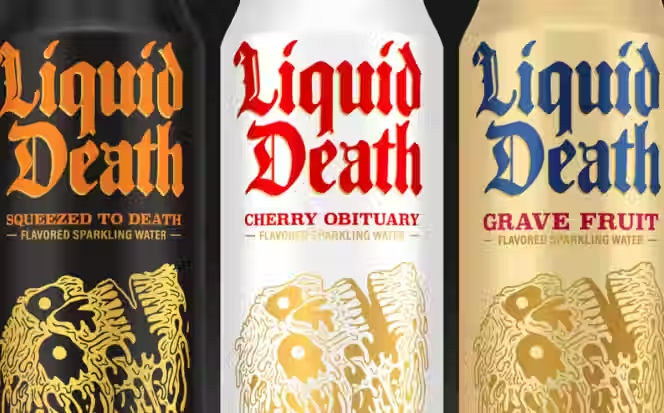
LA-based brand (founded 2018 by Mike Cessario) that started DTC and scaled via mass retail with metal “tallboy” cans and irreverent branding. With an attention-engine brand and omnichannel DTC play, Liquid Death hit ~$333M revenue in 2024 (up 26% YoY) and has been discussed at a ~$1.4B valuation in major business press—evidence of sustained consumer pull and retail expansion.
A Trove Brands label (FreeSip launched 2020) known for patented lids and social-fueled demand. A breakout in the “water-bottle wars,” Owala was flagged by Numerator as winning with Gen-Alpha households for 2025. Third-party retail intelligence tracked >400% monthly sales growth across 2024 and persistent search spikes into mid-2025—signals of real demand acceleration.

UK D2C fitness apparel pioneer (founded 2012; HQ Solihull) built on community, creator collabs, and drops. Gymshark crossed the £600M revenue mark for the year ended July 2024—its 12th straight year of growth—as it deepened DTC and opened key flagship stores. Despite profit pressure from expansion, U.S. growth and omnichannel investment continue to compound brand equity.

D2C health platform (founded 2017; HQ San Francisco) spanning telehealth consults and subscription treatments. Hims & Hers posted Q2 2025 revenue of $544.8M (up 73% YoY), exceeded 2.4M subscribers (+31% YoY), and guided FY2025 revenue to $2.3B–$2.4B—exceptional scale for a consumer-health DTC platform.

The OG D2C eyewear disruptor (founded 2010; HQ NYC) now omnichannel with 270+ stores + Target shop-in-shops ahead. Warby Parker raised its FY2025 net revenue outlook to ~$869M–$886M (≈13–15% growth) The OG D2C eyewear disruptor (founded 2010; HQ NYC) now omnichannel with 270+ stores + Target shop-in-shops ahead. while improving profitability metrics—showing that the original DTC eyewear disruptor is still growing its active-customer base and omnichannel footprint.

Southern California athleisure brand (founded 2015 by Joe Kudla) blending performance and lifestyle aesthetics. Vuori continues outlier growth in premium athleisure, with sales up ~23% YoY (late 2024) and an accelerated global retail rollout toward 100 stores by 2026—on top of a previously reported $4B+ valuation.

MrBeast’s CPG arm (launched 2022) leverages creator reach + retail ubiquity (Walmart/Target/7-Eleven). Creator-led Feastables is scaling like a tech startup: multiple reports peg 2024 revenue at ~$215–$250M, with some investor materials suggesting a $520M sales target for 2025. Even conservative figures imply one of the fastest CPG ramps of the decade.

LA-based clean-label supplement company (founded 2016 by Katerina Schneider) known for traceable ingredients and a DTC-first subscription model, now omnichannel (Amazon, Target, Whole Foods, Ulta). Ritual surpassed $250M in 2024 retail sales across channels, has served 2M+ customers and sold 25M+ bottles, while maintaining a DTC-first brand engine augmented by Amazon/Target/Whole Foods distribution.

The rise of these fastest-growing D2C brands in 2025 proves that customer connection, transparency, and innovation drive modern commerce. Each brand—from wellness to fashion—has mastered direct engagement, agile marketing, and fast fulfillment to outpace traditional players. As technology reshapes the consumer journey, brands that prioritize data-driven personalization and seamless customer experience will continue to lead. Whether you’re launching your first product or scaling globally, platforms like Spocket make it easier to source high-quality goods, manage suppliers, and grow your D2C brand efficiently—helping you become the next name on this list of global success stories.