Writing Envelopes for Money: Legit or Scam? The Honest Truth Behind the Viral Side Hustle
Is writing envelopes for money legit or a scam? Learn the red flags, real earning potential, safe ways to find legit work, and better alternatives.
.avif)

The idea sounds almost too perfect: sit at home, write addresses on envelopes (or “stuff” envelopes), mail them out, and get paid. No degree. No experience. No laptop. Just a pen, paper, and free time.
So it’s understandable that “writing envelopes for money” keeps going viral—especially on short-form platforms where a quick video can make it look like effortless income.
But here’s the reality: most “envelope writing for money” offers you see online are either scams or wildly exaggerated, and the legit opportunities (when they do exist) rarely pay anything close to what the viral posts claim.
This guide breaks down what’s real, what’s not, how the scams work, how to spot red flags fast, and what you can do instead if your goal is flexible income from home.
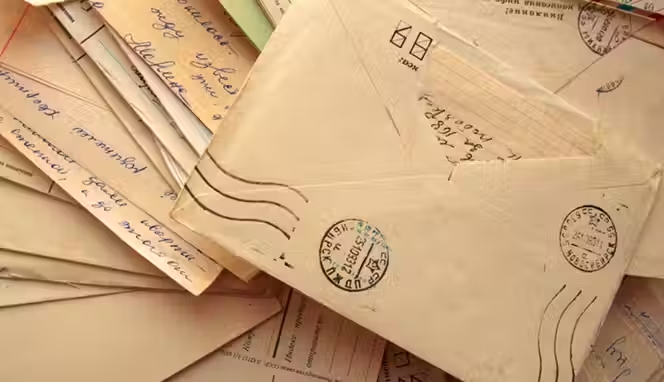
What “writing envelopes for money” actually means
When people search “writing envelopes for money,” they’re usually talking about one of these three things:
1) Handwriting addresses for mail campaigns (sometimes legit)
Small businesses, nonprofits, wedding planners, and direct mail marketers sometimes want a handwritten look because it can increase open rates and response rates compared to printed mail. This can be real work—more like “hand-addressing” or “calligraphy-style addressing.”
2) Stuffing envelopes with flyers or inserts (rarely remote, often not worth it)
Bulk mailing jobs exist, but they are usually handled in-house, through mail houses, or with machinery. Work-from-home “stuffing” jobs are commonly used as bait in scams.
3) The viral “send letters to get paid” scheme (almost always scammy)
This is the one TikTok and “side hustle” reels push most aggressively: “copy this script,” “mail it to these addresses,” “get paid per envelope,” or “earn $50–$70/hour.” Multiple consumer sources warn these claims don’t match reality.
So… is writing envelopes for money legit or a scam?
The answer isn’t black-and-white. Hand-addressing envelopes for real clients—like small businesses or local organizations—can be a legitimate way to earn some side income if you find real work and negotiate fair pay. However, the viral “write or stuff envelopes from home and get rich fast” offers are almost always scams or misleading promotions that rely on upfront fees, vague job descriptions, and unrealistic pay claims. The key difference is whether you’re being paid for actual work by a real buyer versus being asked to pay before you earn anything, which is a classic scam red flag.
Both exist—but the viral version is where people get burned.
- Legit: You can sometimes earn money by hand-addressing envelopes for local organizations, small businesses, or events—especially if you have neat handwriting, speed, and consistency.
- Scam (most common): “Envelope stuffing” and “mailing letters for guaranteed payouts” offers that require an upfront fee, a “starter kit,” or pressure you into recruiting others.
The quickest way to think about it is this:
If the “job” is really about you paying them (fees, kits, training, memberships), it’s not a job. It’s a funnel.
And if the promise is “big money for minimal effort,” it’s almost always marketing—at best—and fraud—at worst.
Why this side hustle keeps going viral
The envelope writing trend keeps resurfacing because it hits several emotional triggers:
- It sounds simple: write addresses, mail, get paid
- It feels “offline safe”: no complicated tech setup
- It looks flexible: “work whenever you want”
- It’s familiar: envelope-stuffing scams have existed for decades, just repackaged for social media
The FTC and state consumer protection resources have warned about envelope stuffing promotions historically because they are easy to sell with big promises and vague details.
How envelope stuffing scams usually work
Envelope stuffing scams tend to follow a predictable pattern. They attract people with ads or social media posts promising easy, high-paying work from home that requires no skills or experience. Once interest is shown, the “company” asks for a small upfront fee—often described as a starter kit, training cost, or access charge.
After payment, victims usually receive generic instructions, outdated mailing lists, or directions that simply tell them to recruit others into the same scheme. In most cases, there is no real employer, no guaranteed work, and no reliable way to earn the promised income.
Most envelope stuffing scams follow the same pattern, even if they use different branding:
Step 1: Hook you with huge earnings
Claims like:
- “Earn $2–$5 per envelope”
- “Make $1,000 a week from your couch”
- “No experience required”
These numbers are designed to trigger urgency and hope—especially for people looking for quick income.
Step 2: Ask for a “small” upfront payment
The pitch is usually:
- “Starter kit $10–$50”
- “Membership fee”
- “Training materials”
- “Access to addresses/scripts”
This is the turning point. Consumer protection guidance flags exactly this: promoters advertise that for a “small fee” they’ll tell you how to earn big money stuffing envelopes at home.
Step 3: Deliver junk instructions or a recruiting loop
Often, what you receive is:
- generic instructions
- a “system” that tells you to recruit others to buy the same kit
- scripts that push you into reselling their method
You pay for a starter kit and discover it’s basically instructions to recruit others into the same scheme.
Step 4: You’re stuck, and refunds are messy (or impossible)
If you complain, you may get ignored, blamed, or told you didn’t follow the steps correctly.
The biggest red flags to spot instantly
If you remember nothing else, remember these.
Red flag 1: Upfront fees (kit, training, “registration”)
Legit employers pay you. You don’t pay them.
Red flag 2: Guaranteed income claims
If someone claims you’ll definitely make $300/day or $70/hour for basic tasks, that’s a classic “too good to be true” pattern.
Red flag 3: Vague job details
Scam offers avoid specifics like:
- exact company name
- who the mail is for
- what you’re mailing and why
- how they verify work completed
Red flag 4: Pressure tactics
- “Limited slots”
- “Only today”
- “Don’t Google this, you’ll get confused”
- “This is the secret method”
Red flag 5: The job is actually recruiting
If your “earnings” depend on bringing in other people to buy a kit or join a program, that’s a major warning sign.
What legit envelope writing opportunities look like (and where the money actually is)
Let’s be fair, there are legitimate versions of this work. But they usually look different from viral offers.
Legit version A: Hand-addressing for small businesses and nonprofits
Some organizations want handwritten addresses because they believe it can improve response rates. One reference explains legitimate opportunities exist mainly through small businesses and local organizations—and stresses avoiding scams that require upfront payments.
What you’d typically do:
- handwrite names/addresses neatly and consistently
- sometimes add small personalization (like “Hi Sarah!”)
- follow strict formatting rules (post office standards may apply)
How it pays:
- usually per project or per batch
- income varies and is not guaranteed
Legit version B: Calligraphy-style addressing (higher skill, higher pay)
This is closer to “event stationery.” If you can do modern calligraphy, you can charge more—but it’s not “easy money.” It’s a skill-based service that takes practice.
Legit version C: In-person mailing/clerical roles (not the viral remote gig)
Mail houses, offices, and fulfillment centers may hire for mail prep, but that’s more like general clerical work and often isn’t remote.
How much can you really earn writing envelopes for money?
Here’s the part viral videos rarely say out loud: even when it’s legit, it’s not a high-paying hustle for most people.
Its claims to be “$50–$70/hour” which don’t reflect reality, and that writing envelopes isn’t a viable primary income for most people.
Also, some analyses of stuffing-envelope claims show why the math collapses: if pay is only a few cents per envelope, you’d need huge volume to make decent hourly money.
A realistic expectation for legit “hand-addressing” work is:
- modest side income
- inconsistent demand
- earnings tied to speed + accuracy + reliability
Pros and Cons of Writing Enveloped for Money
Writing envelopes for money can sound like an easy, low-effort side hustle, especially if you prefer simple tasks you can do at home. In some legit cases—like hand-addressing mail for small businesses, nonprofits, or events—it can offer flexible work with minimal startup costs.
However, it’s also a category filled with misleading offers and envelope-stuffing scams, so it’s important to understand both the benefits and the drawbacks before you invest your time. The earning potential is often lower than viral claims, work can be repetitive and time-consuming, and consistent gigs aren’t always easy to find—so this option works best as small supplemental income, not a reliable full-time job.
Benefits (when it’s legit)
If you find real clients (not schemes), there are genuine upsides:
- Flexible schedule: You can often do batches in the evenings or weekends.
- Low startup cost: A pen, good paper, and maybe basic supplies.
- Simple, low-tech work: No complex software required—though good organization helps.
- Satisfying for people who enjoy repetitive tasks: Some people like the calm, methodical nature of it.
Drawbacks (even when it’s legit)
Legit doesn’t mean ideal. Common drawbacks include:
- It’s repetitive and can cause hand strain: This is a well-documented downside in side hustle breakdowns.
- Income is inconsistent: You may have one good week and then nothing for weeks.
- It’s time-intensive for the money: If you’re slow, the hourly rate drops fast.
- Quality control matters: Messy handwriting, smudges, or formatting mistakes can get you rejected.
How to verify an envelope writing job is legit (step-by-step)
Use this checklist before you send your time—or money.
Step 1: Identify who the real employer is
Ask:
- What’s the company name?
- What’s their website?
- What exactly are you mailing, and why?
If they dodge this, walk away.
Step 2: Confirm there are no upfront fees
Legit opportunities do not require you to buy a kit to “unlock” work.
Step 3: Look for an actual contract or written agreement
You should see:
- pay rate
- pay schedule
- quality expectations
- refund/chargeback policy if relevant
Step 4: Check consumer protection resources if anything feels off
The Florida Attorney General’s consumer guidance specifically recommends checking with consumer protection agencies, the Better Business Bureau, and reporting suspicious programs if needed.
Step 5: Never share sensitive info early
Scammers sometimes “hire” you just to collect:
- your bank details
- copies of your ID
- SSN-style identity info
Only share sensitive info after you’ve verified the business and the role.
What to do if you already paid for an envelope-stuffing “kit”
If you’ve already spent money, don’t panic—but act quickly.
- Stop paying immediately if it’s a subscription or recurring charge.
- Document everything: receipts, emails, the sales page, chat logs, payment confirmations.
- Request a refund in writing and keep proof.
- Dispute the charge with your bank/card provider if the seller refuses or disappears.
- Report it to consumer protection authorities. State AG resources and the FTC are common reporting routes.
Safer (and better-paying) alternatives to “writing envelopes for money”
If your goal is flexible income from home, there are options that tend to be more scalable than handwriting thousands of envelopes.
Freelance writing (real writing, not envelope hype)
If you can write clearly, there are legitimate ways to get paid to write, including beginner-friendly gigs.
Virtual assistant tasks
Email management, scheduling, customer service, simple research.
Reselling and flipping
Small profits add up if you have a system.
Ecommerce side hustle
If you’re exploring online income, building a small store can be more scalable than per-envelope payouts. For example, many people start with dropshipping tools and supplier platforms like Spocket to test products without holding inventory—so the work builds an asset rather than trading hours for pennies.
(And yes—ecommerce still takes effort. But the upside is better than the “$2 per envelope” fantasy.)
Real-world scenarios: when writing envelopes for money is a good idea (and when it isn’t)
Writing envelopes for money can make sense in a few practical situations—but only when it’s tied to real clients and clear pay terms.
When it can be a good idea
- You found a real local client (nonprofit, small business) and the pay terms are clear
- You enjoy repetitive work and want a low-tech side task
- You treat it as small supplemental income, not a “quit your job” plan
When it’s not a good idea
- You’re paying upfront for a kit or “method”
- You’re chasing viral claims like $50–$70/hour
- The work is basically recruiting others into the same scheme
Final verdict: Writing envelopes for money — legit or scam?
Writing envelopes for money sits in a tricky gray area. Yes, there are limited, legitimate opportunities—usually hand-addressing work for real businesses or organizations that value a handwritten touch. But those roles are rare, pay modestly, and should only ever be treated as small side income. On the other hand, the viral “envelope stuffing” offers that promise big money, easy work, and require upfront fees are overwhelmingly scams or misleading schemes designed to profit from hopeful job seekers rather than provide real work.
If your goal is to earn meaningful income from home, it’s worth stepping back and asking a bigger question: Do I want to trade hours for a few dollars, or build something with real growth potential? That’s where smarter online models come in.
Instead of chasing low-paying or risky gigs, many people are choosing to build online businesses using proven ecommerce tools. With Spocket, you can start a dropshipping business by selling high-quality products from vetted suppliers, without worrying about inventory, packing, or shipping.
Start your dropshipping business today
FAQs about Writing Envelopes for Money
Is writing envelopes for money legit?
Sometimes—hand-addressing envelopes for real businesses can be legit. But the viral “envelope stuffing job from home” version often includes upfront fees and exaggerated promises, which is a major scam pattern.
Is envelope stuffing a scam?
Most “work-from-home envelope stuffing” promotions are widely treated as scam-like offers, especially when they ask for a “small fee” to get started or promise huge earnings for simple work.
How can I tell if an envelope writing job is real?
A legit offer is transparent about the company, the task, the pay rate, and does not require you to buy a kit or pay an upfront fee.
Why do these scams keep coming back?
Because the story is easy to sell: simple work, quick money, no skills required. Consumer resources note these promotions appear everywhere and often rely on the same “small fee for big income” pitch.
What’s a safer way to make money from home?
Options like freelance writing, virtual assistant work, or building an ecommerce store (using platforms such as Spocket for sourcing) tend to be more legitimate and scalable than envelope schemes.


Launch your dropshipping business now!
Start free trial


Related blogs

Dripshipper Reviews: Is This Coffee Dropshipping Platform Worth It?
Read this detailed Dripshipper review covering features, pros, cons, pricing, customer feedback, profitability, and better dropshipping alternatives.


Is BigBuy Legit? Honest Review for Dropshipping Businesses
Find out if BigBuy is a reliable dropshipping supplier, including its features, pros, cons, pricing concerns, reviews, and alternatives for ecommerce sellers.

What is Micromarketing and How to Use it Effectively
Learn what micromarketing is, how it works, its benefits, examples, and how ecommerce businesses can use it to target niche customers effectively.