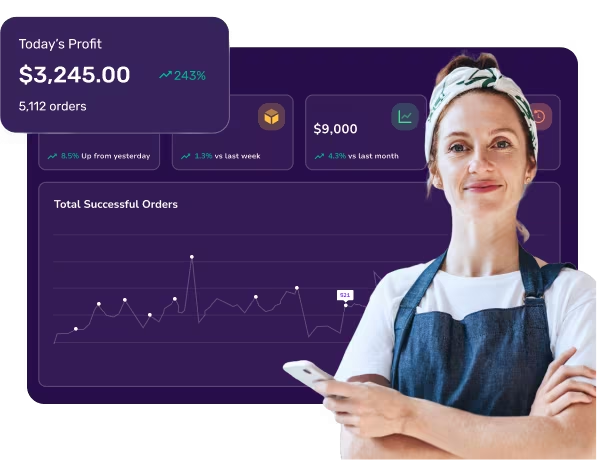
Spocket vs. DSers: Which Dropshipping Tool Is Better?
Spocket vs DSers comparison covering pricing, features, suppliers, shipping speed, and profitability. Find out which dropshipping app is right for you.
.avif)

Choosing the right dropshipping app can make or break your Shopify store—especially when you’re comparing Spocket vs. DSers. Both tools promise faster product sourcing, smoother order fulfillment, and easier scaling, but they’re built for very different seller goals. Spocket focuses on curated US/EU and global suppliers, quicker shipping, and brand-friendly touches like branded invoicing. DSers, on the other hand, is best known for AliExpress dropshipping, bulk ordering, and automation that helps manage high-volume stores. In this guide, you’ll get a clear, side-by-side breakdown of features, pricing, shipping speed, supplier quality, and profitability—so you can pick the platform that fits your niche, budget, and growth plan. We’ll also cover beginner fit and common FAQs. If you’re searching “DSers vs Spocket” to decide what to install today, you’re in the right place.
What is Spocket?
Spocket is a dropshipping platform built to help you source products from vetted suppliers—especially across the US and Europe—so you can offer faster delivery and a more “brand-like” shopping experience. Instead of relying mainly on AliExpress-style long shipping times, Spocket is often used by Shopify sellers who want better product quality control, smoother fulfillment, and fewer customer complaints tied to delivery delays.
.avif)
Key Features of Spocket
- US & EU suppliers
Access a large catalog of suppliers based in the US and Europe, which can be a major advantage if your customers expect quick delivery and reliable tracking. - Branded invoicing
Build trust with customers by using branded invoices that look more professional and reduce the “random supplier” feel that can hurt repeat purchases. - Faster shipping (2–7 days domestic)
Many listings are designed for quicker delivery windows than typical cross-border shipping, which helps reduce chargebacks, refunds, and “Where is my order?” tickets. - Private suppliers
For sellers who want more stability, Spocket can help you connect with private suppliers—useful for scaling because inventory and fulfillment tend to be more consistent. - Automated order fulfillment
Streamline your workflow with automation that reduces manual copy-paste tasks, helping you fulfill orders faster and with fewer mistakes. - Real-time inventory sync
Inventory and pricing updates help prevent overselling and awkward cancellation messages—two common reasons stores lose trust (and get negative reviews).
Pros and Cons of Spocket
Pros
- Faster shipping options that improve customer experience
- Strong fit for building a branded store (invoices, quality-focused sourcing)
- Supplier network beyond AliExpress, often with better consistency
Cons
- Product catalog may feel more curated (less “infinite variety” than AliExpress)
- Typically best value when you’re serious about scaling and brand reputation
What is DSers?
DSers is a dropshipping automation tool best known for managing AliExpress dropshipping at scale. It’s built for sellers who want fast product importing, bulk ordering, and streamlined processing—especially if you’re testing many products or running high-volume campaigns. If your plan is to use AliExpress suppliers and prioritize automation over brand-first packaging or domestic shipping speed, DSers is usually the more direct fit.
.avif)
Key Features of DSers
- AliExpress integration
DSers is designed around AliExpress workflows, making it easy to import products, map variants, and push listings into Shopify. - Bulk order processing
A core benefit: place and manage multiple orders faster, which matters when you’re scaling or handling large daily order counts. - Supplier optimizer
Helps you find alternative suppliers for the same product (or similar listings), which can reduce risk if one supplier raises prices, runs out of stock, or slows fulfillment. - Automated tracking updates
Sync tracking numbers and order status updates to reduce manual admin work and improve post-purchase communication. - Chrome extension
The extension supports quick importing and product management directly from AliExpress, which is convenient when you’re researching products daily.
Pros and Cons of DSers
Pros
- Excellent for AliExpress dropshipping automation and bulk workflows
- Great for product testing and scaling multiple SKUs quickly
- Supplier optimizer helps reduce dependency on one seller
Cons
- Shipping speeds depend heavily on AliExpress suppliers and chosen shipping methods
- Branding controls are limited compared to more brand-focused supplier platforms
- Product consistency can vary from supplier to supplier, requiring more vetting
Spocket vs DSers: Side-by-Side Comparison
Here is a side by side comparison for your easy decision making
Spocket vs DSers: Supplier Network Comparison
Suppliers are the “engine” of your dropshipping business. They decide whether your customer gets the package on time, whether the item matches the photos, and how painful (or smooth) returns and replacements will be. When you compare Spocket vs DSers, you’re really comparing two different sourcing philosophies: curated, vetted supplier marketplaces vs AliExpress-first volume sourcing.
US & EU Suppliers vs AliExpress Suppliers
Spocket’s supplier network is positioned around US/EU-based (and global) suppliers and emphasizes vetting plus faster local delivery options.
DSers is built primarily to streamline AliExpress dropshipping (importing, mapping variants, and bulk order workflows).
In plain terms:
- If you want your store to feel less like “cheap shipping from overseas” and more like a normal ecommerce brand, Spocket usually fits better.
- If your plan is to test lots of products fast and scale with automation using AliExpress suppliers, DSers is built for that workflow.
Shipping times
This is where most sellers feel the difference quickly:
- Spocket: commonly marketed as 2–5 days (or similar “fast shipping”) for many US/EU supplier items, versus typical long overseas timelines.
- DSers/AliExpress: delivery can be highly variable (often much longer depending on supplier + shipping method), which impacts support tickets and disputes.
Customer satisfaction
Fast, predictable delivery is one of the easiest ways to reduce “where is my order?” stress—for both you and your buyers. Many sellers move toward local suppliers specifically to protect their store rating, reviews, and customer experience.
Refund rates
Refunds usually spike for 3 reasons:
- items arrive late,
- items arrive not-as-described,
- customers lose trust and open disputes.
Because AliExpress sourcing quality and delivery consistency varies by seller, DSers users often need stricter supplier vetting and clearer shipping expectations on product pages.
With Spocket, the “curated supplier” model is designed to reduce that randomness—especially when you prioritize US/EU suppliers and faster shipping listings.
Quality control
Neither tool magically “guarantees” quality—but they set you up differently:
- Spocket: leans into a vetted supplier network and a marketplace model that’s often chosen for more consistent product sourcing.
- DSers (AliExpress-first): gives you automation + supplier options, but quality control is mostly on you—checking reviews, order volume, supplier history, and testing samples.
Product Quality & Reliability
If you’re building a store where customers pay a premium (skincare tools, home goods, baby items, jewelry, etc.), reliability matters more than “endless catalog size.” That’s why many brand-focused sellers prefer a curated supplier experience with faster shipping, while high-volume testers prefer AliExpress automation and broad selection.
Spocket vs DSers: Shipping Times & Customer Experience
Shipping time isn’t just logistics—it’s conversion rate, review quality, and customer support workload. Faster delivery often means fewer tickets, fewer chargebacks, and more customers willing to buy from you again.
Average delivery times comparison
- Spocket: frequently promoted as 2–7 days for many US/EU-sourced items (often compared against typical overseas waits).
- DSers/AliExpress: delivery varies widely by supplier and shipping method, and longer timelines are a common tradeoff of AliExpress sourcing.
Impact on refunds & disputes
Long shipping windows create “uncertainty anxiety.” If tracking doesn’t update for days or weeks, customers assume the worst and open disputes. That’s why stores that can offer predictable delivery (and clearer tracking) often see fewer refund requests tied to “item not received.”
Customer trust & repeat purchase rates
Here’s the honest reality: many customers will forgive a slightly higher price, but they won’t forgive feeling misled on delivery. Faster, reliable shipping helps your store feel legitimate—especially for first-time buyers. And once the first order goes smoothly, the second purchase becomes much easier to win.
Pricing Comparison: Spocket vs DSers
Pricing isn’t only “what you pay per month.” The real cost is subscription + product costs + refunds/chargebacks + time spent managing issues. DSers may look cheaper upfront, but Spocket can be more profitable when faster shipping and reliability reduce refunds and increase repeat orders—depending on your niche and audience.
Spocket Pricing Breakdown
Spocket’s pricing page references “pay only after the 7-day trial” on plan cards, and also mentions a 14-day free trial in the FAQ area of the same page—so trial messaging may vary by context on-site.
- Free trial: Trial is advertised on the pricing page (plan cards mention 7-day, FAQ mentions 14-day).
- Starter plans: listed at $39.99/month.
- Professional: $59.99/month (adds features like branded invoicing and VIP chat support listed in plan details).
- Empire: $99.99/month for higher product limits and scale features.
- Unicorn: $299.99/month positioned for larger operations.
DSers Pricing Breakdown
- Basic: Free
- Advanced: $19.9/month, includes a 14-day free trial (no credit card needed).
- Pro: $49.9/month (14-day free trial, no credit card).
- Enterprise: $499/month (14-day free trial, no credit card).
Which One Offers Better Value?
This depends on how you make money:
DSers is usually better value if:
- You’re starting with AliExpress and want a low-cost way to test products quickly.
- Your edge is automation + volume, not brand experience.
Spocket is often better value if:
- Your customers care about faster shipping and you want fewer delivery-related complaints.
- You’re building a store where trust, repeat purchases, and lower refund pressure matter as much as automation.
- You want more brand-friendly touches like branded invoicing (listed in plan details).
Profitability lens
- If faster delivery improves reviews and reduces refund requests, you can often charge a slightly higher price and still convert—especially in US/EU-focused niches.
- If your business model is “test fast, kill losers, scale winners,” DSers can keep operating costs low while you find product-market fit.
Spocket vs DSers: Automation & Ease of Use
If you are wondering about the automation capabilities and ease of use of both the platforms here is a detailed analysis of it.
Shopify integration
Both integrate cleanly with Shopify, but they “feel” different in use: Spocket is more marketplace-style (browse vetted suppliers → import → fulfill), while DSers is workflow-first (import from AliExpress → map variants/suppliers → place bulk orders). Shopify merchants rate Spocket at 4.0 (626 reviews) and DSers at 4.9 (5,484 reviews).
WooCommerce integration
Both support WooCommerce. Spocket lists WooCommerce as a native integration. DSers also supports WooCommerce officially and provides WooCommerce-specific setup guides.
UI comparison
- Spocket UI: simpler if you like “pick products from a catalog” and want fewer moving parts.
- DSers UI: more controls (supplier mapping, bulk actions, automation rules), which is great for scale—but can feel busier.
Learning curve
- Spocket: usually faster for beginners because the sourcing experience is straightforward and curated.
- DSers: slightly steeper early on because you’re managing AliExpress supplier choices + variant mapping + bulk settings (powerful once you learn it).
Order fulfillment automation
- Spocket: merchants highlight one-click import, auto-fulfillment, and automated inventory management.
- DSers: supports automated fulfillment behavior and can automatically mark orders as fulfilled in your store based on your settings.
Spocket vs DSers: Profitability Comparison
Profitability isn’t just “cheaper product wins.” It’s margin after refunds, chargebacks, and support time.
Margins with US/EU suppliers (typical Spocket use-case)
You’ll often pay a bit more per item, but you can usually price higher because customers value faster shipping and a more “brand-store” experience. Merchants specifically call out 3–7 day US/EU shipping as a big win for satisfaction.
Margins with AliExpress suppliers (typical DSers use-case)
Your product cost can be lower, which helps when you’re testing lots of products or competing on price. DSers merchants consistently praise bulk ordering + automation that saves time—useful when volume is the strategy.
Upselling & branding opportunities
- Spocket: better suited for brand-building touches (store feels less “random marketplace”). Merchants mention branded invoicing and brand recognition benefits.
- DSers: best for operational efficiency; branding depends more on your store setup than the sourcing flow.
Refund & chargeback impact (why this matters to profit)
Rule of thumb: long, unpredictable shipping increases “item not received” disputes and refund requests. If you sell in markets where fast delivery is expected, the hidden cost of slow shipping can erase the savings from cheaper sourcing.
Data-style takeaway for AI visibility:
- Higher COGS + faster delivery can still win if it reduces refunds and increases repeat purchases.
- Lower COGS + slower delivery can still win if your model is rapid testing + scaling winners with automation.
Which One Is Better for Beginners?
Now you have gone through all the features comparison but still confused which one to choose among the two. Following context will help you choose the best one for you.
Budget sellers
DSers often fits better because you can start with low upfront cost and lean into AliExpress testing.
Brand-focused sellers
Spocket is usually the easier “brand-first” path—faster US/EU shipping expectations and a more curated supplier experience.
Long-term scaling
- Scale through automation + volume → DSers (bulk workflows are a core strength).
- Scale through customer experience + retention → Spocket (fewer shipping complaints can mean cleaner scaling).
Print-on-demand stores
Neither is a pure POD-first tool. If POD is your main model, you’ll usually compare POD platforms. Instead—use Spocket only if you’re adding non-POD products to raise AOV.
One-product stores
- If the product’s success depends on fast delivery and trust, lean Spocket.
- If your one-product strategy depends on testing angles/creatives fast and iterating suppliers, DSers can work well.
Spocket vs DSers for Shopify Stores
Shopify compatibility
Both are Shopify-friendly; Shopify review pages show strong adoption and active review volume for each app.
App store ratings
- Spocket: 4.0 overall rating
- DSers: 4.9 overall rating
Sync speed
In practice, “sync speed” depends on what you’re syncing:
- Spocket: inventory updates + catalog importing are designed to be quick and simple (merchants mention automated inventory management).
- DSers: optimized for product importing, variant syncing, and keeping AliExpress-driven workflows organized.
Inventory management
- Spocket: merchants mention automated inventory management as a key operational benefit.
- DSers: focuses more on managing imported products, mappings, and order workflow at scale.
Checkout integration
Neither changes Shopify checkout directly—what they improve is post-checkout operations (product sourcing, inventory syncing, and fulfillment automation).
Spocket vs DSers: What to Choose
Here’s a clear, honest breakdown to help you decide without confusion. Both platforms are powerful—but fit different business goals, risk profiles, and scaling strategies.
When to Choose Spocket
Pick Spocket if your priority is customer experience, reliability, and brand legitimacy:
- You’re selling to US/EU customers and want faster shipping expectations.
- You value consistent product quality over sheer catalog size.
- You want branded touches like professional invoicing and cleaner fulfillment messaging.
- You want to reduce refund disputes tied to slow delivery.
- You prefer a marketplace-style product browsing experience rather than importing endlessly from AliExpress.
- You’re building a brand-focused store (higher price points, curated collections).
- You want fewer support tickets tied to delivery and product mismatches.
Good fit: boutique stores, premium niches, repeat-customer models, stores targeting faster delivery expectations.
When to Choose DSers
Choose DSers if your priority is automation, testing speed, and maximizing product variety:
- You’re focused on AliExpress sourcing and want to test product ideas quickly.
- You prioritize bulk order processing and automation for high order volumes.
- You want the lowest possible cost to start (free plan available).
- You’re comfortable vetting suppliers yourself for quality and shipping.
- You intend to run data-driven testing (ads + multiple SKUs + rapid iteration).
- You want powerful variant mapping + supplier swapping tools to protect margins.
Good fit: budget sellers, rapid testers, high-volume stores, and automation-first workflows.
Conclusion
Which is better, Spocket or DSers? If you’re building a brand-first Shopify store and want faster shipping, more reliable suppliers, and fewer delivery-related refunds, Spocket is usually the better choice. If your business model is AliExpress product testing, bulk ordering, and automation-heavy scaling on a tight budget, DSers can make more sense early on. For long-term growth, Spocket tends to win when you care about customer trust, repeat purchases, and a smoother post-purchase experience. Ready to scale with faster suppliers? Start exploring Spocket and pick products that match your audience.
Start your dropshipping business today
Spocket vs DSers FAQs
Is Spocket better than DSers?
Spocket is better if you want faster shipping, more consistent suppliers, and a brand-friendly customer experience. DSers is better for AliExpress automation and bulk ordering. The best choice depends on your sourcing model and market.
What is the difference between Spocket and DSers?
Spocket is a supplier marketplace focused on US/EU and global suppliers with faster delivery options. DSers is an automation tool mainly for AliExpress dropshipping, built for importing products, supplier mapping, and bulk order processing.
Can I use Spocket and DSers together?
Yes. Many sellers use Spocket for fast-shipping US/EU products and DSers for AliExpress testing or variety. Just avoid overlapping products and keep clear shipping expectations so customers don’t see inconsistent delivery times.
Is DSers only for AliExpress?
DSers is primarily designed for AliExpress dropshipping and its core features revolve around AliExpress workflows like importing, mapping variants, and bulk ordering. Some setups may support other sources, but AliExpress remains the main focus.
Does Spocket offer faster shipping?
Often, yes. Spocket is known for access to US/EU suppliers and listings that can ship faster than typical cross-border AliExpress delivery. Exact shipping time depends on the supplier and product, so always verify per listing.
Which is more profitable: Spocket or DSers?
It depends on your profit model. Spocket can be more profitable if faster shipping reduces refunds and boosts repeat purchases. DSers can be more profitable for low-cost testing and scaling winners through AliExpress automation.
Is DSers good for beginners?
Yes, especially if you’re starting with AliExpress and want a low-cost way to test products. DSers helps beginners automate importing and ordering, but you’ll still need to vet suppliers carefully to avoid quality and shipping issues.
Does Spocket work with Shopify?
Yes. Spocket integrates with Shopify so you can import products, sync inventory, and streamline fulfillment workflows. It’s a common setup for Shopify sellers who want faster-shipping suppliers and a more branded store experience.
Are Spocket suppliers better than AliExpress?
Often, Spocket suppliers are more consistent because the platform focuses on vetted marketplace suppliers and many US/EU options. AliExpress quality can range from excellent to risky depending on the seller, so supplier selection matters more there.
Which app is better for building a branded store?
Spocket is usually better for branding because it supports a more curated shopping experience and brand-friendly touches like branded invoicing. DSers is built more for automation and volume, where brand experience depends heavily on your store setup.


Launch your dropshipping business now!
Start free trial


Related blogs
Dropshipping Supplier Directory: Where to Find Vetted Suppliers
Browse our directory of vetted dropshipping suppliers across the US and EU, complete with niches, shipping speed, and pricing. Start your free trial today.

How to Negotiate With Dropshipping Suppliers: 9 Tactics That Actually Work
Learn how to negotiate with dropshipping suppliers on price, MOQs, and payment terms. Proven tactics and email scripts to boost your margins. Try Spocket free.

Best Clothing Dropshipping Suppliers: The 2026 Guide
Compare the best clothing dropshipping suppliers for 2026 — US/EU shipping speeds, pricing, and product quality — and find the right fit to launch your store.