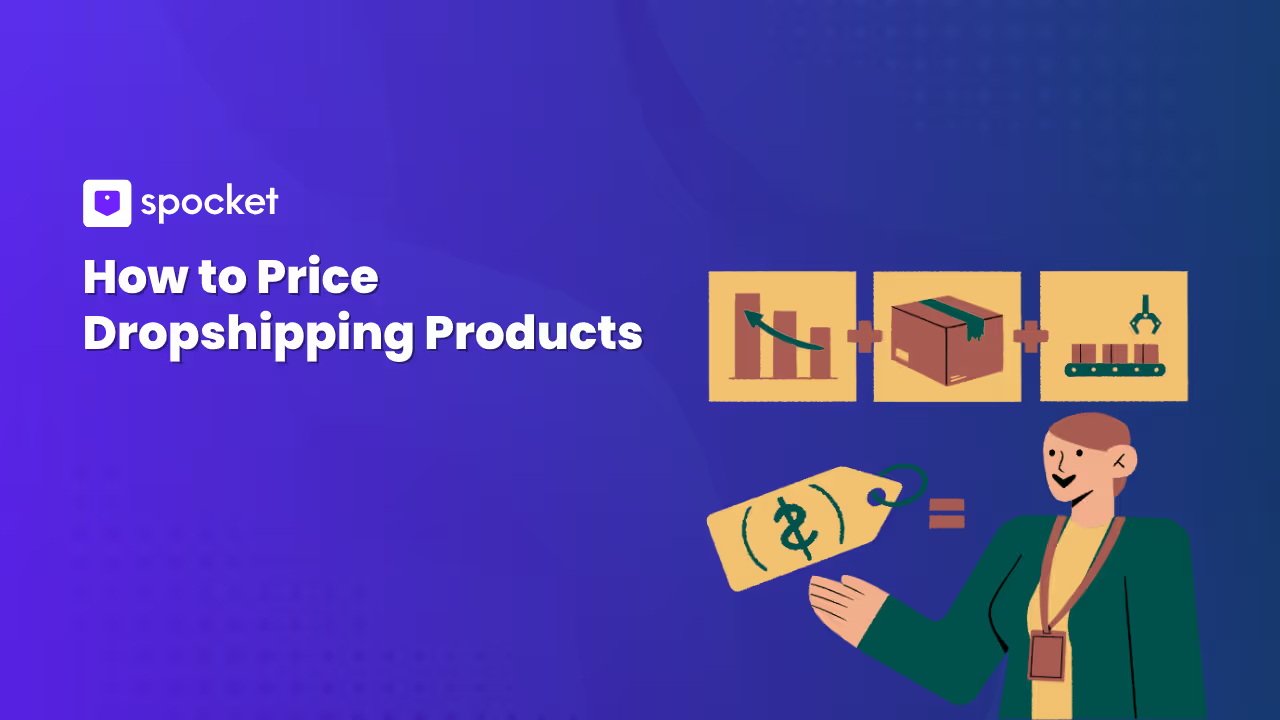
How to price my dropshipping products for 40% profit margins
Learn how to price dropshipping products for 40% profit margins. Discover proven pricing formulas, examples, and Spocket’s role in maximizing your profitability.
.avif)

Pricing your products is one of the most critical — yet often misunderstood — aspects of running a successful dropshipping business. Set your prices too low, and you’ll struggle to make a profit. Set them too high, and you’ll lose customers to competitors.
So how do you strike the perfect balance?
The secret lies in building a pricing strategy that ensures consistent profit margins — ideally around 40%. A 40% margin gives you enough breathing room to cover your expenses, absorb ad costs, and reinvest into growth while staying competitive.
In this article, you’ll learn exactly how to price dropshipping products for a 40% profit margin, step-by-step. You’ll also discover how tools like Spocket simplify cost tracking, supplier management, and margin optimization for your store.
Why Your Pricing Strategy Matters
Your pricing directly impacts how customers perceive your brand and how much profit you actually keep. Unlike traditional retail, dropshipping has extra layers of cost — such as supplier pricing, shipping, marketing, and platform fees — so guessing your prices can quickly erode your margins.
A strong pricing strategy ensures that:
- You cover every cost involved in the sale.
- You maintain consistent, predictable profits.
- You stay competitive without undervaluing your products.
- You scale your store sustainably, without cutting corners.
According to Spark Shipping, most dropshippers average a 20–30% margin. But with careful planning, better supplier selection, and regional fulfillment through platforms like Spocket, achieving 40% margins is entirely possible — especially if you focus on premium or niche products.
Understanding Margin vs. Markup
Before diving into formulas, let’s clear up two terms many new sellers mix up — profit margin and markup.
- Profit Margin is the percentage of your selling price that is profit.
- Markup is how much you increase your product’s cost to reach your selling price.
Example
If your product costs £30 and you sell it for £50:
- Profit = £50 − £30 = £20
- Margin = £20 ÷ £50 = 40%
- Markup = £20 ÷ £30 = 66.7%
So to achieve a 40% margin, you need to apply a markup of around 66% — not 40%. Understanding this distinction ensures your pricing formula actually delivers your target profit.
As AutoDS explains, knowing the difference between markup and margin is crucial because even small miscalculations can cut your profit margins in half.
The Goal: Achieving a 40% Profit Margin
A 40% margin means you’re earning 40p for every £1 you sell — after covering all costs.
This may sound ambitious, but it’s attainable when you:
- Choose the right products (ideally medium-to-high-ticket).
- Source from reliable suppliers through Spocket to reduce hidden costs.
- Implement a disciplined pricing formula that factors in all your expenses.
The formula for your selling price is simple:
Selling Price = Total Cost ÷ (1 − Desired Margin)
If your total cost is £30 and you want a 40% margin:
Selling Price = 30 ÷ 0.6 = £50
That’s your minimum viable selling price — anything lower will eat into your profit.
Step-by-Step: How to Price Dropshipping Products for 40% Margins
Let’s break the process down step-by-step so you can apply it immediately.
Step 1: Identify Your True Total Cost
Many dropshippers make the mistake of only counting their supplier’s product cost. But your total cost includes every penny you spend to sell that product.
Here’s what to include:
- Product cost from your supplier (via Spocket, for example).
- Shipping fees (to your customer or warehouse).
- Packaging and inserts (especially if you’re private labeling).
- Transaction fees from Shopify, PayPal, or Stripe.
- Marketing and ads (Facebook, Google, or influencer campaigns).
- Customer service and refunds (build a small buffer).
Pro tip: On Spocket, you can view supplier cost and shipping upfront — no hidden fees — which helps you calculate your total cost precisely.
Once you’ve added everything, label it Total Cost (C). This is the base for your pricing formula.
Step 2: Apply the 40% Margin Formula
Use the formula:
Selling Price = Total Cost ÷ (1 − 0.40)
That’s the same as multiplying your cost by 1.67 (since 1 ÷ 0.6 = 1.67).
Example:
If your total cost is $25,
Selling Price = $25 × 1.67 = $41.75
You can round this up to $41.99 to make it psychologically appealing while maintaining your margin.
This ensures that, even after paying all expenses, you keep a 40% profit.
Step 3: Research Competitor Pricing
After calculating your ideal price, benchmark it against competitors. If you’re significantly higher, find out why:
- Are competitors using cheaper suppliers?
- Is their shipping slower or less reliable?
- Do they lack branding, packaging, or service quality?
If your offer is clearly better (e.g., faster shipping from Spocket’s US/EU suppliers, premium materials, or branded packaging), your customers will gladly pay more.
Competitor research isn’t about undercutting — it’s about justifying your price through quality and value.
Step 4: Use Psychological Pricing Tactics
Small pricing tweaks can significantly affect sales.
Here are a few strategies proven to work:
- Use charm pricing (e.g., $39.99 instead of $40).
- Offer bundle discounts to increase average order value.
- Test tiered pricing (basic, standard, premium) for higher conversion.
- Highlight perceived value — instead of selling a “$30 product,” sell a “$50 product now on sale for $39.99.”
Psychological pricing doesn’t reduce your margins — it just improves your conversion rates while keeping profitability intact.
Step 5: Test and Adjust Over Time
Once your pricing is live, monitor how customers respond.
Track:
- Conversion rate (how many visitors buy).
- Cart abandonment rate.
- Profit per order after ad costs.
If your conversion rate is low, test slightly lower prices. If it’s high and you’re selling out, increase prices incrementally.
Using Spocket, you can track real-time supplier costs and automatically adjust your retail pricing to keep your desired margin intact — even if supplier rates fluctuate.
Example: A Realistic Pricing Scenario
Let’s apply everything to a real example.
Product: Bamboo desk organizer
Supplier cost (Spocket): $20
Shipping: $5
Packaging & branding: $2
Transaction fees: $1
Marketing cost per unit: $2
Returns buffer: $1
Total Cost (C) = $31
Now, apply the 40% margin formula:
Selling Price = $31 ÷ 0.6 = $51.67
Round it to $51.99 — this pricing gives you approximately a $20 profit per sale, or 40% margin.
If competitors are selling similar items for $45 but with slower shipping or generic packaging, your slightly higher price is justified by value.
How Spocket Helps You Maintain a 40% Margin
Most sellers lose margin not because they price incorrectly, but because hidden costs and unreliable suppliers eat into profits. Spocket solves both problems.

Here’s how:
Transparent Pricing and Shipping
Spocket shows exact product and shipping costs upfront, helping you make data-driven pricing decisions.
Verified US and EU Suppliers
By sourcing locally, you reduce shipping delays and refund rates — two major profit killers.
Easy Sample Testing
Order samples before you launch to verify quality and calculate real-world costs (including packaging and shipping).
Automated Inventory Sync
Spocket’s automation ensures that supplier price updates instantly reflect in your store — protecting you from sudden margin losses.
Regional Advantage
US and European customers are more likely to buy from stores offering fast local delivery, and Spocket’s supplier base gives you that edge.
With these features, Spocket helps you maintain consistent 40% margins without compromising quality or customer experience.
Common Pricing Mistakes to Avoid
Even experienced dropshippers sometimes struggle to hit their profit targets — not because their products are bad, but because their pricing strategy has blind spots. To build and maintain a 40% profit margin, you must avoid these common pitfalls that quietly eat into your bottom line.
Ignoring Hidden Costs
One of the biggest mistakes is only considering the supplier’s base cost when pricing your products. Hidden costs like marketing expenses, transaction fees, packaging, branding inserts, and refunds can easily reduce your margin by 10–15%. To stay profitable, calculate your true total cost — not just what you pay your supplier.
Copying Competitor Prices
It’s tempting to simply copy your competitors’ prices, but this is one of the most damaging habits in eCommerce. Every seller has different suppliers, costs, and shipping arrangements. Matching someone else’s price might mean sacrificing your profit without realizing it.
Instead, base your pricing on data — your actual costs, not assumptions. Use competitor analysis as a reference, not a rule. If your store offers faster delivery through Spocket’s US and EU suppliers, premium quality, or branded packaging, you can confidently charge more and still win customers.
Not Testing Prices
The market never stays still — consumer behavior, ad costs, and competitors constantly change. What worked last month may not work now. That’s why regular price testing is critical.
Test multiple price points to find your “sweet spot” — the balance between conversion rate and profitability. A small adjustment (like $49.99 instead of $44.99) can significantly affect both sales and perception.
By testing, you’ll learn what your audience truly values — and whether you can maintain your 40% margin while maximizing conversions.
Using Flat Markups
Not all products should have the same markup. A flat pricing model may simplify things, but it can kill profitability.
High-ticket items (like electronics or furniture) can work with slimmer margins because each sale generates significant revenue. Low-ticket items (like phone cases or pet accessories) need higher markups to offset transaction and shipping fees.
The best pricing strategies are tiered — adjusting markup by category, niche, and perceived value. Use Spocket’s catalog insights to analyze product demand and determine which categories can support premium pricing.
Forgetting Customer Perception
Pricing isn’t just about math — it’s also about psychology and perceived value. If you price too low, customers may assume your product is low-quality. If you price too high without justification, they’ll abandon your store.
The key is to communicate why your product is worth the price — highlight features like fast local shipping , eco-friendly packaging, or excellent customer support. The story you tell around your pricing can often matter as much as the number itself.
Avoiding these mistakes ensures your pricing remains strong, competitive, and profitable — even as market conditions shift.
Optimizing for Long-Term Profitability
Once you’ve set a solid pricing foundation, the real work begins — maintaining and improving it. Dropshipping success isn’t about setting one “perfect” price; it’s about continuous optimization based on data, experience, and customer feedback.
Here’s how to keep your margins healthy as your business grows:
Negotiate with Suppliers
As your store scales and sales volumes rise, you gain leverage. Use it to negotiate better rates or exclusive discounts with your suppliers. A small reduction in product or shipping costs can dramatically improve your margins without increasing retail prices.
Spocket’s verified suppliers are known for transparency and reliability, and many are open to bulk discounts or long-term partnerships once you build a track record. Don’t hesitate to ask — even a 5% discount can translate into thousands in annual savings.
Bundle Products
Product bundling is a proven way to boost average order value (AOV) without increasing acquisition costs. When customers buy two or more items together, you spread your marketing expenses across multiple products — improving overall profitability.
For example, bundle a pet grooming brush with shampoo, or offer “Buy 2 Get 1 Free” deals. You’ll sell more items per transaction, which helps maintain a strong 40% overall margin even if individual product margins vary.
Raise Perceived Value
Customers are willing to pay more when they perceive your product as premium. This perception comes from branding, packaging, product imagery, and communication.
Invest in better packaging, professional product photos, and consistent branding. Highlight benefits like “Ships from the USA” or “Eco-friendly packaging” — all available through Spocket’s regional suppliers. When value perception increases, you can raise prices without losing sales, improving your profit per order.
Track Metrics That Matter
Never assume your pricing is working — measure it. Regularly monitor:
- Gross profit margins
- Conversion rates
- Average order value (AOV)
- Return/refund rates
Platforms like Shopify and Spocket provide analytics that show how pricing changes affect sales and profitability. Reviewing this data monthly helps you stay agile and ensures that your business decisions are based on facts, not assumptions.
Automate Everything
As your store grows, manual pricing management becomes inefficient. Use automation tools like Spocket’s dynamic pricing to automatically sync product costs, update retail prices, and maintain consistent margins even when supplier costs fluctuate.
Automation eliminates human error, saves time, and keeps your pricing strategy consistent across hundreds of SKUs — allowing you to focus on growth and marketing instead of manual updates.
Profitability Is a Continuous Process
Long-term success in dropshipping isn’t about one-time wins — it’s about small, steady improvements that compound over time. When you regularly optimize pricing, negotiate better rates, and improve perceived value, your store becomes not just profitable but sustainable.
Conclusion
Setting the right price is the fine line between running a profitable business and running a hobby. To consistently achieve 40% profit margins, you need to start by accurately calculating all your costs — from supplier fees to marketing and fulfillment. Then, apply the right pricing formula, use psychological pricing to drive conversions, and continuously test, refine, and automate your approach.
With Spocket, you can simplify every step of this process — managing real-time product costs, automating fulfillment, and maintaining healthy profit margins without sacrificing speed or quality. Ultimately, your pricing strategy isn’t just about making money; it’s about defining your brand’s value, positioning your store for growth, and building a business that thrives sustainably. Take control today, trust your data, and start pricing smarter with Spocket.
Start your dropshipping business today
FAQs About How to Price Dropshipping Products
What’s the Best Way to Price Dropshipping Products for Profit?
The most effective way to price dropshipping products is to calculate your total cost — including product, shipping, fees, and marketing — and apply the formula Selling Price = Cost ÷ (1 − Margin). For a 40% profit margin, divide your total cost by 0.6 to set a profitable selling price.
How Much Profit Margin Should I Aim for in Dropshipping?
Most dropshippers average 20–30% margins, but with strategic sourcing, automation, and better supplier selection through Spocket, achieving 40% or higher is realistic. High-quality, niche, and branded products usually support higher profit margins.
How Can I Use Spocket to Improve My Pricing Strategy?
Spocket helps you optimize pricing by giving transparent supplier costs, regional shipping options, and real-time syncing. You can calculate accurate profit margins, avoid hidden expenses, and automate pricing updates — ensuring your store always stays profitable.
How Often Should I Review My Product Prices?
It’s best to review your pricing monthly or after any major change in supplier costs, ad spend, or market trends. Regular adjustments help you maintain your desired profit margins and stay competitive in fast-changing dropshipping markets.
What Common Mistakes Should I Avoid When Pricing Dropshipping Products?
Avoid ignoring hidden costs, copying competitor prices blindly, and using the same markup for every product. Instead, base your pricing on data, test regularly, and highlight your product’s value — especially when offering faster delivery via Spocket’s US and EU suppliers.


Launch your dropshipping business now!
Start free trial


Related blogs
Dropshipping Supplier Directory: Where to Find Vetted Suppliers
Browse our directory of vetted dropshipping suppliers across the US and EU, complete with niches, shipping speed, and pricing. Start your free trial today.

How to Negotiate With Dropshipping Suppliers: 9 Tactics That Actually Work
Learn how to negotiate with dropshipping suppliers on price, MOQs, and payment terms. Proven tactics and email scripts to boost your margins. Try Spocket free.

Best Clothing Dropshipping Suppliers: The 2026 Guide
Compare the best clothing dropshipping suppliers for 2026 — US/EU shipping speeds, pricing, and product quality — and find the right fit to launch your store.