Power of Micro-Influencers: How to Scale Your Store via Partnerships
Micro influencer marketing drives higher ROI than traditional ads. Learn where to find creators, what to pay them, and how to land deals that grow your store.

If you run a dropshipping store, you already know paid ads get expensive fast. Customer acquisition costs climb. Click-through rates drop. But there is another channel that scales without burning cash. A micro influencer with 10,000 engaged followers can drive more conversions than a celebrity with millions. Their audiences trust them like friends.
When they recommend your product, people buy. This is not a trend. It is a structural shift in how consumers shop. Here is exactly how to find, pay, and partner with micro influencer creators to scale your store in 2026.
What Makes a Micro Influencer Different in 2026?
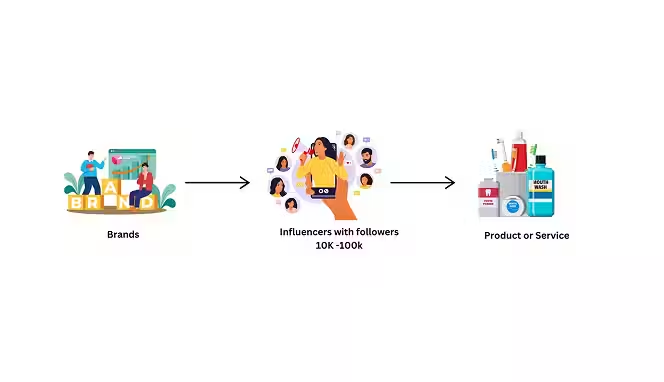
Not every creator with a phone and an account qualifies as a micro influencer. The definition has tightened as the creator economy matures. A true micro influencer sits between 10,000 and 100,000 followers. Below that threshold are nano influencers—great for hyperlocal buzz but inconsistent for scaled campaigns. Above that are macro influencers who broadcast but rarely converse.
What sets the micro influencer apart is the blend of authenticity and professionalism. They post consistently. They reply to comments. They know their audience demographics by heart. And they treat partnerships as collaborations, not paychecks.
Mackage founder Eran Elfassy put it plainly: paying celebrities to wear your stuff looks paid for. Customers sense it. A micro influencer who actually uses your product and films themselves unboxing it? That looks real. Because it is.
Where to Find Micro Influencers Without Paying for Databases
Paid influencer platforms have their place, but you do not need them to start. You need a spreadsheet, a few hours, and a clear picture of your customer.
Start with platform search. Open Instagram or TikTok. Type hashtags your ideal customer would follow. If you sell home goods, search #homedecor, #apartmenttherapy, #scandinavianhome. Scroll past the viral posts. Look for accounts posting consistently with 2,000 to 30,000 followers. Check their comments. Are people asking where to buy things? Are they tagging friends? That is your signal.
Build a list of 50 names. Include their handles, follower counts, average likes, and email if listed. Do not skip nano creators in this phase. Someone with 2,000 followers but 150 likes per post has a 7.5 percent engagement rate. A macro influencer with 500,000 followers and 2,000 likes sits at 0.4 percent. You want the 7.5 percent person.
Look for cross-platform super fans. You can spot these easily. Check if a creator’s Instagram followers match their YouTube subscriber count. If 15,000 people follow them on both platforms, those are not casual viewers. Those are fans who consume everything the creator makes. Those fans convert.
If you need to scale this process across hundreds of creators, you can use a micro influencer marketing platform like Upfluence. These tools let you filter by audience demographics, engagement thresholds, and past brand partnerships. They also centralize outreach tracking. But start manually. You will learn more about your niche in three hours of scrolling than three weeks of software demos.
Check out this list of micro influencer marketing platforms that integrate with dropshipping stores.
What to Pay Micro Influencers: Rates, Rights, and Hidden Costs
Paying creators is not guessing games anymore. The market has standardized enough to build rate bands. But you still need to account for what you are actually buying.
Base rates by follower tier. A creator with 10,000 followers might charge $100 to $200 per post. At 50,000 followers, rates typically run $300 to $600. At 100,000 followers, expect $800 to $1,500. These are starting points. Engagement and niche fit move creators between bands. A food blogger with 30,000 followers who posts about sourdough daily is worth more to a kitchenware brand than a general lifestyle creator with 80,000 followers.
Content format changes the price. A single Instagram Reel is your baseline. A multi-slide carousel with researched captions takes more work. Budget 1.5x base for that. If you need the creator to concept, script, and film a video with multiple scenes, budget 2x base. Live shopping events command 3x to 5x base because they require real-time hosting skills and schedule commitment.
Whitelisting changes everything. When a creator whitelists you, they grant permission to run ads from their account. Your ads appear as posts from the creator, not your brand. This borrows their credibility and typically doubles return on ad spend. It also costs more. Expect to pay 50 percent to 100 percent above base rates for whitelisting rights. Negotiate this upfront. Do not wait until a video goes viral and the creator knows they have you cornered.
Product-only deals still work but only in specific cases. If you are testing a new product category or a creator with under 5,000 followers, offering free product plus a discount code for their audience is acceptable. You still must disclose this as a paid partnership under FTC rules. Professional creators know their worth. If you approach a 50,000-follower creator with product only, do not be surprised when they decline.
The Micro Influencer Playbook in 2026: Step by Step
Scaling micro influencer partnerships is not about one viral hit. It is about building a bench of reliable creators who post consistently and perform predictably. Here is the process that works for dropshipping stores moving from five figures to six figures and beyond.
Step 1: Write Outreach That Respects Their Work
Cold DMs fail when they sound like copy-paste templates. You need specificity.
Here is a script that works:
Hey [first name],
My name is [your name] with [store name]. I found your page through the #homeoffice hashtag and your video comparing standing desk mats genuinely helped me pick one for my own setup.
We are launching a campaign this month featuring home office accessories that reduce clutter. I think your audience would genuinely appreciate what we make. Would you be open to a conversation about testing a few products and sharing your honest thoughts?
You would have complete creative control. We are reaching out because you already know how to make this content better than we could prescribe.
Let me know if you are open to chatting.
Do you see what this does? It names specific work. It compliments actual skill, not just follower count. It offers creative freedom. It positions the creator as the expert.
Step 2: Run a Kickoff Call That Sets Boundaries
Once a creator agrees, hop on a 15-minute video call. Do not email briefs without talking first. You need to hear how they speak about products. You need to answer their questions about shipping timelines, product specs, and brand voice.
During the call, cover three things:
- What the product does and who it is for
- The one or two key benefits you want highlighted
- The posting timeline and any exclusivity windows
Do not script their lines. Do not send bullet points of features to list. If you wanted an infomercial, you would have filmed it yourself. You partnered with a micro influencer because their voice drives sales. Let them use it.
Step 3: Create Briefs That Free, Not Constrain
After the call, send a one-page Google Doc. Include product images, key specs, and the talking points you discussed. Also include three or four examples of content they have already made that aligns with your campaign.
“We loved how you filmed your unboxing of X product. Something with that same lighting and pacing would work great for us.”
This tells the creator exactly what you want without imposing your brand voice on theirs.
Step 4: Pay Fast and Communicate Clearly
Nothing ruins a creator relationship like late payments or unclear revision requests. Pay within seven days of content delivery. If you need changes, group them into one request. Do not drip-feed feedback across three days.
When creators trust you to pay promptly and communicate cleanly, you move from vendor to preferred partner. Preferred partners get better rates, faster turnaround, and early access when creators test new products.
Step 5: Whitelist Winning Content Immediately
You will not know which posts perform until they go live. Monitor engagement and click-through rates in the first 24 hours. If a post is outperforming your projections, ask the creator to whitelist that specific piece of content. Run $50 to $100 per day in ad spend from their handle. This is where micro influencer marketing transforms from awareness channel into direct response engine.
Learn more about scaling your store through creator partnerships and paid amplification.
Brands That Built Stores Through Micro Influencer Partnerships
Obvi, a supplement brand targeting women, does not chase viral TikTok dances. They partner with fitness creators in the 15,000 to 40,000 follower range who post honest supplement reviews. Their affiliate program gives creators commission plus free product. Many creators stay with them for years, posting weekly content. This consistency built a community, not a campaign.
Grüns, a gummy vitamin brand, used SARAL to identify micro influencer creators whose audiences overlapped with their ideal customer profile. They started with 20 creators at $150 per post. After tracking which posts drove sample orders, they scaled the top performers into whitelisted ad campaigns. Their customer acquisition costs dropped 40 percent compared to Facebook-only campaigns.
Mackage took the opposite path and regretted it. They paid a celebrity six figures for a single Instagram post. The post performed below their internal benchmarks. Their team spent months negotiating the deal and coordinating the shoot. A single micro influencer campaign with 10 creators at $500 each would have cost less, reached more engaged viewers, and produced 10 unique content assets instead of one.
How Spocket Helps You Scale Micro Influencer Campaigns
Your micro influencer strategy is only as strong as your supply chain. Nothing kills a creator partnership faster than shipping delays or out-of-stock notifications. When a creator posts about your product and their followers click through to a sold-out page, you lose sales and credibility.
Spocket solves this with automated inventory management that syncs supplier stock levels to your store in real time. If a supplier runs low, your store unpublishes the product automatically. Your creators never send traffic to dead product pages.
Spocket connects you with verified US and EU suppliers who ship in 2 to 5 business days. Fast shipping is non-negotiable for Gen Z shoppers. If your delivery window stretches past a week, your repeat purchase rates drop. Spocket's supplier network keeps transit times short.
Over 500,000 entrepreneurs use Spocket to source products across 100 million catalogs. You can order samples before you pitch creators. You can white label packaging so your micro influencer partners unbox products that already carry your branding. You get branded invoicing that makes your store look established from day one.
Spocket offers a 7-day free trial on all paid plans. You can test the platform, import products, and start building your creator outreach list before you commit. No minimum order quantities. No long-term contracts.
Measuring What Matters in Micro Influencer Campaigns
Vanity metrics kill good campaigns. Likes and comments feel good but do not pay suppliers. You need to track what actually moves your store forward.
- Return on ad spend is your north star when you whitelist content. If you spend $500 promoting a creator's post and generate $1,500 in sales, your ROAS is 3x. Scale that post until performance drops. Pause everything else.
- Customer acquisition cost matters more than total spend. If a micro influencer campaign brings in customers at $15 each and your Facebook ads cost $35, you have found an efficiency gain. Shift budget toward the lower-cost channel.
- Repeat purchase rate tells you whether the creator attracted bargain hunters or loyal customers. Track cohort performance at 30, 60, and 90 days post-purchase. If customers from Creator A buy again and customers from Creator B never return, you know which partnership to renew.
- Content library value is often overlooked. Every creator partnership produces photos and videos you own the rights to. A campaign with 20 creators yields 40 to 60 pieces of content. Use these in your email flows, on your product pages, and in retargeting ads. This extends the ROI of your original spend by months.
Conclusion
Micro influencer partnerships are not a side experiment. They are a primary growth channel for dropshipping stores that want to control customer acquisition costs and build lasting brand equity. The brands winning in 2026 treat creators as distribution partners, not line items. They pay fairly, communicate clearly, and amplify winning content through whitelisted ads. They build benches of reliable creators who post consistently and perform predictably. You can start this week. Open Instagram. Search your niche hashtags. Find five creators whose work you genuinely respect. Write them a specific, respectful DM. The stores that do this consistently are the stores that scale.
Start your dropshipping business today
Micro Influencer FAQs
How many followers should a micro influencer have to be effective?
Look for creators between 10,000 and 100,000 followers. This range balances reach with authentic audience connection. Engagement rate matters more than follower count. A creator with 20,000 followers and 8 percent engagement will outperform a creator with 80,000 followers and 1 percent engagement.
Do I need a contract for every micro influencer partnership?
Yes for paid campaigns involving money or long-term exclusivity. A simple one-page agreement should outline content deliverables, posting dates, usage rights, and payment terms. For product-only exchanges, written DMs confirming the arrangement provide basic protection.
How long should a micro influencer campaign run?
Partner with creators for 3 to 6 month cycles rather than one-off posts. This gives you time to test, optimize, and scale what works. Long-term partnerships also signal to audiences that the creator genuinely likes your brand.
What platforms work best for micro influencer campaigns?
Instagram and TikTok drive the highest engagement and conversion rates for dropshipping stores. YouTube works well for detailed product reviews and tutorials but requires higher compensation due to production time. Pinterest can be effective for home decor and fashion niches.
Should I give micro influencers creative freedom or strict guidelines?
Give creative freedom with guardrails. Specify the key benefits you want highlighted and any must-mention details like shipping timelines or warranty information. Leave the visual style, tone, and format up to the creator. Their audience trusts their taste, not yours.
Can micro influencer marketing work for brand new stores?
Yes, and it often works better for new stores than paid ads. New stores lack social proof. A micro influencer endorsement transfers their credibility to your brand. Start with 5 to 10 nano and micro creators. Use their content as social proof on your site and in your ads.


Launch your dropshipping business now!
Start free trial.avif)


Related blogs
Conversion Rate Optimization Audit Checklist That Works
Run a powerful conversion rate optimization audit with this proven checklist. Improve UX, boost sales, and fix conversion leaks fast.


Social Media Giveaway Ideas and Contest Examples for 2026
Discover high-converting social media contests and giveaway ideas with real examples to boost engagement, followers, and sales.

11 Proven Free Advertising Ideas Every Small Business Should Try
Increase your brand’s visibility with these cost-free advertising tactics designed for startups and small businesses.