How to Start a Podcast: The Complete Beginner's Guide
Learn how to start a podcast from planning and equipment through publishing and promotion. This complete guide covers everything beginners need to launch a show.

Ever thought of making money by just rambling on a microphone in your spare time?
Whether you want to build a loyal audience, establish thought leadership, or simply share your passion with the world, launching a podcast show is a smart move.
This guide walks you through every step—from planning your concept to publishing your first episodes.
How to Start a Podcast Step-by-Step
You don't need expensive equipment, technical expertise, or an existing audience. With clear direction and the right approach, you can create a podcast that resonates with listeners. Read our guide to learn how to start a podcast and monetize your audio content.
Now, if you are serious and ready about launching your first podcast, follow these steps below.
Step 1: Define Your Podcast Topic and Purpose
Before you touch any equipment, get crystal clear on what your podcast is about. Your topic is the foundation of everything that follows. If you start a podcast without a focused direction, you'll struggle to stay consistent and attract the right audience. Spend time thinking about subjects you could discuss for dozens of episodes without losing interest. The best podcast topics are ones you're genuinely passionate about—your enthusiasm will come through in every episode.
Consider your end goal. Are you starting a podcast to generate leads for your business? Build a community around a shared interest? Position yourself as an expert in your field? Or simply entertain people during their commute? Your purpose shapes your content strategy, episode length, and promotion approach.
Finding Your Niche
Avoid broad topics that try to appeal to everyone. "Self-improvement" is too wide. "How to build morning routines for remote workers over 35" is specific and searchable. When you narrow down your focus, you attract a more engaged audience. These listeners become devoted fans because you're speaking directly to their needs.
Research your potential topic using tools like Spotify Charts, Google Trends, and Reddit. Search for communities discussing similar subjects. Join those groups and listen to how people talk about these topics. This research helps you understand whether real demand exists and how you should frame your show.
Clarifying Your Why
Your "why" keeps you motivated when recording feels like a chore. It's also the reason your audience should tune in. Be honest about your motivations. Maybe you want to help people solve a specific problem. Maybe you want to network with industry leaders. Maybe you simply love talking to interesting people. Whatever your reason, let it guide every decision moving forward.
Step 2: Know Your Audience Inside and Out
Building a podcast without understanding your audience is like throwing darts blindfolded. You might get lucky, but you won't hit your target consistently. Take time to define exactly who you're creating for—not just their interests, but their habits, pain points, and what they value.
Ask yourself these questions: How old are your listeners? What's their profession? What problems are they trying to solve? Where do they spend time online? What tone resonates with them—formal and educational, casual and humorous, or somewhere in between? The more specific you get, the better you can tailor your content.
Researching Your Listeners
Talk to potential listeners before you launch. Post questions in relevant Facebook groups or Reddit communities. Conduct informal surveys with friends and colleagues. This feedback shapes your episode topics, guest selection, and even your show's tone. When you understand what your audience actually wants—not what you think they want—your content hits harder.
Your goal isn't necessarily the largest audience. Ten thousand passionate listeners who hang on your every word are worth far more than one hundred thousand casual listeners who skip episodes. Build for depth, not breadth.
Step 3: Choose Your Podcast Format and Structure
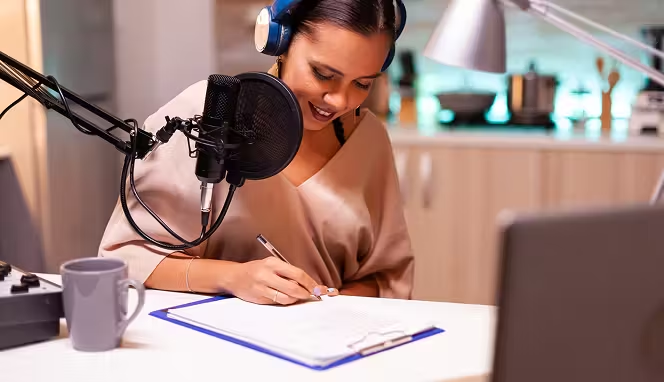
How you deliver your content matters as much as what you're saying. Different formats work better for different topics. An interview show about career transitions looks totally different from a solo-host narrative podcast about true crime. Choose a format that plays to your strengths and suits your content.
Popular Podcast Formats
Here are some of the best podcast formats we recommend:
Solo host monologue
You're the only voice. This works well for personal essays, educational content, or storytelling. You have complete control and consistency, but you shoulder the entire production load.
Co-hosted show
Two hosts or more add dynamic conversation and chemistry. Co-hosts can bounce ideas off each other, which often feels more natural than solo hosting. You also split the workload. The trade-off is coordinating schedules and managing different personalities.
Interview format
Bring on guests each episode. This format brings fresh perspectives and can attract listeners from your guests' networks. Interviews require more prep and scheduling, but they're among the most popular podcast formats.
Narrative or storytelling
Tell a larger story across multiple episodes. Documentary-style podcasts often use interviews, archival audio, and music to build a narrative arc. This format demands more production time upfront but can be incredibly engaging.
Panel discussion
Gather a group to debate or explore a topic. Panel shows work well for shows about entertainment, sports, or current events. They generate natural conversation, though managing multiple speakers requires practice.
Our tip: Pick one format to start, but you don't have to stick with it forever. Some successful podcasters blend formats—sometimes solo, sometimes interviews, sometimes co-hosted. Consistency matters more than perfection.
Setting Your Episode Length
How long should episodes be? More than half of podcasts run over 30 minutes, but that doesn't mean you should. The right length depends on how much value you can deliver without filler. Match your length to your publishing schedule. If you release weekly, aim for 30 to 50 minutes. If you publish monthly, you can go longer. If you post multiple times per week, shorter episodes (15 to 20 minutes) work better.
Don't add content just to hit a time target. Listeners quit when episodes drag. Keep them short and focused. A 25-minute episode packed with value outperforms a 50-minute rambling session every time.
Planning Your Episode Structure
Every episode needs a clear structure. Start with a hook that grabs attention in the first 30 seconds. Skip the small talk—jump into your content. Nobody cares about the weather or what you had for breakfast. Hit them with something interesting immediately.
Follow your hook with the main content (interviews, storytelling, educational material, or whatever your format demands). Include a clear conclusion that ties everything together and leaves the listener with something to think about or act on. End with a call to action—ask them to subscribe, leave a review, share an episode, or visit your website. Close with an outro that signals the episode's end.
Step 4: Plan Your Show's Brand Identity
Your podcast needs a strong name that's easy to remember, spell, and search for. The name should hint at what your show is about without being too vague. "The Marketing Show" tells people nothing. "Marketing for Bootstrapped SaaS Founders" immediately tells people what they're getting.
Check whether your chosen name is available on Spotify, Apple Podcasts, and major platforms. Register the domain name if possible. Claim the social media handles. If you can't get an exact match, adjust your name before investing in branding.
Creating Visual Assets
Podcast cover art is the first thing potential listeners see. Your artwork should reflect your show's tone and topic. If your podcast is about luxury travel, your cover should look polished and high-end. If it's casual and funny, your art should feel approachable. Use tools like Canva to design your own cover, or hire a designer on Fiverr or 99designs if you have the budget.
Design your cover at 3000 × 3000 pixels, keep it under 500 KB, and save it as JPG or PNG. This size works across all major platforms without issues. Include your podcast name prominently in the cover art because many apps display only the cover without the title.
Selecting Intro and Outro Music
Music shapes your listeners' first impression. A distinctive theme tune makes your show immediately recognizable. Use royalty-free music from sites like Epidemic Sound, Artlist, or Free Music Archive. Avoid copyrighted tracks unless you've obtained proper licenses. Many podcasters hire composers on Fiverr to create original intros that perfectly match their show's vibe. Music doesn't need to cost hundreds of dollars—budget options work great for beginners.
Step 5: Invest in Basic Equipment
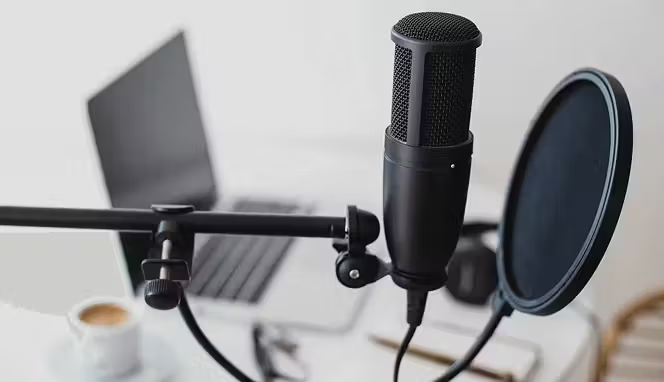
You can technically start a podcast with just your phone and free software, but basic equipment dramatically improves audio quality. Good audio separates amateur podcasts from professional ones. Invest smart, not expensive.
Essential Equipment
You can start for under $200. Skip expensive gear until you know your show will stick around.
Here’s some basic stuff we recommend getting:
Microphone
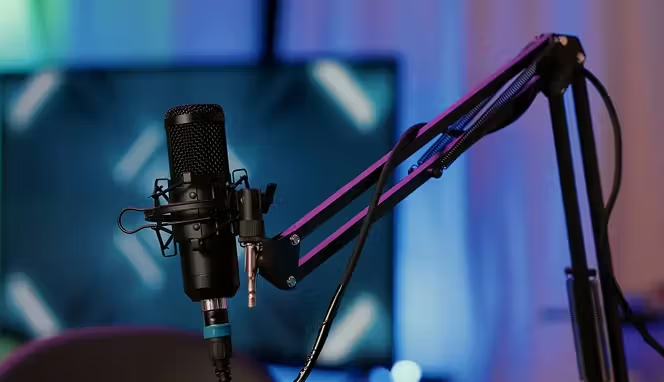
This is your biggest investment. USB microphones like the Blue Yeti, Audio-Technica AT2020USB, or Rode NT1 work perfectly for beginners. They plug directly into your computer, require no extra gear, and sound professional. Budget $60 to $150. If you go with an XLR microphone, you'll need an audio interface to connect it to your computer, which adds cost and complexity.
Headphones
Closed-back headphones let you hear yourself during recording without audio bleeding into your microphone. Good options like Audio-Technica ATH-M20x cost around $50 to $70. Wired headphones are better than wireless to avoid connection drops.
Pop filter
This inexpensive accessory ($10 to $20) sits between you and your mic, reducing harsh "P" and "B" sounds. It's one of the easiest ways to improve audio quality.
Microphone stand
Keep consistent mic positioning during recording. Arm stands or desk stands ($20 to $40) let you maintain proper distance from the mic.
Recording space
This costs nothing but matters hugely. Find a room with minimal echo—a bedroom with soft furnishings beats a bathroom with tile. If your space is noisy, add blankets, foam panels, or bookshelves to absorb sound.
Step 6: Choose Your Recording and Editing Software
Recording and editing software doesn't need to be complicated. Look for tools that handle recording, editing, and exporting without overwhelming you with features.
For beginners, consider these options:
- Riverside.fm lets you record remote interviews with high quality. Everything records locally on each person's device, so quality stays crisp regardless of internet connection. It includes an AI-powered editor that lets you edit by deleting text from a transcript.
- Audacity is completely free. It's powerful but has a steeper learning curve for beginners. Tutorials online can help you get up to speed.
- GarageBand (Mac users only) is free and intuitive. It's not designed for podcasting, but it works for simple editing projects.
- Descript combines recording, editing, and transcription. Edit audio by editing text. Filler word removal happens automatically. It's not free, but it saves enormous amounts of editing time.
Pick software based on your budget and technical comfort. Don't overthink this—you can always switch later.
Step 7: Record Your First Episodes
Before you launch publicly, record at least three to five episodes. This buffer keeps you consistent when life gets busy. Plus, early episodes help you find your voice and rhythm.
Set up a quiet space free from distractions. Position your microphone 2 to 4 inches from your mouth at a 45-degree angle. Test your levels before each recording session. Speak clearly and naturally, as if talking to a friend sitting across from you. Don't rush. Pause for emphasis.
If you mess up a line, pause, then re-record it. You'll edit these fixes out later. Imperfection is normal and expected—embrace it.
Step 8: Edit Your Episodes for Polish
Great editing separates amateur podcasts from professional ones. You don't need to edit for perfection, but you do need to edit for clarity and pace.
Remove obvious mistakes, long silences, and filler words like "um" and "uh" (many editing tools do this automatically now). Balance volume levels so no one is suddenly too loud or soft. Add intro and outro music. Include chapter markers if your hosting platform supports them.
Don't over-edit. Some silence and natural pauses make podcasts sound real and conversational. Listeners connect with authenticity, not artificial perfection.
Step 9: Write a Compelling Show Description
Your podcast description is your sales pitch. Write it as if you're describing the show to a friend who might not know whether it's for them. Explain what listeners get from your show. Who is it for? What problems does it solve? What makes it different? You can use Smartli’s AI tools to get some help with this.
Step 10: Choose a Hosting Platform and Publish
A podcast hosting platform stores your audio files and distributes them to Spotify, Apple Podcasts, and other listening apps. Major platforms include Buzzsprout, Podbean, Transistor, Anchor (now Spotify for Podcasters), and Simplecast. Pick a platform with good analytics, easy RSS feed submission, and customer support.
When you upload your first episode, fill in all metadata: episode title, description, guest information, and tags. These details help your podcast get discovered. Write show notes that summarize the episode and include timestamps for key topics.
Submit your show to major directories: Apple Podcasts, Spotify, YouTube, Google Podcasts, and Amazon Music. Each platform may require a separate submission, though many hosting services handle this automatically. Approval usually takes a few days to two weeks. Once approved, new episodes auto-distribute to each platform when you upload them.
Step 11: Promote and Grow Your Audience
Publishing an episode is just the beginning. Promotion determines whether your podcast grows or disappears. Here are some actions you can take to see instant results:
- Share on social media: Create short clips from your episodes and post them to Instagram, TikTok, and YouTube. Include a link to the full episode. These clips give people a taste and drive traffic to your show.
- Build an email list: Encourage your listeners to sign up for a newsletter with bonus content, early access to episodes, or transcripts. Email marketing is your most direct line to your audience.
- Guest swaps: Appear on other podcasts in your niche. You'll expose your show to new audiences through cross-promotion.
- Engage with listeners: Reply to comments, reviews, and messages. A small audience that feels heard becomes a loyal fan base. Don’t ignore DMs.
Conclusion
How to start a podcast comes down to choosing a topic you love, understanding who needs to hear it, and committing to consistent publication. Equipment matters less than content quality and audience engagement.
Start simple, improve over time, and enjoy the process. Your unique voice is your greatest asset—no fancy studio or expensive gear can replicate it.
Spend time talking about what you love. Don’t force it. Because it’s meant to be fun!
Launch your first episode this week. If you’re struggling to come up with a good name for your podcast show, try out our business name generator to take inspo!
Start your dropshipping business today
How to Start a Podcast FAQs
What's the cheapest way to start a podcast?
You can start completely free using your phone, free software like Audacity, and a free hosting platform like Anchor (Spotify for Podcasters). Audio quality won't be perfect, but it's possible. Most beginners spend $100 to $200 on a basic USB microphone and headphones for much better results.
How often should I release new episodes?
Choose a schedule you can sustain long-term. Weekly works best for building momentum, but twice monthly is fine if that's realistic for you. Consistency matters more than frequency. Missing a scheduled release disappoints listeners and breaks the habit you're building.
Do I need a co-host or guest interviews?
No. Solo-host shows work perfectly if you have enough to say. Co-hosts and guests add variety and take pressure off you to carry every episode alone. Try solo first, then experiment with guests once you're comfortable recording.
How do I find guests for my podcast?
Reach out to people in your network or industry. Start with relationships you already have. Use Twitter and LinkedIn to find experts relevant to your topics. Explain why they'd be good guests and how their expertise benefits your audience. Most people are happy to talk about their work if you make a thoughtful pitch.
Can I make money from my podcast?
Yes, but it takes time. Once you build an audience of several thousand listeners, sponsorships become possible. You can also earn through affiliate marketing, listener donations, selling courses or products, or premium subscriber-only content. Most new podcasts don't make money in their first year—focus on audience first.
What's the difference between audio and video podcasts?
Audio podcasts are distributed through podcast apps and listeners can consume them while doing other things. Video podcasts (often called vodcasts) are posted to YouTube and similar platforms. Many successful shows release both formats. Start with audio to simplify production, then add video later if you want.


Launch your dropshipping business now!
Start free trial.avif)


Related blogs
How to Set Up Automated Order Fulfillment With Spocket and Shopify
Set up a smoother Shopify dropshipping workflow with Spocket by connecting your store, importing products, processing orders, syncing tracking, and reducing manual fulfillment tasks.

How to Open a Business Bank Account for Your Dropshipping Store
Set up your dropshipping finances the right way with a dedicated business bank account built for payouts, supplier payments, taxes, and long-term store growth.
Spocket vs Dropified: Which Tool Is Better for Multi-Store Scaling?
Compare Spocket and Dropified for multi-store dropshipping, supplier quality, automation, fulfillment, product sourcing, and scaling across ecommerce platforms.