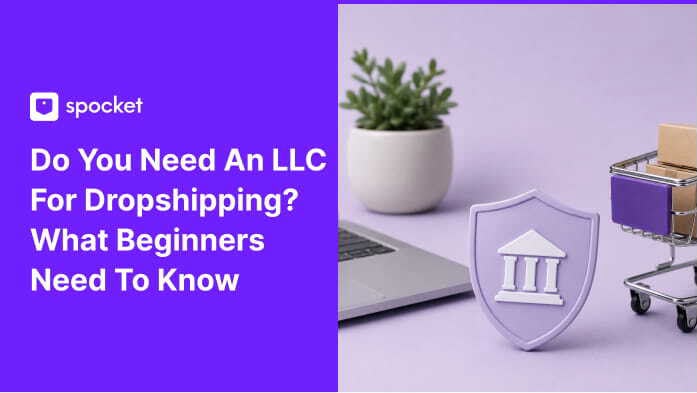
Do You Need an LLC for Dropshipping? What Beginners Need to Know
An LLC can protect your personal assets, but do you really need one on day one? We break down the costs, risks, and timing for dropshipping store owners.

You're setting up your store, picking products, maybe even running your first ads. Then someone in a Facebook group or a YouTube comment says, "You need an LLC before you do anything else." So now you're stressed. Are you breaking the law? Are you about to get sued? Is the IRS going to show up at your door?
Here's the short answer: no, you don't legally need an LLC to start a dropshipping store. Thousands of people launch and run profitable stores as sole proprietors without ever forming a business entity. But that doesn't mean you should ignore the question forever. An LLC exists for a reason. It protects your personal stuff if things go sideways. And in dropshipping, where you don't control the product quality or the shipping, things can go sideways.
Let's walk through what an LLC actually does, when it makes sense to form one, and how to do it without overcomplicating your life.
What Is an LLC and Why Would a Dropshipper Need One?
.webp)
An LLC, or Limited Liability Company, is a business structure that separates your personal assets from your business assets. If your store gets sued, the person suing can only go after what the business owns. Not your car, not your house, not your personal bank account. That's the big draw.
For a dropshipper, the liability risks are real. A customer claims your product caused an injury. A supplier ships a counterfeit item and the brand owner comes after you. A payment processor decides you've had too many chargebacks and freezes your account. Without an LLC, you're personally on the hook. With one, the business takes the hit.
There's also a tax angle. An LLC doesn't change how you're taxed by default, it's still pass-through income. But it does give you the option to elect S-Corp status later, which can save you money on self-employment tax once your store is generating solid profit.
When Should You Actually Form an LLC?
You don't need one on day one. If you're testing products, spending $50 on ads, and still figuring out if this whole thing works, forming an LLC is premature. The paperwork and fees aren't worth it when you haven't validated your store yet.
The right time to form an LLC is when one of three things happens. Your store is generating consistent monthly revenue, let's say $1,000 or more. You're selling products that carry any kind of physical risk, supplements, skincare, electronics, anything a kid might put in their mouth. Or you're running paid ads at a scale where chargebacks and disputes are a regular occurrence.
For most beginners, that means you can safely run as a sole proprietor for the first few months. Focus on finding products that sell, building a brand, and getting your operations smooth. Once you've got traction, then protect what you've built. If you're sourcing products from dropshipping suppliers , you're already on the right track because vetted suppliers reduce your risk. But no supplier eliminates risk entirely.
The Risks of Running a Dropshipping Store as a Sole Proprietor
Running as a sole proprietor is the default. You open a store, you start selling, the government considers you a sole proprietor whether you filed any paperwork or not. It's simple. No formation fees, no annual reports, no separate tax return. Just a Schedule C on your personal return.
The downside is that you and your business are legally the same person. A lawsuit against your store is a lawsuit against you. Your personal savings, your home equity, your future wages, all exposed.
In dropshipping, lawsuits aren't theoretical. They happen. Maybe a customer has an allergic reaction to a beauty product you sold. Maybe a supplier used a copyrighted image and you get a demand letter. Maybe a chargeback spiral gets your merchant account terminated and you're left holding unpaid supplier invoices. An LLC puts a wall between those problems and your personal life.
There's also a credibility factor. Some suppliers and payment processors prefer to work with registered businesses. Spocket doesn't require an LLC, suppliers on the platform work with sole proprietors just fine. But as you scale, having an EIN and a business bank account makes you look more professional.
How an LLC Protects Your Personal Assets?
The protection isn't automatic. You have to maintain the LLC properly. That means a separate bank account for business transactions, no mixing personal and business funds, and signing contracts in the LLC's name, not your own. If you blur those lines, a court can "pierce the corporate veil" and go after your personal assets anyway.
But done right, the LLC means that if your store gets sued and loses, the judgment is limited to what the business owns. Your business bank account, your inventory, your store domain. Your personal checking account, your retirement fund, your house stay untouched.
For a dropshipping store doing $5,000 or $10,000 a month in revenue, that protection is worth the few hundred dollars it costs to form and maintain the LLC. For a store doing $200 a month in its first month, it's probably overkill.
LLC and Taxes: What Changes and What Doesn't
By default, a single-member LLC is taxed exactly like a sole proprietorship. You report income and expenses on Schedule C. You pay self-employment tax on your net profit. The LLC itself doesn't pay taxes or file a separate federal return. So forming one doesn't change your tax bill.
What it does change is your options. Once your store is profitable enough, you can elect S-Corp status. That lets you pay yourself a reasonable salary and take the rest as distributions, which aren't subject to self-employment tax. The savings can be significant on net profits above $60,000 or so. But it adds payroll complexity. You'll need a payroll service and quarterly filings. Not worth it at lower income levels.
You'll also likely need to register for sales tax in states where you have nexus. An LLC doesn't change your sales tax obligations, but it does make the registration process cleaner since you'll have an EIN.
Start your dropshipping business today
Sign up on Spocket Free
How to Set Up an LLC for Your Dropshipping Store?
The process isn't complicated, but it varies by state. In most states, you can file online in under an hour. Here's the general flow.
- Pick your state. Most dropshippers form in the state where they live. Some form in Delaware or Wyoming for privacy or tax reasons, but for a small store, your home state is fine. You'll need to register as a foreign LLC if you form in one state but operate in another.
- Choose a name. It has to be unique in your state and include "LLC" or "Limited Liability Company." Check your state's business registry to make sure the name is available. Also check that the domain and social handles are available if you want them to match.
- File Articles of Organization. This is the main formation document. You fill it out online, pay the filing fee (usually $50 to $500 depending on the state), and the state processes it. California is on the expensive end. Arizona and Kentucky are cheaper.
- Get an EIN from the IRS. Free, takes five minutes online. You'll need this to open a business bank account.
- Create an Operating Agreement. Even for a single-member LLC, this document spells out how the business is run. Some states require it, but even if yours doesn't, having one strengthens your liability protection.
- Open a business bank account. This is non-negotiable. Never run business transactions through your personal account after forming an LLC.
- Register for sales tax if needed. Check your state's requirements. If you have nexus, you'll need a seller's permit.
- Annual requirements will vary by state. Some require an annual report and a fee. Others have a franchise tax. California, for example, has an $800 minimum annual franchise tax. Factor these ongoing costs into your decision.
Do You Need an LLC to Work with Dropshipping Suppliers Like Spocket?
No. Spocket doesn't require an LLC or any formal business structure. You can sign up, browse the catalog, and start selling as a sole proprietor. The platform cares about the quality of your store and your orders, not your legal structure.
What an LLC does give you, though, is a cleaner setup when you're ready to scale. Branded invoicing, which Spocket offers on higher plans, looks more professional when it's issued by a registered business. Payment processors sometimes offer better terms to registered businesses. And if you're ordering samples or placing bulk orders, having a business bank account and EIN makes the accounting cleaner.
Other Business Structures for Dropshippers
An LLC isn't your only option. Here's how the other structures compare.
- A sole proprietorship is the default. No paperwork, no fees, no separation between you and the business. It's fine for the testing phase. The risk is entirely yours.
- An S-Corp isn't a separate entity type but a tax election you make after forming an LLC or corporation. It can reduce self-employment tax on higher profits. The trade-off is more paperwork and payroll requirements. It becomes worth considering around $60,000 to $80,000 in annual net profit.
- A C-Corp is a separate tax-paying entity. The corporation pays taxes on its profits, and then you pay taxes again on dividends. For a small dropshipping store, this double taxation almost never makes sense. C-Corps are for businesses planning to raise venture capital or go public.
For the vast majority of dropshippers, the choice is between sole proprietor for the early days and LLC once the store has traction. You don't need to overthink it.
Common Mistakes Beginners Make with LLCs
Forming too early is the biggest one. I've seen people spend $800 on a California LLC before they've made a single sale. They pay the annual franchise tax for two years while the store never takes off. That's money that could have gone toward product testing and ads. Make sales first. Then form the LLC.
Forming in the wrong state is another. Unless you have a specific reason, like your home state has very high fees and you're willing to register as a foreign LLC, form in the state where you live and operate. The tax savings from Delaware or Wyoming are minimal for a small online business, and the extra paperwork usually isn't worth it.
Not separating finances is the one that kills your liability protection. If you form an LLC but keep using your personal checking account for business, a court can ignore the LLC and go after you personally. Open a business bank account the same week you get your EIN. Move all business transactions there.
Forgetting about ongoing compliance. Your LLC doesn't just exist forever once you file. Many states require an annual report and a fee. Missing those can dissolve your LLC or cost you in penalties. Set a calendar reminder.
Assuming an LLC protects you from everything. It doesn't. If you personally commit fraud, an LLC won't save you. If you personally guarantee a loan, you're still on the hook. The LLC protects against business debts and lawsuits, not your own bad actions.
How to Decide if Now Is the Right Time?
Ask yourself three questions. Am I making consistent sales? Is my store generating at least $1,000 a month in revenue? Am I selling products that could cause harm if something went wrong? If the answer to any of those is yes, it's probably time.
If you're still in the testing phase with no consistent revenue, keep things simple. Run as a sole proprietor, focus on finding winning products, and revisit the LLC question once you've got traction. The legal protection isn't doing much for you if there's nothing to protect yet.
When you do decide to form one, don't let the process intimidate you. It's a few hours of paperwork and a few hundred dollars in most states. You don't need a lawyer for a simple single-member LLC. Most states have straightforward online filing systems.
Conclusion
You don't need an LLC to start dropshipping, but you'll want one once your store is making real money or selling products with any risk. The protection it offers, the tax flexibility it unlocks, and the credibility it adds are worth the cost and effort when the time is right. Until then, focus on building something worth protecting. Get your store up, find products that sell, and make your first few thousand dollars.
Just don't delay starting your store because you think you need an LLC first. Use Spocket's free plan or trial, list some products, and make a few sales. Once you've proven the concept, then formalize it. Start your free trial with Spocket and get the store running before you worry about the paperwork.
Do You Need an LLC for Dropshipping? What Beginners Need to Know FAQs
Can I start a dropshipping store without an LLC?
Yes. You can operate as a sole proprietor from day one with no legal paperwork. The government automatically considers you a sole proprietor when you start a business. You can open a store, list products, and collect payments without forming an LLC.
At what income level should I form an LLC?
There's no fixed dollar amount, but a good rule of thumb is when your store consistently generates $1,000 or more per month in revenue, or when you start selling products that carry any physical liability risk. Some owners wait until $3,000 to $5,000 per month before forming.
How much does it cost to form an LLC?
State filing fees range from $50 to $500 depending on the state. California has an additional $800 minimum annual franchise tax. Most other states have lower annual fees, typically $0 to $100. You can file yourself without a lawyer for just the state fee.
Does an LLC reduce my taxes?
By default, no. A single-member LLC is taxed the same as a sole proprietorship. But forming an LLC gives you the option to elect S-Corp taxation later, which can reduce self-employment tax on profits above roughly $60,000.
Do I need a separate bank account for my LLC?
Yes. Mixing personal and business finances can cause a court to disregard your LLC's liability protection. Open a dedicated business checking account as soon as your LLC is formed and route all business transactions through it.
Will forming an LLC in Delaware or Wyoming save me money?
For most small dropshipping stores, no. The tax benefits are minimal and you'll still need to register as a foreign LLC in your home state, which adds costs and paperwork. Form in the state where you live and operate.


Launch your dropshipping business now!
Start free trial.avif)


Related blogs
Dropshipping Supplier Directory: Where to Find Vetted Suppliers
Browse our directory of vetted dropshipping suppliers across the US and EU, complete with niches, shipping speed, and pricing. Start your free trial today.

How to Negotiate With Dropshipping Suppliers: 9 Tactics That Actually Work
Learn how to negotiate with dropshipping suppliers on price, MOQs, and payment terms. Proven tactics and email scripts to boost your margins. Try Spocket free.

Best Clothing Dropshipping Suppliers: The 2026 Guide
Compare the best clothing dropshipping suppliers for 2026 — US/EU shipping speeds, pricing, and product quality — and find the right fit to launch your store.