Affiliate Marketing on Instagram
Learn how Instagram affiliate marketing works, how to add affiliate links the right way, create high-converting content, stay compliant, and track results.

.avif)

Instagram affiliate marketing is one of the simplest ways to turn content into income—without creating your own product, handling inventory, or dealing with customer support. You recommend products your audience already wants, share a trackable link or code, and earn a commission when someone buys.
But here’s the part most guides skip: Instagram is not a “link-first” platform. It’s a trust-first platform. People buy because they trust you, not because they saw a link. So if you want affiliate revenue that’s consistent (not random spikes), you need a repeatable system: the right niche, the right offers, the right content formats, and the right tracking.
This guide walks you through exactly how to do affiliate marketing on Instagram—from beginner setup to advanced optimization—so you can build a long-term income stream.
What is Instagram affiliate marketing?
Instagram affiliate marketing is a model where creators (or businesses) promote a product or service on Instagram and earn commission when followers purchase through their tracked link, code, or in-app affiliate tools.
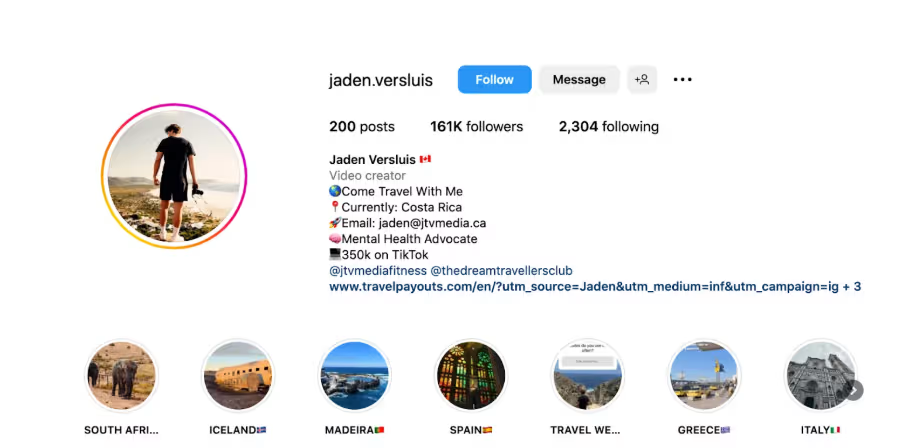
Depending on your setup, you might earn through:
- A unique affiliate link (tracked by the brand or affiliate network)
- A promo code (tracked at checkout)
- In-app affiliate features (where available), where creators earn commission on eligible purchases from tagged content or a shop experience
The result is the same: you get paid for the sales you influence.
Why Instagram works so well for affiliate marketing
Instagram is built for product discovery. People come to:
- get ideas (“what should I buy?”)
- compare options (“what’s the best?”)
- watch demos (“how does it look in real life?”)
- follow recommendations (“what does this creator use?”)
Affiliate marketing fits that behavior perfectly—especially when your content shows the product in action (Reels, Stories, carousels) and makes buying feel like a natural next step.
A practical advantage is that you don’t need celebrity-level followers. Many creators do well by going niche and serving a specific audience consistently, which tends to produce higher conversion rates.
How Instagram affiliate marketing works (the full funnel)
To make this predictable, think in funnels—not posts.
Step 1: Attention (stop the scroll)
Your content earns attention with:
- a strong hook (first 1–2 seconds on Reels)
- a relatable problem
- a visual “before/after”
- a clear promise (“I tested 3 options…”)
Step 2: Trust (why your recommendation matters)
Trust comes from:
- specific experience (not generic claims)
- honest trade-offs (pros AND cons)
- consistency (you show up in one niche)
Step 3: Action (make buying easy)
Instagram limits clickable links in many places, so the “action” step typically happens through:
- Story link stickers
- link-in-bio pages
- pinned comments (to direct people to bio)
- product tagging/affiliate tools where available
Step 4: Tracking (know what’s working)
If you don’t track, you’ll repeat the wrong things. Tracking tells you:
- which content format converts best
- which offer fits your audience
- where drop-offs happen (clicks vs purchases)
What you need before you start
You can start with almost nothing, but these basics make it far easier.
Switch to a Professional account
Use a Creator or Business account so you can access Insights and performance analytics (reach, plays, profile activity, etc.). Instagram Insights is tied to professional accounts.
Pick one niche (don’t go broad)
Broad accounts struggle because recommendations feel random. A niche account wins because followers know what to expect.
Examples of profitable niches:
- skincare for sensitive skin
- home gym + fat loss routines
- minimalist men’s fashion
- small apartment organization
- ecommerce + product sourcing tips
Choose “buyer-friendly” product categories
Affiliate offers work best when:
- the product solves an obvious problem
- the price matches your audience
- the value can be demonstrated visually (perfect for Instagram)
How to choose affiliate programs for Instagram
There are two common paths:
Option A: Direct brand affiliate programs
You apply directly with brands and get:
- a custom link or code
- commission rate details
- a dashboard for tracking
Best for: creators in a specific niche who want long-term brand relationships.
Option B: Affiliate networks / platforms
Networks give you access to many brands in one place and handle tracking.
Best for: creators who want variety or are testing multiple niches.
Selection checklist
- Do they offer link + code tracking?
- Are payouts consistent (payment method + schedule)?
- Is the product return rate high? (returns can reduce commission)
- Is the product allowed on Instagram? (no restricted categories)
- Do they provide creative assets (images, landing pages, guidelines)?
Where to put affiliate links on Instagram
Instagram doesn’t let you place clickable links everywhere, so placement strategy matters more than people think.
1) Story link sticker (high-intent traffic)
Stories are one of the best places for affiliate marketing because:
- it’s immediate
- it feels personal
- you can build “micro funnels” with multiple frames (problem → demo → link)
Pro tip: Don’t drop a link on the first frame. Warm it up:
- Call out the problem
- Show the solution
- Add the link sticker with a clear CTA (“Get the exact one here”)
2) Link in bio (your affiliate hub)
Most creators use a link-in-bio landing page to host:
- top recommendations
- category pages (“Skincare,” “Gym gear,” “Work-from-home tools”)
- seasonal bundles (“Holiday gift list”)
This is the easiest way to manage multiple affiliate offers and keep your profile clean.
3) Pinned posts + Highlights (evergreen conversions)
If you only post affiliate content in Stories, it disappears fast. The best creators save affiliate-performing content into:
- Highlights (“My gear,” “Tools I use,” “Best finds”)
- Pinned posts (“Start here,” “Top 10 recommendations”)
This turns affiliate marketing into long-term, semi-passive income.
4) Product tags / affiliate tools (where available)
In some setups, creators can earn commissions from purchases tied to tagged posts, Reels, Stories, or Shop-related surfaces for eligible products.
If you have access, these tools can reduce friction because people can shop without hunting for links.
How to Stay Compliant, Create High-Converting Content, and Track Real Affiliate Results
Instagram affiliate marketing isn’t just about dropping links — it’s about building trust, choosing the right content formats, and measuring what actually drives revenue. In this section, you’ll learn how to disclose affiliate relationships properly, use Instagram formats that naturally convert, structure your content so it doesn’t feel spammy, and track the metrics that turn visibility into consistent commission income.
1. The #1 rule: disclose affiliate relationships (stay compliant)
Affiliate marketing is advertising. You must disclose your relationship clearly.
The FTC’s guidance stresses that disclosures should be clear and conspicuous—easy to notice and understand, not buried in hashtags or hidden at the end.
Simple disclosure examples that work
Use plain language:
- “Affiliate link — I may earn a commission at no extra cost to you.”
- “I earn from qualifying purchases.”
- “Paid link” / “Commission link” (clear and short)
Best placement by format
- Stories: put the disclosure on the same frame as the link sticker (top or center, easy to read)
- Reels: include disclosure in the caption + on-screen text early in the video
- Carousel/Feed posts: put disclosure in the first line or near the recommendation (not buried)
Compliance isn’t just legal—it builds trust. And trust is what makes instagram affiliate marketing actually convert.
2. Content that converts: the best Instagram formats for affiliate sales
You don’t need to “sell.” You need to help people decide.
Reels (best for reach + demos)
Reels are ideal for:
- product demos
- comparisons
- before/after
- “3 mistakes + fix”
- “best under $50”
High-converting Reel frameworks
- “I tested X so you don’t have to”
- “3 options, 1 winner”
- “If you struggle with [problem], try this”
- “Things I bought that were actually worth it”
Stories (best for conversions)
Stories are where sales happen because:
- people already trust you
- the link is clickable
- you can answer objections quickly
Story sequence that sells without being pushy
- Problem frame
- Proof frame (show the product)
- Benefit frame (what changed)
- Objection frame (“Yes, it’s pricey—but…”)
- Link frame (CTA)
Carousels (best for saves + long-term traffic)
Carousels are underrated for affiliate marketing because saves and shares create recurring discovery. Carousel ideas:
- “The only 7 tools you need for X”
- “Beginner’s checklist”
- “Do this, not that”
- “My exact setup”
Then your CTA is simple: “Links in bio” + a highlight that matches.
Lives (best for high-trust selling)
Live sessions work well for:
- Q&A demos
- product try-ons
- “shop with me” sessions
If your audience asks questions live, they’re already close to buying.
3. How to create an affiliate content plan that doesn’t feel spammy
If every post screams “buy this,” your audience tunes out. The solution is a value-first ratio. A simple, proven structure:
- 70% value content (education, tips, routines, opinions, personal stories)
- 20% soft affiliate (recommendations inside helpful content)
- 10% direct affiliate (clear promo posts, launches, deals)
That keeps trust high while still making money.
Content pillars that naturally support affiliate links
Pick 2–3 pillars:
- Education: “how to” content
- Proof: results, before/after, case studies
- Recommendations: tools and product stacks
4. Tracking: how to know what’s actually making you money
Affiliate marketing becomes real when you track the full path.
Use UTM parameters where possible
UTMs help you see which:
- Story
- Reel
- campaign
- CTA
…drove the click and conversion.
Track four numbers weekly
- Link clicks (Story sticker taps / bio link clicks)
- Conversion rate (purchases ÷ clicks)
- EPC (earnings per click) if your platform shows it
- Revenue per content type (Reels vs Stories vs carousels)
Use Instagram Insights to guide content
Insights helps you find:
- which posts drove profile visits
- which content earned the most reach
- follower growth spikes (what caused them)
The goal is to double down on what attracts buyers, not just views.
Advanced strategies to increase affiliate conversions on Instagram
Once the basics work, these tactics can multiply results.
1. Build “shopping episodes”
Instead of one-off links, create a weekly series:
- “Sunday Budget Finds”
- “3 Tools I Use Every Week”
- “Best Amazon Alternatives” (if relevant to your niche)
- “Founder Stack Friday”
Series builds habit, which builds repeat buyers.
2. Create a “Top Picks” landing page
Most conversions come from a few top offers. Make a simple hub:
- Best overall pick
- Budget pick
- Premium pick
- FAQ section
This reduces decision fatigue and increases conversion rate.
3. Use comparison content (it converts like crazy)
If you want more sales, make “decision” content:
- A vs B
- Best for beginners vs best for pros
- What I’d buy again vs skip
People search comparisons because they’re ready to buy.
4. Build trust with “what I don’t recommend”
This sounds counterintuitive, but it’s powerful:
- “What I wouldn’t buy again (and why)”
- “Products that look good but fail fast”
- “Avoid these 3 mistakes”
Honesty increases conversion when you do recommend something.
Instagram affiliate marketing for Ecommerce Creators
If your audience includes entrepreneurs, store owners, or people exploring ecommerce, affiliate content can go beyond physical product recommendations.
You can create high-converting Instagram content around:
- product sourcing education
- supplier quality checklists
- shipping expectation frameworks
- “how to pick products that don’t get refunded”
In that context, Spocket fits naturally as part of the solution—because it connects sellers with curated suppliers and products, making it easier to build a store with reliable fulfillment. (The key is to show a workflow: how you research, validate, and launch—rather than dropping a random tool link.)
Common mistakes in Instagram affiliate marketing
Many creators jump into instagram affiliate marketing thinking it’s just about posting links and waiting for commissions. In reality, small strategic mistakes — like weak positioning, poor disclosure, inconsistent content, or promoting too many products — can quietly kill conversions. Understanding these common pitfalls helps you protect trust, improve engagement, and turn your affiliate efforts into a sustainable income stream instead of random one-off sales.
Posting links without context
A link with no story doesn’t convert. Always add:
- why it matters
- who it’s for
- what problem it solves
Promoting too many products
If everything is a recommendation, nothing is trusted. Keep a tight “recommended stack.”
Weak CTAs
“Link in bio” is okay, but specific CTAs convert better:
- “Get the exact one I use”
- “Watch the demo, then grab it here”
- “This is the only version that worked for me”
Not disclosing clearly
This can hurt trust and compliance. FTC guidance emphasizes disclosures that are hard to miss and easy to understand.
Not tracking conversions
If you don’t track, you can’t improve. You’ll chase views instead of revenue.
A 30-day plan for Instagram affiliate marketing (beginner to earning)
If you’re starting instagram affiliate marketing from scratch, the fastest way to see results is to follow a structured plan instead of posting randomly. This 30-day roadmap helps you set up your profile, choose the right offers, publish content that earns trust, and build repeatable conversion loops through Reels, Stories, and Highlights. By the end of the month, you’ll know what’s working, what to double down on, and how to turn consistent content into consistent commissions.
Days 1–3: Foundation
- Pick a niche + audience
- Switch to Professional account
- Create a link-in-bio page with 3–5 offers
Days 4–10: Content ramp
- Publish 3 Reels using “problem → demo → result”
- Post 5–7 Stories with a warm-up sequence + link sticker
- Start one Highlight for recommendations
Days 11–20: Optimize
- Identify top-performing format (Reels vs Stories)
- Repeat the winning framework with 2 new products
- Add FAQs to your link hub (reduce objections)
Days 21–30: Scale what works
- Build a weekly series
- Publish a comparison carousel
- Collect common DMs and turn them into content
This plan turns affiliate marketing from “random links” into a system.
Conclusion
Instagram affiliate marketing works best when you treat it like helpful content—not ads. Start with one niche, recommend a small set of products you genuinely trust, make buying easy through Stories and a clean link hub, and track what converts.
Do that consistently, and instagram affiliate marketing becomes more than a side experiment—it becomes a scalable channel for commission income that grows as your content and credibility grow. For Ecommerce brand owners, you should combine affiliate marketing on Instagram along with top suppliers from Spocket for a win-win situation.
Start your dropshipping business today
FAQs about Instagram affiliate marketing
Is Instagram affiliate marketing still worth it?
Yes, instagram affiliate marketing is still worth it when you focus on trust-based content that helps people decide. Comparisons, demos, routines, and “best for X” posts tend to convert because they match buyer intent. The real advantage comes from using repeatable formats and consistently tracking what drives sales. When you treat it like a system, results become predictable.
Do I need a lot of followers to start?
No. A small, niche audience can outperform a large audience because your recommendations feel more relevant and credible. If your content solves a specific problem for a specific group, conversions can happen even with a few hundred or a few thousand followers. Clarity and trust matter more than follower count.
What’s the best place to put affiliate links?
Stories usually convert best because the link sticker is clickable and the content feels personal and immediate. A link-in-bio hub is also essential because it lets you organize multiple offers in one place. Add Highlights to save your best converting Story sequences so they keep earning over time. This creates evergreen affiliate traffic.
Do I need to disclose affiliate links?
Yes, you should disclose affiliate links clearly so people understand you may earn a commission. The disclosure should be easy to notice and not hidden at the end of captions or buried in hashtags. Clear disclosures protect you legally and also build trust with your audience. Trust is what drives consistent conversions.
How do I track sales from Instagram?
Use your affiliate dashboard to monitor clicks, sales, and commissions across products. Add UTM parameters to links so you can track which Story, Reel, or campaign drove each click. Then use Instagram Insights to connect content performance to profile visits and link activity. This helps you double down on formats that attract buyers, not just views.


Launch your dropshipping business now!
Start free trial


Related blogs
Referral Marketing: The Ultimate Guide to Getting More Referrals
Referral marketing explained with real examples and a clear framework. See how businesses build trust and acquire customers through referrals.


Top Affiliate Programs for 2026
Explore the top affiliate programs for 2026. From Spocket to Amazon Associates, learn which affiliate programs offer the best commissions and benefits for marketers.


How to Use Coupon Advertising to Drive Conversions in E-commerce
Are you a coupon ads newbie? Learn how to use coupon advertising to drive conversion for your e-commerce store with our handy guide!