Dropshipping Product Finder: Best Tools for 2026
Compare the best dropshipping product finder tools for 2026 and see exactly what each one is built to do. Start sourcing winners with a free Spocket trial.


Author
Written by Mansi B, a dropshipping content strategist who has tested product-research tools across live Shopify and WooCommerce stores while managing content operations for multiple e-commerce brands.
Editorial disclosure
This piece is independently researched and includes objective coverage of tools outside the Spocket ecosystem alongside Spocket's own product.
Last Updated: July 7, 2026
A dropshipping product finder is what separates a store built on data from a store built on a guess. Pick a random item off AliExpress and you are betting on luck. Pull the same item through one first, and you know its sales trend, its ad activity, and its margin before you spend a dollar on inventory or ads.
This piece ranks 15 tools that working dropshippers pay for in 2026, walks through the exact steps for finding a product that sells, and gives you a 4-part check to run before you list anything. In testing these tools across live stores, the pattern holds: the sellers who win are not the ones scrolling the longest. They are the ones checking the same product against two or three data sources before they commit.
What a Dropshipping Product Finder Actually Does?
A dropshipping product finder is software that pulls sales, ad, and search data from marketplaces and social platforms, then surfaces the products already showing demand. Instead of scrolling AliExpress or Amazon by hand, you search by category, price, or shipping country and get a ranked list back, usually with a sales chart, a profit estimate, and links to the ad or store where the product is already running.
Most tools draw from one or more of three data pools:
- Marketplace data: order counts, ratings, and price history pulled from AliExpress, Amazon, or Shopify store fronts.
- Ad data: active Facebook, TikTok, and Instagram ads scraped from public ad libraries, along with engagement counts.
- Trend data: search volume and rising queries from Google Trends or a platform's own trend model.
These data pools split the tools into three rough types: marketplace scanners that rank products by order history, ad-spy tools that rank products by ad spend and engagement, and all-in-one platforms that blend both plus a trend score into one search. Knowing which type a tool falls into tells you what it will miss before you rely on it.
It is not the same as a supplier. The finder tells you what to sell. A supplier, like Spocket, gets that product to your customer. Some tools do both, others hand off to a separate app once you have picked a product.
Some platforms brand themselves as a dropshipping product research tool rather than a finder. The label changes, the mechanics do not: pull sales and ad data, filter by demand, rank by profit potential.
How to Find Dropshipping Products That Sell?
Understanding how to source profitable products is not an issue of luck but rather a matter of repetition. Screen your candidates using a dropshipping product finder prior to spending a single penny on your inventory. Below is the method that reduces dead inventory:
- First, define the boundary of the chosen category. Decide on either a single niche or several niches related to each other before accessing any tools. A finder will produce thousands of hits, and a boundary will help you avoid importing ten unrelated items in one store.
- Get demand signals from 2 different places. Look at both the marketplace bestsellers' list and ads spying tool for one particular product idea. Any decent dropshipping product research tool worth its money must have both hits available in one search. One source alone can fool you – products with lots of advertisement and no previous sales history may prove to be a short-lived trend.
- Don’t look at the current sales only; examine the sales trend line. Products with flat trend for 90 days and a spike in sales this week should be avoided in favor of products with consistent upward sales trend for 3 months. Ask for the graph, not just the figure.
- Do the math first. Add cost from supplier, estimates of shipment, processing costs, and roughly calculate the advertising cost per unit sold. If the margin becomes less than 30% after that calculation, find another option.
- Order a sample first. The picture on the supplier’s web site doesn’t show you anything about stitching, quality of plastic, or how well it’s packed for shipping. Order one unit and ship it to yourself before launching it in your web store.
- Create a set budget for testing and a deadline for achieving certain results. Set up a certain amount of budget and certain date for a product to achieve certain returns. Reduce the budget if the product fails to achieve it on time and do not wait for the next week for this product to perform well.
Insider Tip: The biggest mistake made by the majority of new drop shippers is not making step 2; the second source of data. A dropshipping product finder will show you how others have done it and if only one tool shows that a certain product demands high demand, then you should know that the data is poor, not that you have found a unique product.
The Best Dropshipping Product Finder Tools in 2026
All the 15 tools that you may want to pay for or try for free are listed here, sorted according to their capabilities. Some call themselves a dropshipping research tool, but they all fall into the four categories which include the following: purpose of the tool, core capability, target user base, and estimated monthly cost.
1. Spocket: Best Dropshipping Product Finder
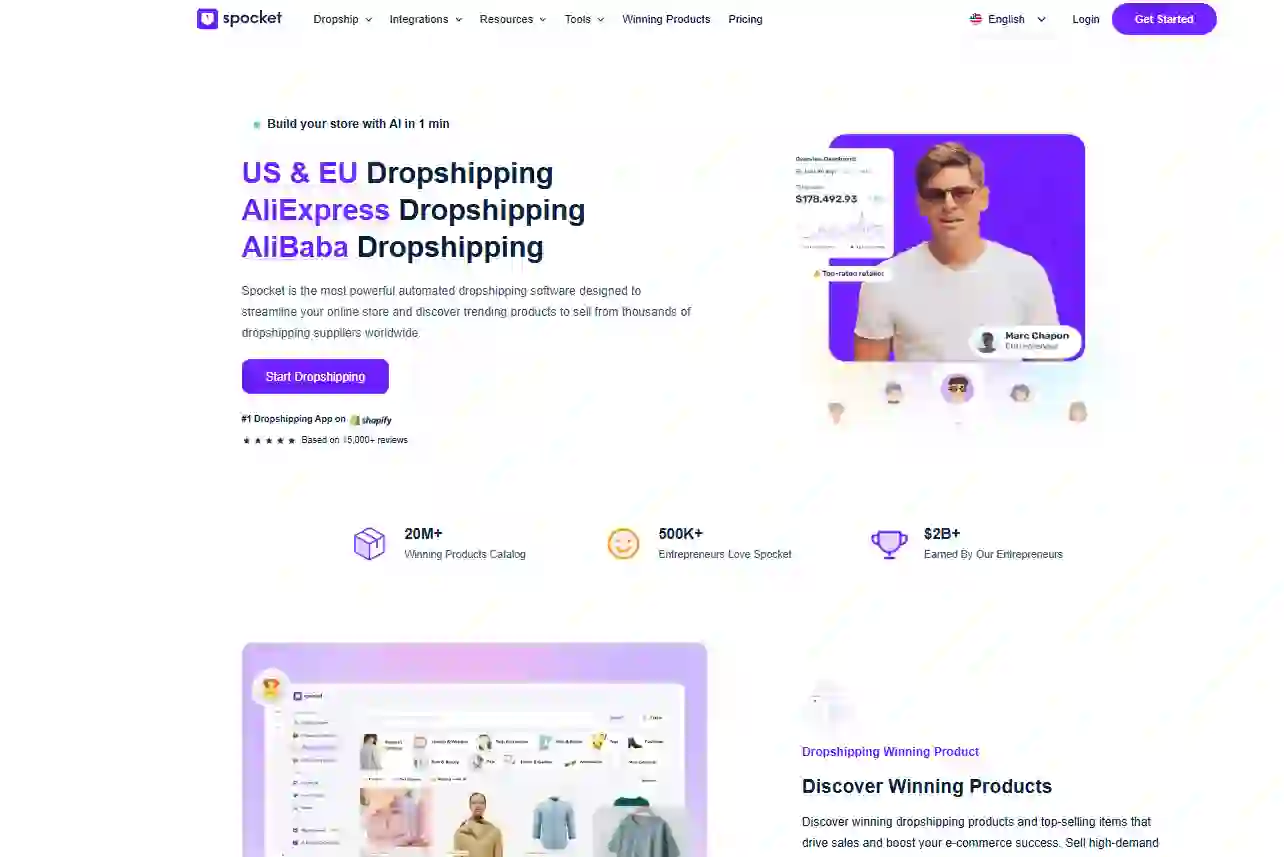
Spocket is built differently from most tools on this list. It is not just a research tool that hands you a product name; it connects you straight to a US and EU supplier who can ship that product in 2 to 7 days. The catalog runs past 100 million products, with a curated set of over 20 million items already flagged as strong sellers, so filtering by category, price, or shipping country gets you to a shortlist fast.
Main capability: sample ordering with no minimum order quantity, so you can check quality on any item before it goes live. Read more on how Spocket has no MOQs for new sellers testing a product for the first time. The catalog also makes it easy to browse trending dropshipping products already flagged by category, so you are not starting from a blank search bar.
Who should use it: anyone building a US or EU-facing store who wants a shorter delivery window than the standard 15 to 30 day AliExpress wait, and anyone who wants branded invoicing and automated inventory sync built in rather than bolted on.
Pricing: Plans start at $39.99 a month, with the Empire plan at $99.99 a month unlocking 10,000 unique and premium product imports and a 7-day free trial on every tier. Full breakdown on Spocket pricing.
2. Sell The Trend
Good fit for: Trending tracking using AI on AliExpress, Amazon, Shopify, and TikTok all in one place.
Primary feature: With NEXUS, trending products with increasing order volume that aren’t yet flooded will be detected and then imported to Shopify/WooCommerce within 1 click.
Target audience: Sellers looking for automation throughout the process of product searching and importing without changing applications.
Estimated cost: Plans starting from around $30 - $40/month depending on promotion.
3. Dropship.io
Useful for: Sales analysis of the Shopify store and competitors.
Key feature: a list of products chosen by an algorithm, as well as a Chrome plugin for spying on any live Shopify store.
Who needs it: sellers who would like to know the potential sales of the competitors prior to copying their products.
Cost: prices begin at around $39 per month.
4. ZIK Analytics
Best for: eBay and Shopify product research in one account.
Main capability: an ad-spy tool paired with a sales tracker, so you can confirm a product is both advertised and actually selling.
Who should use it: eBay sellers specifically, since most product finders on this list skip eBay entirely.
Rough price: plans start near $20 to $40 a month depending on trial terms.
5. Minea
Best for: ad intelligence across Facebook, TikTok, and Pinterest.
Main capability: a database of several hundred million tracked ads, so you can check how long a creative has run and whether engagement is still climbing.
Who should use it: sellers who plan to launch paid ads immediately and want proof a creative already converts before they copy the angle.
Rough price: plans start around $49 a month after a free trial.
6. Ecomhunt
Best for: beginners who want a short daily list instead of an open-ended database.
Main capability: each product ships with a profit breakdown, a suggested audience, and live ad examples, cutting out the analysis step.
Who should use it: first-time dropshippers who want fewer decisions to make per product.
Pricing: a free plan exists, with paid tiers starting around $14 to $23 a month.
Start your dropshipping business today
Try Spocket Free!
7. Helium 10
Best for: Amazon-specific product and keyword research.
Main capability: Black Box filters Amazon's own catalog by sales, reviews, and competition, which most dropshipping-focused finders cannot do.
Who should use it: sellers running or planning an Amazon storefront alongside a Shopify store.
Pricing: plans start around $39 a month.
8. AutoDS
Best for: pairing product research with hands-off order automation.
Main capability: once a product is chosen, AutoDS handles pricing rules, stock monitoring, and order fulfillment without manual input.
Who should use it: sellers scaling past a handful of manual orders a day who need the research and the fulfillment in one system.
Pricing: plans start under $20 a month.
9. Niche Scraper
Best for: checking market saturation before committing ad spend.
Main capability: a saturation score flags how many stores are already selling a given item, which most finders leave out.
Who should use it: sellers who have a shortlist already and want a saturation check before they import.
Pricing: a free plan exists, with the Pro tier around $50 a month.
10. Dropship Spy
Best for: Facebook-first product research with influencer data attached.
Main capability: each listing ships with real engagement numbers pulled from an active Facebook ad, plus a database of influencers who have promoted similar products before.
Who should use it: sellers running Facebook or Instagram ads who want a ready angle and a contact list of influencers tied to the product, not just a name and a price.
Pricing: plans start around $10 to $40 a month depending on the tier.
11. Jungle Scout
Best for: Amazon product and keyword research with a supplier database attached.
Main capability: the Black Box filter narrows millions of Amazon listings by demand and competition, while a second tool called Cerebro reverse-engineers which keywords a competitor ranks for.
Who should use it: sellers building or scaling an Amazon storefront who want product and keyword data in the same account.
Rough price: plans start around $49 a month.
12. Tradelle
Best suited to: combining product research and order automation into one dashboard.
Key feature: a saturation index lets you know just how saturated a product is in terms of other stores selling it, in addition to a market finder that reveals where that particular product is most in demand.
Ideal for: sellers who prefer one software package to provide all their research and order fulfillment needs.
Price range: pricing starts at less than $20 per month.
13. FindNiche
Best for: deep filtering across AliExpress and Shopify data in a single search.
What it does: a store analyzer shows what a competitor is actually selling and how those products are trending, alongside country-level filters for order volume and price.
Who should use it: sellers who want to slice a market by country, price, and order count before settling on a niche.
Rough price: plans start around $30 a month.
14. AliExpress Dropshipping Center (Free)
Best for: checking real order and shipping data straight from the source.
Feature: shows order counts, shipping time, and price history for any AliExpress listing without leaving your AliExpress account.
Who should use it: anyone sourcing from AliExpress who wants to confirm a product's order history before importing it.
Pricing: free.
15. Google Trends (Free)
Best for: checking whether interest in a product name is climbing, flat, or already past its peak.
Main capability: search volume charts by region and time range, so you can tell if a trending product is still trending or already fading.
Who should use it: anyone who wants a free second opinion before trusting a paid tool's trend score.
Pricing: free.
AI Dropshipping Product Finder Tools vs Manual Research
An AI dropshipping product finder evaluates each product based on demand and saturation information, doing so in mere minutes rather than hours. Manual research, which involves looking through AliExpress listings, going through hashtags, and analyzing Shopify store fronts, will help in identifying problems that can't be seen by AI: bad photography of an item on all listings, incorrect translation in descriptions, and communities discussing an issue that hasn't been addressed yet with a product.
Advantages of using AI tools
Speed. Using an AI-assisted tool to find patterns in listings and sales and ad data will take the time needed for a person to analyze just ten listings manually.
Pattern recognition. These tools recognize the rise in order number or ad spending before the human can see it on their scroll.
Multiple references. Tools can use one listing and refer to marketplace information, ad information, and trends chart simultaneously, which is impossible manually.
Advantages of manual research
Context: Which cannot be represented through a score, such as solving the problem mentioned in the forum thread or comment section.
Quality control of suppliers. Tools do not tell you how the product feels like or what happens when its package goes through delivery – for that, you need to order the sample.
Spotting niche or local trends. Especially those that have not been indexed yet by a general-purpose tool, primarily those outside the United States.
According to ZIK Analytics, automated stores that combine more than one automated task, for example, combining automated research with inventory or automated pricing management, show better performance results in 75% of the cases in 2026. Automation does not choose a profitable product by itself. This method is only useful because it removes the routine work from people's shoulders, allowing them to analyze the most promising product candidates personally.
Those dropshipping business owners who have succeeded in 2026 manage to perform both tasks. Choose one of them for narrowing down the market into a short list and then manually check the top five products by analyzing their reviews, ordering a test copy, and visiting a competing website.
How to Validate a Profitable Product Before You List It?
Regardless of the dropshipping product finder that provided you with a particular product idea, use the 4F Product-Finder Filter on it before its launch: Fit, Freshness, Fees, Fulfillment.
Fit ensures that the product corresponds to your niche and price range. $6 mobile phone accessories will be out of place among $60 skincare sets; even if it sells very well on the other websites, the product will increase the cart abandonment rate.
Freshness analyses the growth pattern instead of the volume itself. Get the sales statistics for the previous three months. The constant increase will always beat the sales spike from the viral video posted last week.
Fees makes sure the actual margin, after taking into account the cost from the supplier, shipping, transaction fees (which average about 2.9% + a flat rate), and an approximate ad cost for each purchase, is accurate. A product that may appear to have a margin of 45% might end up with single digit profit margins after deducting the ad cost, hence do the math using an actual ad cost estimate rather than the optimistic one. A study done last year involving 3,161 store owners, according to SellersCommerce, found that 52% and 64% use thin margins and shipping delays respectively as their biggest problems.
The fulfillment part determines who ships your product and its speed. 84% of drop shippers in 2026 identify the search for reliable suppliers as the primary obstacle, and shops which use suppliers based in the USA deliver the goods 35% faster and have 20% more returning customers than the ones who ship goods from abroad. If your supplier takes 20-30 days to ship through AliExpress, even a good product won’t return you customers twice.
But Spocket dropshipping changes all calculations because using suppliers from the USA and the EU reduces the time to 2 to 7 days while sample swith zero MOQ lets you control the build quality of the product before the customer gets the item.
According to Grand View Research, the global dropshipping market reached an estimated $583.5 billion in 2026, growing at a compound annual rate near 20.7%, with the fashion category holding the largest share of that revenue. That kind of growth means more sellers testing the same viral products at the same time, which is exactly why the Fees and Freshness checks matter more now than they did two years ago.
Conclusion
A dropshipping product finder pays for itself the first time it stops you from importing a product nobody wants. Run any candidate through at least two data sources, check its 90-day trend, do the real fee math, and confirm a supplier that can ship it fast before it goes live. Spend less time scrolling and more time checking the products that already have proof behind them.
Sources
- Grand View Research, "Dropshipping Market Size, Share, Growth Report," 2026.
- SellersCommerce, "Detailed Dropshipping Statistics," 2026.
- ZIK Analytics, "60 Important Dropshipping Statistics for 2026," 2026.
- Google Trends, trends.google.com, accessed 2026.
Dropshipping Product Finder FAQs
What is a dropshipping product finder?
A dropshipping product finder is a tool that pulls sales, ad, and trend data from marketplaces and social platforms, then filters that data down to products already showing real demand. Instead of guessing, you get a ranked list with sales history, profit estimates, and links to where the product is already selling.
How to find winning products for dropshipping?
Validate demand using at least two data sources: marketplace's top-selling products list and ads spy. The product that appears in only one of these sources has weak evidence to prove its popularity. After validation, analyze the product's 90-day trend line, do the math on margins (after fees), and get a product sample.
How to find products to dropship?
Begin with a product finder and apply filters based on the categories, pricing, and countries in which you can have items shipped. Verify your choice against another website, like Google Trends or a competitor’s live store, and place an order for a sample before allocating your shelf space to the item.
How to find trending products for dropshipping?
Trend-based tools can be used to monitor an increase in search activity and advertisement spending in real-time. It is important that you spot a consistent increase over a period of 90 days as opposed to just one week. You can use Spocket to find winning dropshipping products and for dropshipping automation.
Is there a free dropshipping product finder?
Yes. The AliExpress Dropshipping Center and Google Trends both have free versions and do two things: supply-side information on orders and demand-side information through trends in searches. Paid software provides automation, ad spying, and saturation analysis capabilities, which the free versions lack. Spocket offers a 7-day free trial period.
How much does a dropshipping product finder cost?
Most paid tools run $20 to $50 a month, alongside free options like Google Trends and the AliExpress Dropshipping Center. Spocket plans start at $39.99 a month with a 7-day free trial, so you can test the full catalog before choosing a paid tier.


Launch your dropshipping business now!
Start free trial.avif)


Related blogs
Dropshipping Supplier Directory: Where to Find Vetted Suppliers
Browse our directory of vetted dropshipping suppliers across the US and EU, complete with niches, shipping speed, and pricing. Start your free trial today.

How to Negotiate With Dropshipping Suppliers: 9 Tactics That Actually Work
Learn how to negotiate with dropshipping suppliers on price, MOQs, and payment terms. Proven tactics and email scripts to boost your margins. Try Spocket free.

Best Clothing Dropshipping Suppliers: The 2026 Guide
Compare the best clothing dropshipping suppliers for 2026 — US/EU shipping speeds, pricing, and product quality — and find the right fit to launch your store.