What Is Ecommerce? Definition, Types and Models
What is ecommerce? Learn the definition, types (B2C, B2B, D2C), business models, and 2026 US Census data, plus how to work out profit on a single order.


Ecommerce is buying and selling goods or services over the internet. That covers a shopper ordering shoes from a brand's website, a business buying packaging in bulk through an online portal, and a student reselling textbooks on a marketplace. It does not matter whether the payment happens online, only that the order or the terms of the sale are agreed through an online channel. This guide explains what ecommerce is in plain terms, the main types and business models, how big it really is in 2026 using US Census data, how a single order flows through a store, and how to decide which model suits you.
What is ecommerce?
The word is short for electronic commerce. The US Census Bureau, which measures it, defines ecommerce sales as sales of goods and services where the buyer places an order, or the price and terms of the sale are negotiated, over an internet, mobile device, extranet, electronic data interchange, email or other online system. It adds that payment may or may not be made online. So a customer who orders on your website and pays cash on delivery still counts.
A few terms get mixed up with it:
- Ecommerce is the selling itself: the order, the checkout, the fulfilment.
- M-commerce is ecommerce done on a phone or tablet. Same thing, different screen.
- E-business is wider. It includes everything a company does online, such as internal tools, supplier systems and marketing, not only sales.
An ecommerce business, then, is any business whose sales happen mainly through online orders. It might run its own store, sell through marketplaces like eBay and Amazon, or use both. Amazon and eBay both started in 1995, and the core idea has not changed since. What changed is the tooling: today you can open a store in an afternoon, and the harder parts are finding a product people want and keeping the unit economics healthy.
How big is ecommerce in 2026?
The latest quarterly figures from the US Census Bureau put US retail ecommerce sales at an estimated $340.2 billion for the second quarter of 2026, seasonally adjusted. That is up 3.8% from the first quarter and up 12.2% from the second quarter of 2025. Total US retail sales grew 6.7% over the same year, so ecommerce is growing at nearly twice the pace of retail overall. Ecommerce accounted for 17.1% of total retail sales in the quarter.
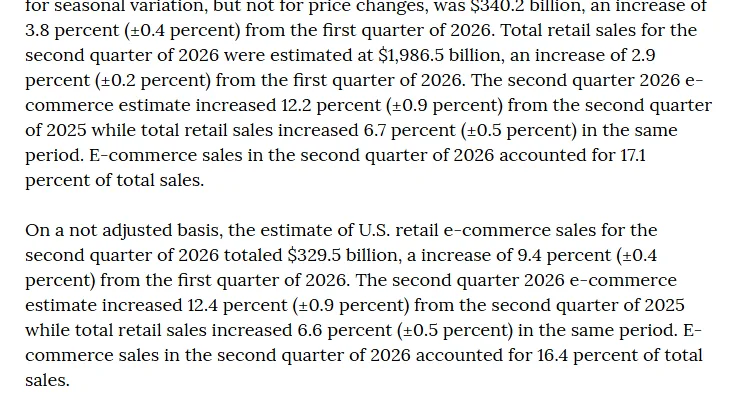
Read that last number carefully. 17.1% means that more than four out of five retail dollars are still spent in physical shops. Ecommerce is large, but it is not the whole market, and many shoppers mix both. The chart below, from the St. Louis Fed's FRED database using the same Census data, shows the share climbing steadily for two decades, with a sharp jump in 2020 and a slower climb since.
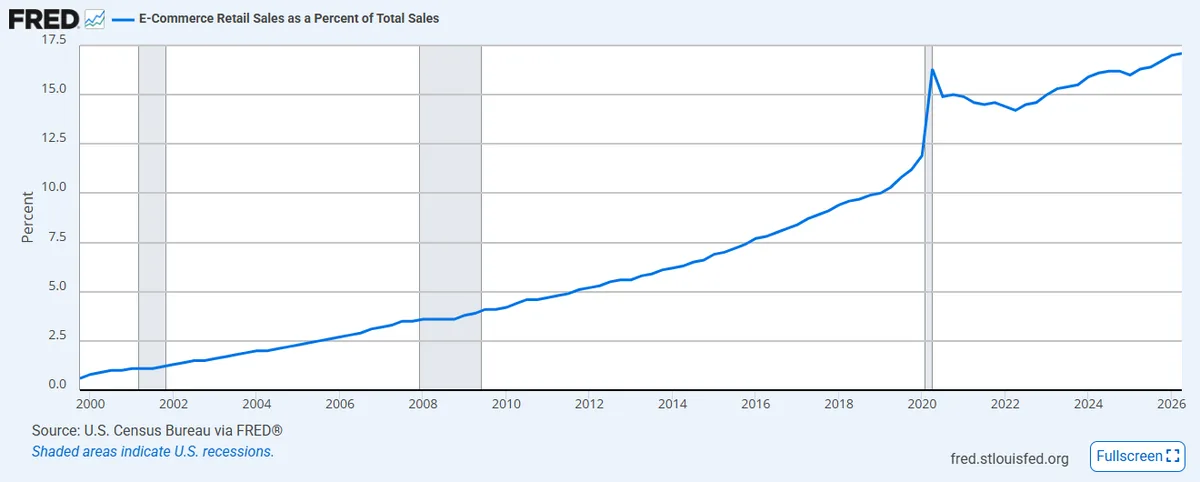
You can check the numbers yourself on the Census Quarterly Retail E-Commerce Sales page and the FRED series E-Commerce Retail Sales as a Percent of Total Sales. Both update each quarter, and the Census page notes that revised estimates follow in later releases. These figures cover US retail only, so treat them as a guide to direction, not a global total.
Types of ecommerce
People usually split ecommerce by who sells to whom:
| Type | Who sells to whom | Example |
|---|---|---|
| B2C (business to consumer) | A company sells to individual shoppers | A brand's own online store, Amazon retail |
| B2B (business to business) | A company sells to another company | A manufacturer selling to a retailer through an online portal |
| C2C (consumer to consumer) | Individuals sell to each other through a platform | eBay listings, Etsy handmade goods |
| D2C (direct to consumer) | A brand skips wholesalers and sells straight to customers | A skincare brand selling on its own website |
| C2B (consumer to business) | Individuals sell skills or content to companies | A freelancer, a photographer licensing images |
| B2G (business to government) | A company sells to a public body | Supplying office equipment through a procurement portal |
For someone starting a small online business, B2C and D2C are the relevant ones, with C2C as a way to test products on a marketplace first. B2B is a different game, with larger orders, longer sales cycles and account-based pricing.
Ecommerce business models
The type tells you who the customer is. The business model tells you how you get the product to them, and it decides your costs and risk. These are the models most new sellers pick between:
| Model | How it works | Upfront cost | Inventory risk | Typical drawback |
|---|---|---|---|---|
| Dropshipping | A supplier stores and ships the product when you get an order | Low | None | Thinner margins, less control over shipping |
| Wholesale or own stock | You buy in bulk, store it, ship it yourself or via a 3PL | High | High | Cash tied up in stock |
| Private label | A manufacturer makes a product under your brand | Medium to high | Medium | Minimum orders, long lead times |
| Print on demand | A provider prints your design on each order | Low | None | Higher unit cost |
| Digital products | You sell files, courses or software | Low | None | Easy to copy, needs an audience |
| Subscription | Customers pay on a recurring basis for a product or service | Medium | Varies | Churn, constant retention work |
There is no best model, only the best fit for your cash, time and risk tolerance. Dropshipping and print on demand let you test an idea without buying stock. Own stock and private label give you control and better margins once demand is proven. Many sellers start with the first and move toward the second. Our comparison of dropshipping vs ecommerce goes into that choice, and what dropshipping is and how it works explains the first model in detail.
Where ecommerce happens: store, marketplace or both
You can sell from your own store, on a marketplace, or on both. A store gives you the brand, the customer data and full control of the checkout, but you must bring your own traffic. A marketplace such as eBay or Amazon brings built-in shoppers, but you play by its rules, pay its fees and compete on its page. Our guide to the best ecommerce platforms compares store builders, and the eBay Seller Hub guide shows what running a marketplace shop involves day to day.
How an ecommerce order works, step by step
- A shopper finds your product through search, social media, an ad, an email or a marketplace listing.
- They view the product page and decide, based on photos, price, reviews and delivery information.
- They check out. The store collects the address, shipping choice and payment.
- A payment processor takes the payment and deducts its fee before paying you.
- The order is fulfilled. You pack it, a warehouse ships it, or a supplier ships it directly.
- The carrier delivers and the customer gets tracking along the way.
- After-sales: support questions, returns, refunds and review requests.
Each step has a cost and a way to fail, which is why running the numbers per order matters more than watching revenue. For the fulfilment side in depth, see our guide to dropshipping order fulfillment.
A worked example: the economics of one order
Take a pet grooming glove that sells for $39 in a small online store. These numbers are illustrations, so replace them with your own.
| Line | Amount |
|---|---|
| Selling price | $39.00 |
| Product plus shipping from supplier | -$17.00 |
| Payment fee (assumed 2.9% + $0.30) | -$1.43 |
| Advertising per sale (assumed) | -$10.00 |
| Profit per order | $10.57 |
That is about 27% of the selling price. Two lessons sit in this table. First, revenue is a vanity number: $39 turns into $10.57. Second, advertising is the line most likely to wreck the maths. If ad cost per sale rises from $10 to $20, the profit falls to $0.57. Most new stores fail not because the product is bad, but because the cost of getting a customer is higher than the margin. Before you build anything, estimate your margin per order and what you can afford to spend on a customer.
Ecommerce vs traditional retail
The products are often the same. The difference is where the costs sit and what you can see. A physical shop pays rent, staff and stock up front and sees only the customers who walk in. An online store swaps the rent for a platform subscription and advertising, and sees every visitor, every abandoned cart and every search term.
| Factor | Physical shop | Ecommerce store |
|---|---|---|
| Main costs | Rent, staff, stock | Platform fees, advertising, shipping, stock if you hold it |
| Reach | People who can get to the shop | Anyone you can ship to |
| Opening hours | Set by staff and lease | Always on, but support still takes time |
| Customer data | Limited unless you run a loyalty scheme | Detailed by default |
| Trust signals | The shop itself, face-to-face service | Reviews, clear policies, branding, fast replies |
| Returns | Handled at the counter | Handled by post, with shipping costs to absorb |
Neither is better in the abstract. The Census figure above is the clearest reminder: most spending still happens in shops, so ecommerce is an extra channel for many businesses and the only channel for others.
Ecommerce terms you will hear
New sellers meet a lot of jargon. These are the terms worth knowing before you read any ecommerce advice:
| Term | Meaning |
|---|---|
| SKU | The code for one specific product variant, such as a medium blue glove |
| Conversion rate | The share of store visitors who place an order |
| Average order value (AOV) | Total revenue divided by the number of orders |
| Customer acquisition cost (CAC) | What you spend, on average, to win one new customer |
| Chargeback | A payment a customer disputes with their bank, which the seller may have to refund plus a fee |
| Fulfilment | Picking, packing and shipping an order |
| Cart abandonment | A shopper adds items to the cart but leaves before paying |
| Landed cost | The full cost of getting a product to the customer, including shipping and duties |
Of these, CAC and landed cost matter most for a new store. If CAC is higher than your profit per order before ads, the store loses money on every sale however good the product looks.
Advantages and drawbacks of ecommerce
| Advantages | Drawbacks |
|---|---|
| Low cost to start compared with a physical shop | Fierce competition and rising ad costs |
| Sell to customers beyond your town or country | Shipping times and costs shape the customer experience |
| Open all day, with data on every visitor | Returns, chargebacks and fraud need active management |
| Test products cheaply before committing | Customers cannot touch the product, so trust must be earned |
How to start an ecommerce business
- Choose a narrow niche and a customer. "Dog owners with small apartments" beats "pet products". Browse best dropshipping niches for ideas.
- Pick a model. Use the table above and be honest about how much cash you can risk.
- Source your product. Order samples from every supplier before you sell anything.
- Choose where to sell. A store builder, a marketplace, or both.
- Set up payments, shipping and policies. Write clear delivery times and a returns page.
- Run the unit economics as in the example above, and drop any product that does not leave room after ads.
- Test with a small ad budget, keep what sells, and cut what does not.
If you want a step-by-step version, our guide on how to start an ecommerce business goes further.
Where Spocket fits
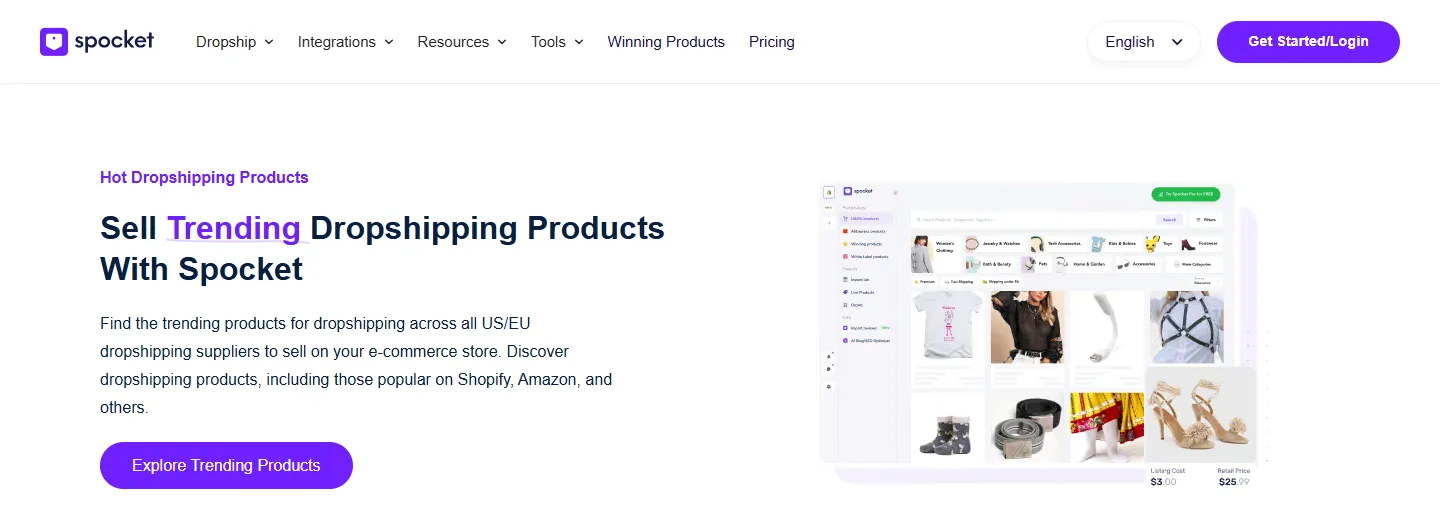
Spocket is a supplier marketplace for dropshipping. It gives an ecommerce store access to suppliers, many based in the US and EU, whose products you can import into your store without buying stock. It connects to Shopify, WooCommerce, Wix, BigCommerce, Squarespace, eBay and other platforms, and orders can be fulfilled automatically with your branded invoice. Its US and EU suppliers advertise shipping in 2 to 7 days, which you should confirm with a test order. Plans start at $39.99 a month with a 7-day trial. Browse trending products to see what is on offer and the Shopify integration to see how it connects, or start the trial here.
Common ecommerce mistakes
- Judging success by revenue. Track profit per order after all costs.
- Selling a broad range. A focused store is easier to market and to trust.
- Promising delivery times you cannot meet. Late parcels drive refunds and bad reviews.
- Skipping samples. You cannot judge quality from a supplier photo.
- Ignoring policies. Shipping, returns and privacy pages build trust and protect you.
- Spending on ads before testing the product. Validate demand cheaply first.
The short version
A sensible first project is small and measurable. Pick one product, sell it for a few weeks through one channel, and write down four numbers: orders, revenue, profit per order after every cost, and how much you spent on ads. Those four numbers tell you whether to carry on, change the price, change the product or stop. Most of the skill in ecommerce is reading them honestly and acting on them quickly, long before you worry about logos, apps or fancy store themes.
Ecommerce is selling over the internet, and in the US it now accounts for just over 17% of retail sales and is growing faster than retail as a whole. Pick a type and a model that match your budget, work out the profit on a single order before you build, and test small. When you are ready to try the dropshipping route, start your Spocket trial.
Start your dropshipping business today
What Is Ecommerce FAQs
What is ecommerce in simple terms?
Ecommerce is buying and selling goods or services online. A customer places an order through a website, app, marketplace or other online channel, and the seller fulfils it. The payment does not have to happen online for a sale to count. Everyday examples include ordering from a brand's store or buying a used item on eBay.
What are the main types of ecommerce?
The main types are B2C (business to consumer), B2B (business to business), C2C (consumer to consumer), D2C (direct to consumer), C2B (consumer to business) and B2G (business to government). For most people starting a small online business, B2C and D2C are the relevant ones, sometimes testing products on a C2C marketplace first.
What are examples of ecommerce business models?
Common models are dropshipping, buying wholesale and holding your own stock, private label, print on demand, digital products and subscriptions. They differ mainly in upfront cost and inventory risk. Dropshipping and print on demand need no stock, while own stock and private label give more control and usually better margins once demand is proven.
How big is ecommerce in the US?
The US Census Bureau estimated retail ecommerce sales at $340.2 billion in the second quarter of 2026, seasonally adjusted. That was up 12.2% from a year earlier and made up 17.1% of total retail sales. Check the Census Quarterly Retail E-Commerce Sales page for the latest release, since figures are revised.
What is the difference between ecommerce and dropshipping?
Ecommerce is the broad category of selling online, while dropshipping is one way to run an ecommerce business. In dropshipping, a supplier stores and ships the product after you make a sale, so you never hold inventory. Other ecommerce sellers buy and store their own stock, or have products made for them.
Do I need a lot of money to start an ecommerce business?
No. You can start small, particularly with dropshipping or print on demand, where you do not buy stock upfront. You still need money for a store platform, samples, advertising and any supplier subscription. Estimate your profit per order first, so you know how much you can spend to win a customer.
Is ecommerce profitable?
It can be, but margins are often thin after product cost, shipping, payment fees and advertising. Profit comes from choosing products with healthy margins and keeping the cost of winning each customer below that margin. Work through the numbers for a single order before you spend on a store or ads.
What is the best platform to start an ecommerce business?
It depends on your goals. Store builders such as Shopify, WooCommerce, Wix, BigCommerce and Squarespace give you control of your brand, while marketplaces such as eBay and Amazon bring built-in shoppers but charge fees and set rules. Many sellers start with one channel and add another once sales are steady.


Launch your dropshipping business now!
Start free trial


Related blogs
eBay Seller Hub: Every Tab Explained
eBay Seller Hub explained tab by tab, with fees worked through, a weekly routine and how dropshippers use it to track orders, seller level and payouts.

Top WordPress eCommerce Themes for 2026
Explore the best WordPress eCommerce themes for 2026. Compare WooCommerce themes by speed, design, features, and dropshipping potential.

Saba Mohebpour Didn't Stop at Spocket: His New $50M Fund, ILA Capital, Is Buying Up Shopify and Amazon Apps
After building Spocket into a major ecommerce platform, Saba Mohebpour is launching ILA Capital with a $50M strategy to acquire Shopify and Amazon apps powering modern ecommerce.