What Is B2B SaaS Ecommerce? Examples and Use Cases
See how B2B SaaS Ecommerce runs modern wholesale and distribution online. Understand key platforms, examples, and use cases across real B2B buying journeys.

B2B SaaS Ecommerce is just cloud software that runs your business‑to‑business online sales on subscription instead of on your own servers. You pay monthly or yearly, log in through a browser, and let the vendor handle hosting, updates, and security while you focus on selling to other businesses.
If you need to future‑proof your wholesale or distribution brand, you will want to understand how B2B SaaS fits into your ecommerce playbook before your buyers quietly move to someone more modern.
How B2B SaaS Ecommerce Works?
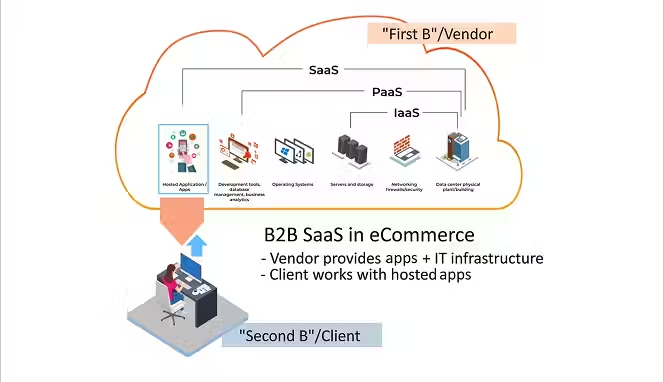
B2B SaaS full form is “Business‑to‑Business Software as a Service.” Instead of buying licences and installing software on your own servers, your business subscribes to cloud applications that run in the provider’s data centers and access them over the internet. When those applications power online catalogs, carts, quotes, and ordering between companies, you get B2B SaaS in commerce.
Think of a manufacturer offering a password‑protected portal where distributors log in, see contract pricing, reorder in bulk, and track shipments in real time. The manufacturer pays a recurring fee to a SaaS vendor, who maintains the ecommerce engine, APIs, and security; the buyer only sees a clean storefront and fast ordering. This is the B2B SaaS ecommerce model in action.
If you’ve ever read the textbook answer to “what is B2B commerce class 11,” it talks about one business selling to another; B2B SaaS Ecommerce is that idea rebuilt as a cloud storefront with subscription billing and constant updates instead of DVDs and on‑prem code. In 2026, major analysts point out that most new B2B ecommerce builds now favor SaaS because it cuts time‑to‑launch and removes the need for big internal IT teams to run commerce infrastructure.
B2B SaaS Definitions and Basics for Businesses
B2B SaaS Ecommerce means your online wholesale or procurement channel runs on subscription‑based software hosted by a third‑party provider. You pay for usage, seats, or GMV, and the vendor ships upgrades, security patches, and new features without you touching servers. The same idea underpins most modern B2B SaaS companies list entries you see on comparison sites today.
B2B SaaS full form and meaning
B2B SaaS full form, again, is Business‑to‑Business Software as a Service, and it covers everything from ecommerce storefronts and CRMs to billing, analytics, and support tools built for organizations rather than end‑consumers. Instead of one‑off licence sales, providers earn recurring revenue while customers trade capital expense for operating expense and faster deployment.
You’ll know you’re looking at true B2B SaaS Ecommerce when the product is cloud‑hosted, accessed via browser or mobile, and sold on a subscription plan that includes hosting, updates, and support. Many leading B2B SaaS companies in USA run on this playbook, offering multi‑tenant infrastructure that serves thousands of merchants from a single codebase while keeping each merchant’s data isolated. If you search any B2B SaaS companies list right now, nearly all of the commerce players fit this structure.
If you need formal knowledge, you can even send team members through a B2B SaaS certification so everyone speaks the same language about SLAs, uptime, API limits, and data residency. That matters once you start negotiating contracts or layering multiple SaaS tools across your stack—commerce, CRM, ERP connection, and marketing all talking to each other through APIs.
What B2B SaaS Ecommerce Looks Like Day to Day
On a normal workday, your buyers access your B2B SaaS storefront, log in with their company account, and see the catalog, pricing, and payment terms tied to their contract. They place orders online, request quotes, or reorder past purchases without emailing your sales team, while your staff sees everything in a single admin.
Behind the scenes, the platform syncs data with your ERP and CRM so inventory, pricing, and customer information stay aligned. Many providers now offer native connectors into major ERPs like SAP, Microsoft Dynamics, or NetSuite, so you don’t spend months building custom integrations from scratch. This gives you live stock levels and account balances inside the ecommerce front end, which is exactly what B2B buyers expect in 2026.
If you notice how modern platforms talk about “self‑service portals,” they’re really describing this loop: buyers handle day‑to‑day ordering online, while sales and support teams jump in for complex quotes, contract changes, and large deals. That mix of automation plus human touch is where B2B SaaS in commerce examples shine compared to older email‑and‑spreadsheet setups.
Why B2B SaaS beats custom builds for most brands
Ten years ago, a lot of B2B brands built custom portals on frameworks or on‑prem platforms and carried big maintenance costs. In 2026, SaaS B2B ecommerce platforms like Shopify Plus, BigCommerce B2B Edition, and others ship new B2B features—company accounts, price lists, payment terms, quote workflows—as part of your subscription, so you don’t fund every feature yourself.
You can still customize heavily through apps, APIs, and headless options, but core infrastructure—scaling, uptime, security certifications, CDN, backups—sits with the vendor. That reduces risk for most mid‑market brands that don’t want to run their own commerce hosting team. Whether you sell wholesale stock, equipment, or even supply products for dropshipping, a SaaS approach usually gives you better resilience for less effort.
You can also mix SaaS platforms: one for ecommerce, another for product sourcing, another for B2B affiliate marketing if you drive partner revenue. As long as they expose mature APIs and webhooks, you will link them into a single experience for customers while keeping each tool responsible for what it does best.
B2B SaaS Ecommerce Examples
You can think of B2B SaaS examples in ecommerce as all the “behind the scenes” apps that keep orders, catalogs, and contracts moving without phone calls. Here are some practical B2B SaaS in commerce examples you’ll actually meet once you start digitizing.
- Cloud commerce storefronts. These are the main B2B SaaS Ecommerce engines buyers see: catalog, search, pricing tiers, quotes, carts, and checkout built for bulk orders and multiple decision‑makers. They handle company accounts, approvals, and repeat ordering so your sales team doesn’t manually key in every PO.
- ERP‑connected web stores. Some SaaS platforms plug straight into your ERP and reuse its pricing rules, credit limits, and product data in the online store. You avoid data copies and your customers always see live stock, contract pricing, and invoice status.
- Digital catalogs and punchout. Here, your SaaS tool exposes your catalog inside a buyer’s procurement system through “punchout,” so purchasing teams shop your catalog inside their own software and send orders back automatically. It still runs as B2B SaaS, just embedded into someone else’s workflow.
- Subscription and contract billing. Many B2B brands mix one‑off orders with recurring subscriptions for consumables, service plans, or SaaS licenses of their own. Billing platforms handle metering, proration, renewals, and invoices so finance teams don’t chase spreadsheets.
- B2B customer portals. These SaaS portals let buyers see order history, track shipments, download invoices, and raise service tickets from one login. You reduce incoming calls and emails, while still keeping account managers around for strategic conversations.
- Marketplace and dropship hubs. A B2B marketplace platform lets you host multiple suppliers and route orders to them automatically while still owning the buyer relationship. You can even layer sourcing tools like Spocket on top if you want to test new assortments through suppliers that already ship direct to customers.
- Data and analytics SaaS. Reporting tools plug into your ecommerce, ERP, and CRM data to show margins, cohort behavior, and product performance across B2B accounts. You could, for example, check which SKUs your top buyers reorder every month and build special bundles for them.
How to Switch to B2B SaaS in 2026?
Switching from legacy or on‑prem commerce to B2B SaaS Ecommerce feels huge, but you can break it into clean steps instead of one scary “big bang.” You should treat this as a business project first and a technology project second.
- Map your current B2B journeys. Start by documenting how quotes, orders, approvals, and reorders actually move today—emails, spreadsheets, phone calls, ERP screens, everything. If you notice bottlenecks (like manual pricing checks or constant stock confirmation calls), mark them; those become must‑have flows in your future SaaS setup.
- Prioritize use cases, not vanity features. Rather than chasing every shiny widget, pick 3–5 high‑impact B2B flows you want live in phase one: self‑service reordering, online quotes, contract pricing, or distributor portals. You can always add more later; shipping something useful quickly matters more than matching a 40‑page wish list.
- Shortlist platforms that match your ERP and CRM. Check which B2B SaaS platforms already ship deep connectors for your ERP (SAP, Dynamics, etc.) and CRM. Platforms like Sana Commerce Cloud and others build the web store directly on top of ERP data, while options like BigCommerce B2B Edition offer APIs and apps for most mainstream back‑office systems.
- Plan data migration early. Clean product data, customer hierarchies, and pricing rules before you move, not after. Bad data in will make even the best B2B SaaS Ecommerce platform feel broken. You will need agreement between IT, sales, and finance on what “source of truth” looks like for each field.
- Run a pilot with real customers. Pick a subset of buyers—maybe one country or one channel partner group—and invite them onto the new portal while the old process still runs in parallel. Use their feedback to tweak catalogs, navigation, and account permissions before you widen rollout.
- Train your internal team properly. Sales, support, finance, and warehouse staff all touch the new system, so you can’t just hand IT a login and walk away. Run short role‑based sessions focused on daily tasks: entering a quote, editing credit limits, issuing refunds, or checking stock.
- Tidy the rest of your ecommerce stack. As you adopt B2B SaaS, this is a good time to clean up adjacent tools—product sourcing, Print-on-demand, and trending dropshipping products if you sell both wholesale and retail, for example. That way your new B2B engine and your sourcing or dropshipping workflows don’t fight each other.
Best SaaS B2B Ecommerce Platforms and Apps in 2026
Here is a list of the best B2B SaaS Ecommerce platforms and apps for 2026:
1. Shopify Plus with B2B on Shopify
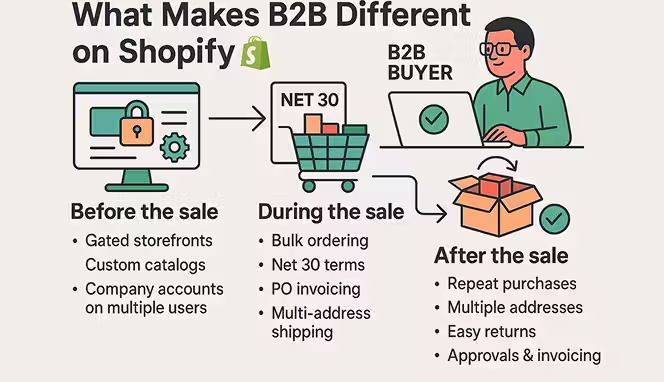
Shopify Plus with “B2B on Shopify” gives larger merchants a single admin for both direct‑to‑consumer and B2B operations, so you don’t run two separate stores. Company accounts, multiple locations, payment terms, and customer‑specific catalogs are built directly into the platform rather than bolted on through a separate wholesale app. Recent 2026 updates add ACH payments for US merchants, store credit at company level, and pickup options at checkout for B2B orders.
Key features
- Company profiles and locations. Create B2B customer records with multiple buyers and locations per company, each with its own payment terms, tax settings, and permissions. This mirrors real account structures instead of cramming everything into one contact.
- Price lists and custom catalogs. Assign negotiated pricing and product visibility per company or market, so a distributor in one region sees different assortments and discounts than another. You can run wholesale and retail from the same catalog while keeping each audience separate.
- Self‑service B2B portal. Buyers log in to a dedicated B2B experience where they can reorder, view invoices, and manage ship‑to addresses without calling your team. That’s ideal if you want sales reps focusing on larger deals, not routine orders.
- Checkout extensibility. Plus merchants can customize checkout with Shopify Functions and the checkout editor, adding rules like order review thresholds, PO number validation, or extra fields for B2B compliance. You can tune flows by market or channel without forking the platform.
- API and automation tools. Shopify’s APIs and Shopify Flow let you connect ERP, PIM, or 3PL systems and automate common tasks like account creation, tagging, and routing orders. That matters once order volumes and account complexity start scaling.
2. BigCommerce B2B Edition
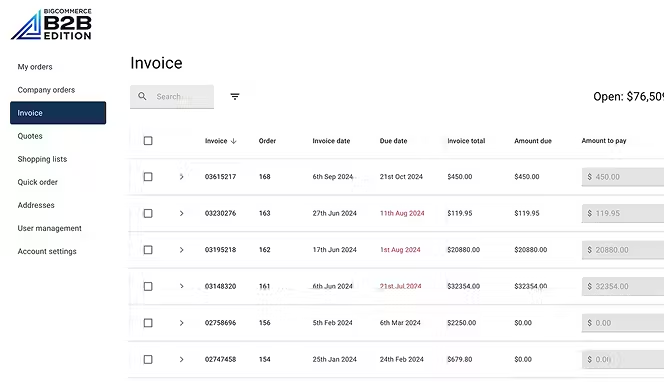
BigCommerce B2B Edition layers a buyer portal, corporate account features, and quoting tools on top of the BigCommerce Enterprise plan. It’s sold as a SaaS bundle that includes the buyer‑side app plus admin features for merchants, and it targets manufacturers, distributors, and wholesalers that want modern UX without owning infrastructure.
Key features
- Dedicated buyer portal. Companies sign in to a portal where they manage shopping lists, view invoices, see past orders, and reorder with a few clicks. It feels like a modern B2C storefront but with B2B extras such as PO‑based checkout.
- Corporate account management. Set up account hierarchies, assign roles, and control which buyers can see which payment methods, addresses, or price lists. This is useful if your customers have central procurement plus local buyers.
- Sales‑rep masquerade and quoting. Reps can log in “as the customer,” build carts, or submit quotes on their behalf, then send them for approval. That keeps the relationship personal while still recording everything in one system.
- Quick order tools. Features like quick order pads and “buy again” lists speed up ordering for buyers who already know SKU codes or repeat similar baskets each week. You reduce clicks for power users and make large carts less painful.
- Open SaaS architecture. BigCommerce’s open‑API approach means you can connect ERP, OMS, and CRM through pre‑built or custom integrations, while BigCommerce still hosts and maintains the core platform. That’s attractive if you have heavy back‑office investments already.
3. Salesforce B2B Commerce (Commerce Cloud)
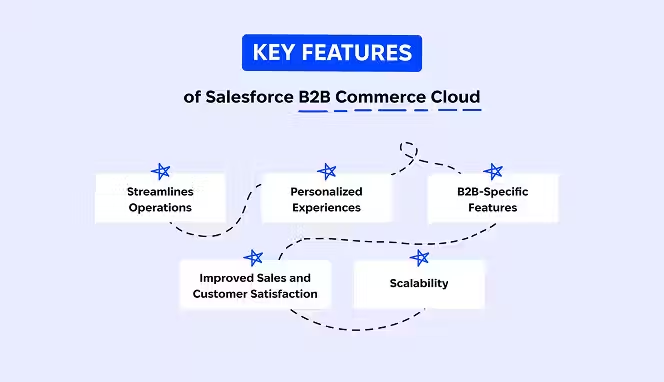
Salesforce B2B commerce runs on Salesforce Commerce Cloud and is tightly connected to Salesforce’s CRM and Data Cloud products. It targets larger organizations with complex catalogs, contract pricing, and global operations where having sales, service, and commerce data in one ecosystem matters.
Key features
- Native CRM connection. Because B2B Commerce sits on the Salesforce platform, account, contact, opportunity, and order data live together instead of bouncing between systems. Sellers see ecommerce activity directly on CRM records.
- Account‑specific catalogs and pricing. The platform supports contract pricing, custom catalogs, and volume breaks per customer or group. That lets you replicate offline agreements online without exposing them to everyone.
- Self‑service ordering at scale. B2B buyers can place large orders, reorder templates, and manage contracts through self‑service storefronts while sales teams handle exceptions and large negotiations. This mix suits high‑volume industrial or distribution scenarios.
- Integration with core Salesforce clouds. B2B Commerce can integrate with Sales Cloud, Service Cloud, and Experience Cloud, so you can bring community portals, service workflows, and selling into the same hub.
- Enterprise deployment options. Salesforce and its partner network offer playbooks and implementation services specifically for B2B Commerce Cloud, covering integrations with ERP, PIM, and custom workflows. That’s useful if you want an SI‑led rollout.
4. OroCommerce
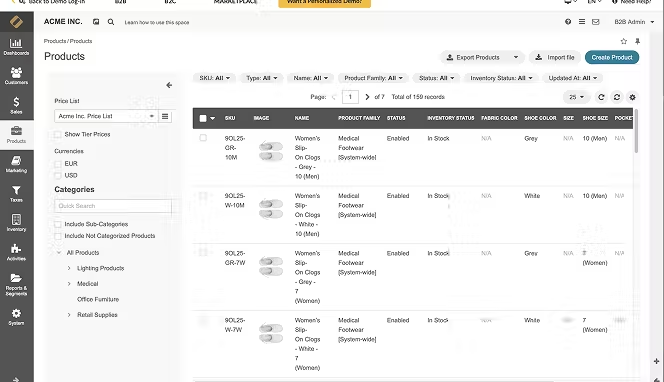
OroCommerce started as a B2B‑first ecommerce platform built by some of the original Magento founders, and it still leans heavily into mid‑market and enterprise B2B needs. You can run it in the cloud or self‑hosted, but many merchants now consume it as a managed SaaS service. It’s known for deep account structures, workflows, and a built‑in CRM.
Key features
- B2B‑native workflows. OroCommerce includes quote‑to‑order workflows, approval chains, and RFQ processes out of the box, rather than treating them as add‑ons. That suits industrial and distribution sellers with custom pricing and negotiation.
- Corporate account hierarchies. You can model multi‑level buyer organizations with roles, permissions, and budget limits for each tier. That makes sense when you sell into franchises or large groups with local branches.
- Built‑in CRM (OroCRM). Unlike many platforms that bolt on CRM later, OroCommerce ships with an integrated CRM for account insights, pipelines, and marketing. That reduces the number of systems smaller teams juggle.
- Flexible deployment. OroCommerce can run in OroCloud or other hosting environments, giving IT teams more choice around infrastructure while still using the same application stack.
- Rich B2B feature set. Out of the box you get buyer‑specific catalogs, price books, CPQ support, punchout options, and multi‑site/multi‑org capabilities. That lets one group manage several brands or regions from one admin.
5. Sana Commerce Cloud
Sana Commerce Cloud is a SaaS ecommerce platform built specifically to sit directly on top of ERPs like Microsoft Dynamics and SAP, using them as the primary data source. Its pitch is simple: if your ERP already knows your items, pricing, and customers, reuse that data live online instead of duplicating it.
Key features
- Real‑time ERP integration. Sana Commerce Cloud syncs orders, pricing, stock, and customer data with the ERP in real time, so buyers always see contract‑accurate information. That cuts manual reconciliation and pricing disputes.
- B2B‑first buying experience. The platform supports customer‑specific assortments, payment and shipping rules, and multiple storefronts for different brands or markets. Buyers see exactly what they’re allowed to buy, on agreed terms.
- Workflow and rule management. You can carry complex internal rules—such as credit checks, approval flows, and delivery constraints—into the web channel by reusing ERP logic. That helps teams avoid re‑implementing everything in a second system.
- Analytics tied to commerce activity. Sana surfaces dashboards around adoption, order error rates, and returning customers across your web stores, helping you understand which accounts are moving online.
- Certified partner ecosystem. As a Microsoft and SAP partner, Sana works within established ERP ecosystems and is supported by regional integrators familiar with both sides of the stack.
6. VTEX

VTEX is a multi‑tenant SaaS platform used by global brands for B2B, B2C, and marketplace models on a single codebase. It leans into composable and headless patterns, with VTEX IO as its serverless development platform and strong marketplace plus order‑management capabilities.
Key features
- Native B2B flows. VTEX supports buying groups, B2B payment methods, RFQ, bulk ordering, and organization‑level account management inside the core platform. Buyers can manage multiple carts, request quotes, and reorder quickly.
- Composable architecture. You can use VTEX’s pre‑built storefront and components or build custom experiences while still running on the shared SaaS core. That lets teams ship faster but still adapt front‑end experiences where needed.
- Marketplace and multi‑model support. VTEX can run B2B, DTC, B2B2B, and marketplace scenarios in one tenant, which matters if you sell directly, through distributors, and as a marketplace operator.
- Order management and omnichannel. Its OMS connects inventory and orders across stores, warehouses, sellers, and channels, so you can offer options like ship‑from‑store or endless aisle.
- SaaS on AWS infrastructure. VTEX runs as a true multi‑tenant SaaS on AWS, with auto‑scaling and CDN, so all customers share the same resilience and performance benefits.
Conclusion
You can think of B2B SaaS Ecommerce as trading server headaches and rigid portals for subscription platforms that keep pace with buyer expectations in 2026. The shift isn’t just technical: it changes how your team sells, how your buyers order, and how easily you can test new models like B2C vs. B2B hybrids, marketplaces, or B2B affiliate marketing programs around your core store. If you start with clear journeys, clean data, and a realistic rollout, B2B SaaS Ecommerce becomes a reliable growth engine instead of yet another software project.
Start your dropshipping business today
B2B SaaS Ecommerce FAQs
What is B2B SaaS Ecommerce?
B2B SaaS Ecommerce is online business‑to‑business selling powered by subscription cloud software rather than on‑premise platforms. You access the storefront and admin through a browser, while the vendor manages hosting, security, and updates. B2B buyers log in, see contract pricing, place orders, and track shipments in self‑service portals. For most brands, this model reduces launch time and keeps features current without heavy IT overhead.
How is a B2B SaaS Ecommerce model different from B2C?
A B2B SaaS Ecommerce model supports company accounts, multiple buyers per customer, negotiated pricing, volume breaks, and quote workflows, which standard B2C stores don’t need. You’ll know the difference when you see features like payment terms, PO‑based checkout, and approval chains built into the platform. These flows mirror traditional B2B practices but move them into a modern, cloud‑hosted storefront.
What are some B2B SaaS Ecommerce examples?
Common B2B SaaS Ecommerce examples include wholesale portals for distributors, dealer portals for equipment brands, and ERP‑connected web stores for manufacturers. Platforms like Shopify Plus, BigCommerce B2B Edition, Salesforce B2B Commerce, OroCommerce, Sana Commerce Cloud, and VTEX all support these scenarios on a subscription basis. You could also pair ecommerce with sourcing tools where Spocket has no MOQs if you want flexible inventory options.
How can a small wholesaler start with B2B SaaS Ecommerce?
You can start small by launching a limited B2B catalog for your top accounts on a SaaS platform, then expanding once buyers are comfortable. Begin with simple self‑service reorders and online invoices; later, add quotes, tiered pricing, and integrations to your ERP or sourcing stack. Even if you also run consumer channels or Print-on-demand lines, you will keep B2B buyers in a dedicated portal with contract‑aware pricing.


Launch your dropshipping business now!
Start free trial.avif)


Related blogs
Top WordPress eCommerce Themes for 2026
Explore the best WordPress eCommerce themes for 2026. Compare WooCommerce themes by speed, design, features, and dropshipping potential.


Saba Mohebpour Didn't Stop at Spocket: His New $50M Fund, ILA Capital, Is Buying Up Shopify and Amazon Apps
After building Spocket into a major ecommerce platform, Saba Mohebpour is launching ILA Capital with a $50M strategy to acquire Shopify and Amazon apps powering modern ecommerce.

Top Trendsi Alternatives for Fashion Dropshipping
Explore the best Trendsi alternatives for fashion dropshipping, fast shipping, branding, Shopify integration, and reliable suppliers.