Print on Demand in Canada
Learn print on demand Canada costs, fulfillment options, pricing formulas, and the best platforms to sell profitably with faster delivery across Canada.
.avif)

Print on demand is one of the simplest ways to start selling custom products online in Canada without buying inventory upfront. You create designs, add them to products like t-shirts, hoodies, mugs, posters, and tote bags, and only pay for production when a customer places an order.
That “no inventory” advantage is exactly why print on demand Canada has become a popular model for creators, side hustlers, and ecommerce brands. But the part that decides whether you’ll actually make money is not your design style alone.
It’s platform choice and cost control.
Because in Canada, small differences in:
- where an item is printed,
- how fast it ships across provinces,
- whether duty or customs applies,
- and what you pay for production + shipping,
can change your margins a lot.
This guide breaks down the best platform types to consider, how costs work in real life, and the exact pricing framework you can use to stay profitable. You’ll also get practical tips for choosing products that ship well inside Canada, setting delivery expectations, and scaling without drowning in returns or thin margins.
What print on demand Canada really means
When someone searches “print on demand Canada,” they’re usually looking for at least one of these outcomes:
- Faster shipping to Canadian customers (especially Ontario, Quebec, and major cities)
- More predictable checkout costs (fewer surprise duties or border delays)
- Local production options for better delivery times and customer trust
- A platform that integrates with Shopify and popular marketplaces
- A clear idea of costs so pricing doesn’t become guesswork
One platform that operates a Canadian fulfillment facility highlights “fast and duty-free” shipping from Canada, and even gives a clear expectation that domestic orders ship in 2 days to Ontario and 4 days to most other provinces.
That kind of transparency is gold for your conversion rate because delivery speed is one of the biggest factors customers use to decide whether they’ll buy.
How print on demand works in Canada
The workflow is straightforward:
- Create designs (or hire a designer)
- Choose products (apparel, drinkware, wall art, accessories)
- Connect your sales channel (Shopify, Etsy, WooCommerce, etc.)
- Publish listings with mockups and pricing
- Customer orders
- The platform prints, packs, and ships
- You keep the difference between retail price and your costs
The best part is you don’t need minimum orders. One Canada-focused provider explicitly describes POD as a model where each item is made only after a customer places an order, with no minimums, making it a low-risk way to launch.
The real costs behind print on demand Canada
If you want to run POD profitably, you need to stop thinking “How much does POD cost?” and start thinking:
What do I pay per order, and what do I keep after fees?
Your per-order cost typically includes:
Product cost
This is the base cost of the blank + printing (and sometimes packaging).
Shipping cost
Shipping varies by product category (mugs vs hoodies vs posters), destination province, and carrier speed.
Storefront and payment fees
Shopify plan cost, payment processing, marketplace fees (Etsy, Amazon, etc.), apps, and currency conversion if applicable.
Margin killers people forget
These sneak up fast:
- returns and reships
- damaged items and reprints
- ads and influencer seeding
- sample orders
- discounts and promo codes
The simplest pricing formula that works for most Canadian POD stores is:
Retail Price = (Product Cost + Shipping) + Fees + Buffer + Profit
You’ll use this throughout the guide.
The Canada-specific factors that change your profit
Canada has a few unique variables that directly affect POD margins:
Province-to-province delivery differences
Even if a platform prints in Canada, shipping times and costs can vary depending on destination. That’s why the platform that states 2 days to Ontario and 4 days to most other provinces is useful—it sets a realistic baseline you can build into your store messaging.
Local vs cross-border fulfillment
If you sell to Canadian customers but the item is produced outside Canada, you may face:
- longer shipping times
- customs delays
- more customer support load (“Where’s my order?”)
- occasional unexpected delivery friction
Catalog availability inside Canada
Not every product on every platform is printed locally. Many platforms let you choose “locally fulfilled” items—this is something you should actively filter for when building your catalog.
Best platforms for print on demand Canada
If you’re looking for the best platforms for print on demand Canada, the right choice depends on what matters most for your store—faster Canadian shipping, local fulfillment options, product variety, or lower overall costs. Some platforms are ideal for sellers who want predictable domestic delivery across provinces, while others offer massive catalogs and flexible production networks that can route orders locally when possible.
Once your print on demand catalog is set up, Spocket can help you grow beyond just custom merch by adding complementary products that match your niche—without holding inventory. This is useful if you want to increase average order value through bundles (example: hoodie + accessory), offer non-POD add-ons, or expand into a broader branded store experience while keeping operations lightweight.
The key is picking a platform that matches your target audience (Canada-first vs global), your product focus (apparel, wall art, gifts), and the margins you want to maintain.
Platform type 1 - A provider with a Canadian facility and clear domestic shipping expectations
If your core audience is in Canada, a platform with a Canadian fulfillment facility such as Printful is often the cleanest option because it reduces complexity and improves predictability.
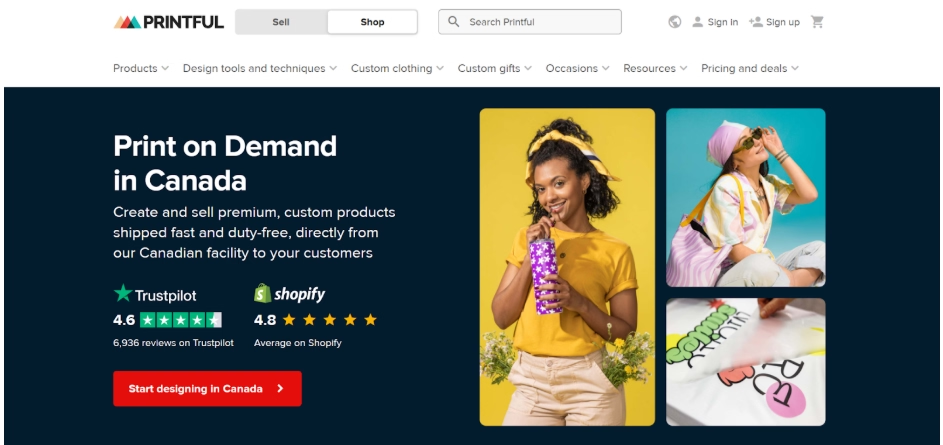
This platform specifically highlights:
- shipping from a Canadian facility
- no surprise customs or duty fees for Canadian domestic orders
- clear domestic delivery expectations (2 days to Ontario, 4 days to most provinces)
It also includes performance and trust signals such as a quality metric stating 99.76% of orders meet or exceed customer expectations.
Best for
- Canada-first apparel brands
- sellers who want fewer delivery surprises
- stores where “fast Canadian shipping” is a major part of the value proposition
Cost impact
- Local fulfillment can reduce shipping costs and customer complaints
- Better delivery speed can increase conversion rate (more buyers complete checkout)
- More predictable operations reduces refund and reship costs
Platform type 2 - A marketplace-style network with multiple Canadian print providers
If you want a broader catalog and the ability to choose among production partners, this platform type is built around giving you many print providers, including those with Canadian fulfillment centers.
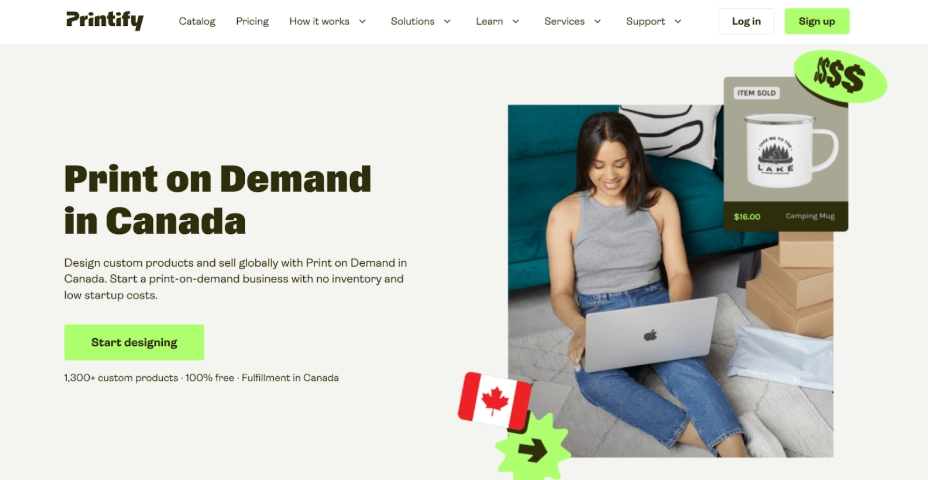
On its Canada page, this platform states it offers:
- 1,300+ customizable products
- fulfillment in Canada
- and the ability to choose local production or international providers from its network
Best for
- sellers who want variety across apparel, accessories, wall art, and more
- stores that want flexibility by choosing among print partners
- merchants optimizing for product selection and pricing control
Cost impact
- You can shop for better margins by selecting different production partners
- Shipping can vary more depending on which partner fulfills the order
- You’ll want to standardize your catalog instead of mixing too many providers early
Platform type 3 - A “produce locally, ship locally” network that routes orders to nearby facilities
If you want “local production” as a core brand message, Gelato focuses heavily on routing orders to the nearest production facility.
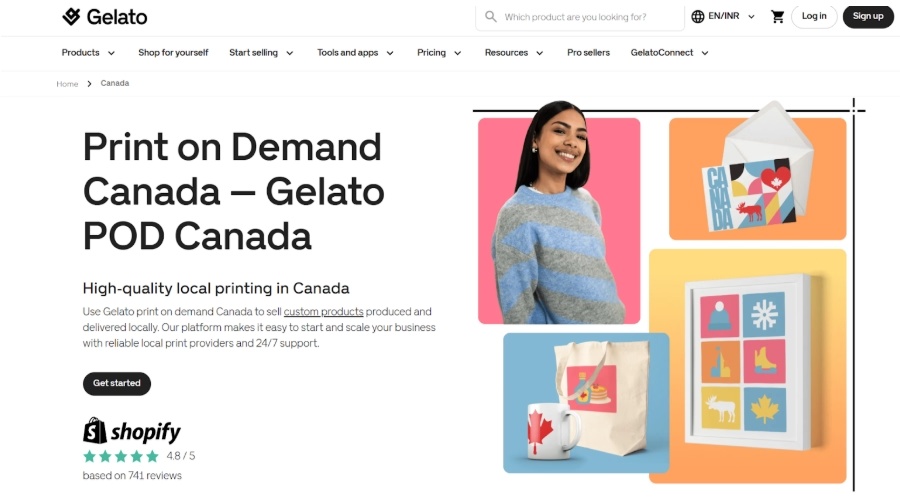
Its Canada page states:
- local production in Canada with partners including Toronto and Montreal
- local production across 32 countries
- a catalog of 500+ customizable products
- and an ecommerce market size claim of $62.12 billion by 2025 for Canada
Best for
- creators selling internationally but wanting local delivery wherever possible
- brands with sustainability messaging
- merchants who want automatic routing to reduce distance and delivery time
Cost impact
- local routing can reduce shipping distance and improve delivery speed
- pricing and shipping may vary by product category and routing availability
- great for multi-country growth because the same system scales beyond Canada
Platform type 4 - A large-scale catalog provider emphasizing rapid domestic fulfillment and huge product range
This platform type is positioned for scale and broad product coverage.
On its Canada page, it claims:
- 500,000+ customizable products
- 50+ suppliers in 10+ countries
- “local production & global fulfilment”
- and that over 80% of custom products are ready for dropshipping within 24–48 hours
It also highlights “Made in Canada” with rapid domestic fulfillment and shipping in Canada.
Best for
- wall art heavy stores (posters, framed prints, canvases)
- brands that want a huge range of customizable product types
- teams that care about speed and production turnaround
Cost impact
- strong for fast production speed which can reduce “where’s my order” support load
- the very large catalog can be a trap if you don’t curate (too many SKUs can make pricing and support messy)
- you’ll want to validate what is truly produced domestically for your key products
How to choose the best print on demand Canada platform for your store
Here’s the decision framework that actually works:
Choose a Canada-first option if
- 70%+ of customers are in Canada
- you want consistent domestic delivery expectations
- your product line is mostly apparel basics and common POD items
Choose a multi-provider network if
- you want a large catalog and flexibility
- you plan to test many product categories
- you want control by switching production partners to improve margins
Choose a local-routing global network if
- you want Canada + international customers
- you want “produce locally” as a brand message
- you want fulfillment that scales globally without replatforming
Choose a scale-heavy catalog platform if
- you sell a lot of wall art or varied product categories
- you prioritize production speed
- you want global fulfillment options baked in from day one
Print on demand Canada costs explained with a practical pricing system
Now let’s get into what most people actually struggle with: pricing.
Step 1 Calculate landed cost
Landed Cost = Product Cost + Shipping
This is the minimum you must recover.
Step 2 Estimate platform and payment fees
If you’re selling on Shopify, payment processing typically applies. If you’re selling on marketplaces, they may charge transaction fees, listing fees, and payment processing.
Instead of trying to be perfect, start with a safe estimate:
- 8%–15% of retail (varies by channel)
Then refine after your first 30–50 orders.
Step 3 Add a buffer
This protects your profit from real-world issues:
- reprints
- occasional refunds
- address problems
- support time
- discount campaigns
A realistic buffer for many stores is:
- $2–$5 per order or 3%–8% of retail, depending on product type
Step 4 Set a profit target per product category
Instead of guessing margins, set a minimum profit per item:
- tees and tanks: aim for a healthy per-order profit, not tiny “percentage wins”
- hoodies: higher retail, but also higher production and shipping—still aim for meaningful net profit
- mugs: great for gifting niches, but breakage risk means your buffer matters
- wall art: can have great margins when priced well, but shipping packaging matters
The Canadian POD shipping strategy that protects margins
Shipping is where POD stores either win or bleed.
Use shipping-baked-in pricing for conversion
If you sell to Canada, customers love predictable checkout. One reason is that domestic delivery can be clearly stated, like “2 days to Ontario and 4 days to most other provinces,” which helps set expectations and reduces cart abandonment.
Don’t price only for Ontario
Ontario delivery can be cheaper and faster. But if you price assuming Ontario shipping, you’ll get hit when orders go farther.
Build pricing around:
- “most likely” destination provinces
- plus a buffer for remote or higher-cost zones
Limit your early catalog to products that ship well
The easiest way to stabilize costs is to pick products with:
- consistent fulfillment times
- predictable packaging
- less damage risk
- simpler size variants
This is why many sellers start with:
- tees + hoodies
- crewnecks
- tote bags
- mugs (if packaging is strong)
- posters (if the platform’s packaging and delivery speed are proven)
A simple “starter catalog” for print on demand Canada
If you’re launching or rebuilding a POD store, this set is usually a strong starting point for Canada:
Apparel core
- unisex tee (your “hero” product)
- heavyweight tee (premium upsell)
- crewneck sweatshirt
- hoodie
- beanie/toque (seasonal Canada-friendly)
Giftable and repeat purchase items
- mug
- tote bag
- stickers
Content-driven products
- poster
- framed print (if you’re in an art niche)
The goal is not to have 200 items. The goal is to have 10–20 items with clear pricing and predictable shipping.
Understanding “free to use” vs actual costs
Many POD platforms are “free to start” because you don’t pay a monthly subscription to the POD provider.
For example, one platform explicitly states “100% free to use” and “no inventory needed.”
That’s true, but your real cost is still per order:
- production
- shipping
- your sales channel fees
So treat “free to use” as:
- no monthly fee to access the platform
not as: - no cost to fulfill orders
The biggest profit mistakes in print on demand Canada
Avoid these and you’ll keep more margin than most new POD sellers.
Mistake 1- Pricing with hope instead of math
If you price based on competitor vibes instead of landed cost + fees + buffer, you’ll end up working for nothing.
Mistake 2- Offering too many products early
A catalog of 100+ items usually creates:
- inconsistent shipping costs
- more customer questions
- higher support load
- more returns due to wrong sizing and unclear product expectations
Mistake 3- Not setting realistic delivery expectations
When delivery is unclear, customers complain more. When it’s clear, they trust you more.
Platforms that provide concrete domestic expectations help you write better shipping policies and reduce support tickets.
Mistake 4- Ignoring quality and packaging realities
Quality issues and damages don’t just cost refunds—they cost your brand reputation and ad performance.
Mistake 5- Running discounts without recalculating margin
A 15% discount can wipe out your profit if your margin is thin. Always test your promo pricing with your formula before you launch a campaign.
Practical steps to launch print on demand Canada profitably
Launching print on demand Canada profitably isn’t about uploading designs and hoping for sales—it’s about setting the right foundation from day one. From choosing products that ship well within Canada to pricing with real margins (not guesses), small setup decisions have a big impact on long-term profitability. The steps below focus on minimizing risk, controlling costs, and creating a store that can scale sustainably without being derailed by thin margins, slow delivery, or avoidable returns.
Step 1- Pick your niche and product angle
Canada-specific angles that often work well:
- winter lifestyle and humor
- city pride (Toronto, Vancouver, Calgary)
- outdoors culture (camping, hiking, lake life)
- bilingual or regional identity products
Step 2- Choose 10–20 products and set pricing using the formula
Get your landed cost and then set pricing with a profit target.
Step 3- Write product pages that reduce returns
Returns are a profit killer. Add:
- size charts
- clear materials
- wash care
- “fit notes” (true to size, relaxed, etc.)
Step 4- Build trust signals
- delivery estimate ranges
- clear refund policy
- customer photos if possible
- support contact details
Step 5- Order samples before scaling
Samples help you:
- validate print quality
- confirm sizing
- shoot original photography (better conversion than generic mockups)
How Spocket can support a POD store strategy
Print on demand is great for custom products, but many stores improve profitability by increasing average order value.
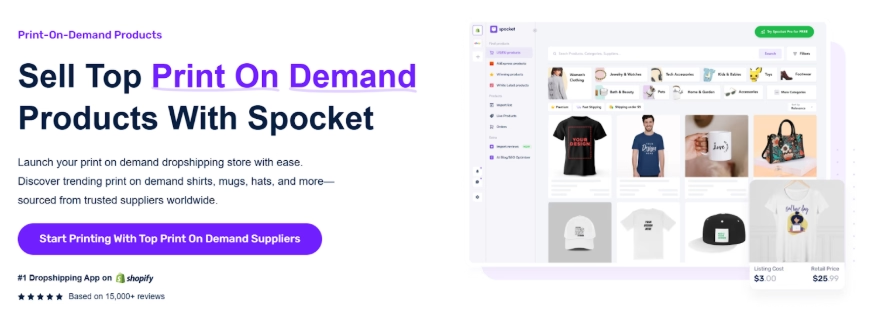
You can build your store around POD as the “signature” line (your designs), then add complementary products that match your brand’s theme so customers can bundle items in one cart. This helps because you’re not relying on one product type to carry the entire business.
Think of POD as the brand identity layer and Spocket as a way to broaden your catalog strategically without turning your store into a random product mix.
Conclusion
Print on demand Canada works best when you treat it like a margin-led business, not just a design project.
Pick a platform based on your audience location and fulfillment needs, build a focused starter catalog, and price every product with a formula that includes landed cost, fees, a buffer, and real profit. Then scale what sells instead of adding endless SKUs.
Once your POD line is stable, adding complementary products can raise your order value and reduce dependence on a single product category—and Spocket can help you expand that way without holding inventory.
Start your dropshipping business today
FAQs about print on demand Canada
Is print on demand profitable in Canada?
It can be, especially when you use local fulfillment options and price with a proper margin buffer. Platforms emphasizing domestic fulfillment and clear shipping timelines make it easier to set expectations and keep customers happy.
Do I need to register a business to start?
You can start small, but if you scale, you’ll want to understand tax obligations and registrations that apply to your business model and province. Many POD guides encourage consulting a tax professional for GST/HST questions.
How much does print on demand cost in Canada?
Print on demand costs in Canada vary by product type, printing location, and shipping destination. Your main costs include the base product price, printing, shipping, platform fees, and payment processing. Profitability depends on pricing with a buffer that covers returns, reprints, and promotions rather than relying on minimal margins.
How long does print on demand shipping take in Canada?
Shipping time depends on where the product is produced and where the customer is located. Orders printed in Canada typically arrive faster and are more predictable than cross-border shipments. Delivery estimates usually combine production time and shipping time, so setting clear expectations on product pages helps reduce customer inquiries and refunds.
What products work best for print on demand in Canada?
Products that ship efficiently and have consistent demand tend to perform best. Apparel like t-shirts, hoodies, and sweatshirts are popular year-round, while mugs, tote bags, and posters work well as gifts. Focusing on a small, curated catalog often leads to better margins and fewer operational issues than offering hundreds of products at launch.


Launch your dropshipping business now!
Start free trial


Related blogs
How to Set Up Automated Order Fulfillment With Spocket and Shopify
Set up a smoother Shopify dropshipping workflow with Spocket by connecting your store, importing products, processing orders, syncing tracking, and reducing manual fulfillment tasks.


How to Open a Business Bank Account for Your Dropshipping Store
Set up your dropshipping finances the right way with a dedicated business bank account built for payouts, supplier payments, taxes, and long-term store growth.
Spocket vs Dropified: Which Tool Is Better for Multi-Store Scaling?
Compare Spocket and Dropified for multi-store dropshipping, supplier quality, automation, fulfillment, product sourcing, and scaling across ecommerce platforms.