Product Information Management (PIM): When You Need It and Best Practices
Learn when to use PIM for ecommerce, how it improves product data quality, and the best practices for managing catalogs, channels, and customer experience.
.avif)

Selling online looks simple from the outside. Add products, upload images, write descriptions, set prices, and start selling. But once a store begins to grow, product data quickly becomes one of the most difficult parts of ecommerce to manage.
A few products may be easy to update manually. A few hundred are not. Add multiple variants, bundles, supplier feeds, region-specific details, marketplace requirements, channel-specific descriptions, and frequent inventory or attribute updates, and things start to break. Titles become inconsistent. Product specifications go missing. Images do not match the right variants. Teams waste hours updating the same information in multiple places.
That is where pim for ecommerce becomes important.
This guide explains what pim for ecommerce really means, when you actually need it, the signs your store has outgrown manual product management, and the best practices for implementing PIM successfully. It also covers how PIM fits into a modern ecommerce workflow, especially for stores managing suppliers, variants, and multichannel sales.
What is PIM for Ecommerce?
Before deciding whether you need PIM, it helps to understand what it actually does.
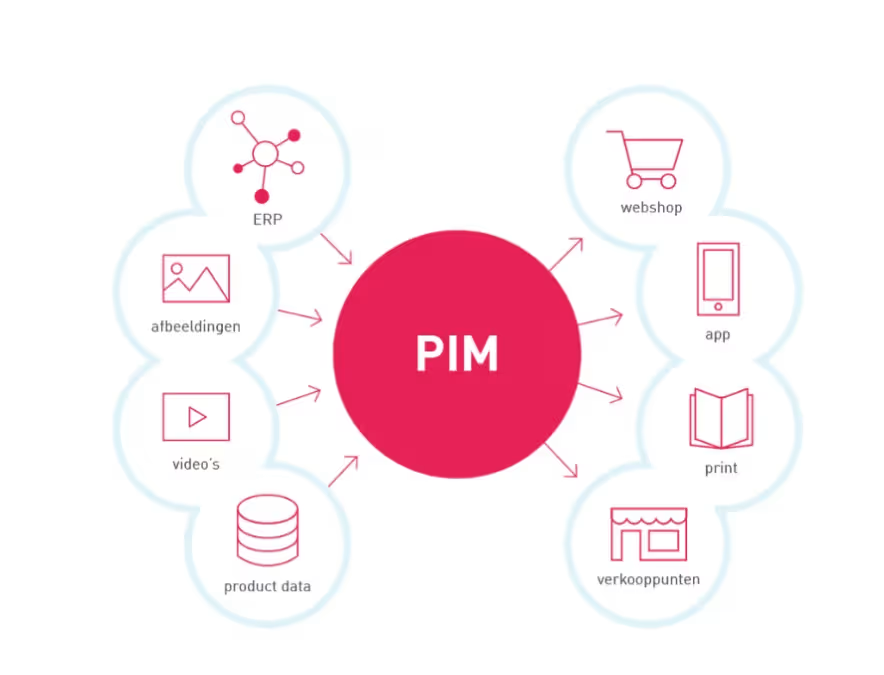
PIM stands for Product Information Management. In ecommerce, it refers to the system and process used to collect, manage, enrich, and distribute all product-related information from a single source of truth. This usually includes:
Product titles and names
These are the customer-facing product names used on your storefront, marketplace listings, and sometimes internal catalogs.
Descriptions and bullet points
This includes short descriptions, long descriptions, feature lists, materials, sizing notes, care instructions, and channel-specific marketing copy.
Product attributes
Attributes are structured details like color, size, dimensions, material, weight, style, compatibility, gender, category, or season.
Images and digital assets
PIM often supports product photos, videos, manuals, diagrams, certifications, and brand assets tied to specific products or variants.
SKU and variant data
This includes internal product identifiers, variant mapping, parent-child relationships, and catalog structure.
Supplier information
Supplier names, sourcing details, origin, lead times, shipping notes, and procurement-related information can all be part of a product information workflow.
Channel-specific requirements
Different channels often require different formats, character limits, image rules, and mandatory attributes. PIM helps adapt the same base product data for each destination.
In simple terms, pim for ecommerce helps you keep product data clean, complete, consistent, and ready to publish everywhere you sell.
Why Product Information Matters So Much in Ecommerce
Product information does more than fill a page. It affects nearly every important ecommerce outcome. A customer cannot touch, test, or inspect your product in person. They rely on the information you provide. If that information is weak, confusing, or incomplete, conversions drop. If it is inaccurate, returns increase. If it is inconsistent across channels, trust erodes.
Here is why strong product information matters.
It improves conversion rates
Clear titles, complete descriptions, accurate specifications, and good images help shoppers understand what they are buying. The easier it is to evaluate a product, the easier it is to convert.
It reduces returns and support tickets
Many returns happen because the product did not match customer expectations. Better product information reduces confusion around size, color, materials, compatibility, and usage.
It supports SEO
Structured, descriptive, keyword-aware product content helps search engines understand your catalog. Better product data can improve organic visibility across category pages, product pages, and long-tail searches.
It enables multichannel selling
When selling across your storefront, social commerce, marketplaces, and retail partners, data consistency becomes critical. PIM makes that possible.
It speeds up internal operations
Teams waste a huge amount of time fixing naming issues, reformatting supplier files, rewriting missing descriptions, and correcting listing errors. Centralized data management reduces that friction.
What a PIM System Is Not
Many ecommerce teams confuse PIM with other systems. That creates unrealistic expectations and poor implementation choices. A PIM is not the same as:
An ecommerce platform
Your store platform displays and sells products. A PIM manages and prepares the product data that feeds into that platform.
An inventory management system
Inventory tools track stock levels and movement. A PIM manages the descriptive and structural information about products.
An ERP
An ERP handles broader business processes like finance, procurement, and operations. A PIM focuses specifically on product information.
A DAM only
A DAM, or digital asset management system, focuses on images and media files. PIM includes product data plus supporting content and relationships.
That distinction matters because many stores try to force one system to do the job of three. Usually, that works only until the catalog becomes too large or too complex.
When You Need PIM for Ecommerce
Not every store needs a dedicated PIM from day one. If you sell ten products with simple variations in one channel, you may be fine using your ecommerce backend and a well-maintained spreadsheet.
But there is a tipping point. Once product complexity increases, manual management starts creating hidden costs. Here are the clearest signs that you need pim for ecommerce.
You Have a Large or Growing Catalog
A growing catalog is usually the first trigger.
The more products you add, the harder it becomes to maintain naming standards, descriptions, tags, specifications, images, and variant logic manually. This gets worse when different team members use different rules.
If your team is spending more time fixing product data than launching products, that is a strong signal.
You Sell Across Multiple Channels
The moment you start selling on multiple channels, product data becomes much harder to manage.
Each channel may need:
- Different title lengths
- Different mandatory attributes
- Different image rules
- Different category mapping
- Different language or regional formatting
Without a centralized product information process, teams end up duplicating work and making errors. PIM solves this by letting you manage one core data set and adapt it for each channel.
Your Product Data Lives in Too Many Places
If product information exists across spreadsheets, email threads, supplier PDFs, cloud folders, marketplace dashboards, and internal notes, you already have a problem.
Disconnected data leads to:
- Version confusion
- Missing fields
- Duplicate effort
- Delayed launches
- Human error
A PIM system creates one structured home for product data so teams stop chasing the latest version.
Your Team Struggles With Data Quality
Poor data quality is one of the biggest reasons to implement PIM.
Common symptoms include:
- Inconsistent naming conventions
- Missing product attributes
- Duplicate SKUs or listings
- Wrong or outdated images
- Incomplete descriptions
- Incorrect variant mapping
These problems hurt both customer experience and internal efficiency. PIM introduces structure, governance, and validation rules to improve quality.
Product Launches Take Too Long
If launching new products feels slow, messy, and dependent on last-minute manual fixes, your current workflow may not scale.
A PIM can streamline onboarding by giving teams a repeatable process for importing, validating, enriching, approving, and publishing product data.
This becomes especially important for seasonal catalogs, promotional drops, and fast-changing product lines.
You Work With Multiple Suppliers
This is a major ecommerce use case.
When suppliers provide product data in different formats, with different naming standards and varying levels of completeness, internal cleanup becomes a constant burden. For stores using supplier-driven models, including dropshipping, this becomes even more important.
With Spocket, merchants can simplify supplier discovery and product sourcing, but product data management still needs structure as catalogs grow. A strong PIM workflow helps standardize product titles, features, media, tags, and attributes across sourced products so the storefront stays consistent and conversion-ready.
You Need Better Product Content for SEO and Conversion
If your team wants to improve product pages for search visibility, ads, and conversion, product data must be managed more strategically.
A PIM can support richer product information by making it easier to:
- Standardize descriptions
- Add structured attributes
- Enrich missing fields
- Create channel-specific content
- Maintain consistency across large catalogs
This is especially useful for stores trying to scale organic traffic without turning catalog management into a manual content operation.
Benefits of PIM for Ecommerce
Once implemented well, PIM creates benefits across marketing, operations, merchandising, and customer experience.
Stronger Product Data Quality
This is the biggest benefit.
A PIM helps teams enforce completeness, standardization, taxonomy rules, attribute consistency, and approval workflows. Instead of relying on memory or spreadsheets, the system supports structured quality control.
Faster Time to Market
When product onboarding is organized, stores can launch new items faster.
That matters when you are working with trending products, seasonal demand, time-sensitive promotions, or fast-moving supplier catalogs.
Better Omnichannel Consistency
Customers expect product information to match wherever they find your brand. A PIM helps ensure consistency across your storefront, mobile experience, marketplaces, ads, feeds, and partner channels.
Easier Scaling
Manual processes often look cheap at first, but they become expensive as the catalog grows. PIM reduces the operational drag that comes from scaling without structure.
Improved Team Collaboration
Merchandising, content, operations, marketing, and supplier management teams often touch product data. PIM makes collaboration easier by assigning roles, defining workflows, and centralizing updates.
Better Customer Experience
Accurate, rich, and consistent product information improves confidence. That often leads to better conversion, fewer misunderstandings, and fewer returns.
Common Ecommerce Scenarios Where PIM Makes Sense
To make this more practical, here are the types of stores that usually benefit most from pim for ecommerce.
- Stores With High SKU Counts: If you manage hundreds or thousands of products, PIM quickly becomes valuable.
- Variant-Heavy Catalogs: Apparel, beauty, electronics, home goods, and accessories often have many combinations of size, color, style, and configuration. Variant-heavy catalogs need structure.
- Supplier-Driven Stores: If product data is coming from many suppliers, normalization becomes essential.
- Multi-Region Stores: Selling across countries often requires language adjustments, measurement conversions, and localized descriptions.
- Marketplace Sellers: If you publish products to multiple marketplaces, PIM helps manage channel-specific formatting and compliance.
- Fast-Growth Brands: Rapid growth often exposes weak backend processes. PIM helps you scale cleanly instead of reactively.
Best Practices for Implementing PIM for Ecommerce
Buying or adopting a PIM is not enough. Success depends on how you structure the process around it. Here are the best practices that matter most.
1. Start With a Product Data Audit
Before implementation, review your existing catalog. Look at:
- Missing attributes
- Duplicate products
- Inconsistent naming
- Broken taxonomy
- Incomplete images
- Supplier data quality issues
- Channel formatting problems
You need to understand your current mess before you can organize it.
2. Define Your Product Data Model Early
One of the most important steps is creating a clear product data model. This includes:
- Product families
- Categories and subcategories
- Attribute sets
- Required fields
- Variant relationships
- Naming conventions
- Units and formatting rules
Without this foundation, the PIM becomes another place to store chaos.
3. Build Around Real Workflows
Do not design PIM around theory. Design it around how your team actually works. Ask:
- Who imports supplier data?
- Who writes descriptions?
- Who approves images?
- Who checks completeness?
- Who publishes to channels?
- Who owns taxonomy changes?
A good PIM workflow reflects real operational responsibilities.
4. Standardize Naming Conventions
Inconsistent naming creates confusion for both customers and teams. Set rules for:
- Product titles
- Variant names
- Attribute labels
- Size formatting
- Color naming
- Brand capitalization
- Bundle naming
This improves both internal efficiency and storefront consistency.
4. Prioritize Attribute Completeness
Missing attributes hurt search filters, product discovery, channel compliance, and customer decision-making.
Define required fields by product type and make completeness a measurable KPI. This is one of the most practical uses of PIM governance.
5. Separate Core Data From Channel-Specific Data
This is a critical best practice.
Keep universal product information in one structured layer, then create channel-specific overrides where needed. That way, you maintain consistency without forcing one-size-fits-all content everywhere. For example:
- Core product title
- Marketplace title version
- SEO product description
- Short mobile description
- Region-specific feature notes
That structure prevents duplication while still allowing flexibility.
6. Create Approval Workflows
Not every update should go live immediately. Use review and approval processes for:
- New products
- Major attribute changes
- Regulatory or compliance-sensitive content
- Brand content edits
- Image updates
This reduces publishing mistakes and strengthens accountability.
7. Clean Supplier Data Before Publishing
Supplier data is often incomplete, inconsistent, and not optimized for conversion. Do not publish it blindly. Instead, use your PIM workflow to:
- Reformat titles
- Normalize attributes
- Rewrite descriptions
- Remove duplicates
- Improve image organization
- Align tags with your storefront structure
This is especially valuable for stores using supplier-sourced catalogs through ecosystems like Spocket, where growth can be fast and product consistency becomes a competitive advantage.
8. Align PIM With SEO Strategy
PIM should not only support operations. It should support discoverability. This means using it to manage:
- Keyword-aware product titles
- Structured product attributes
- Search-friendly descriptions
- Consistent taxonomy
- Collection and filter logic
- Unique product content where needed
When product information is organized well, SEO execution becomes easier at scale.
9. Integrate PIM With the Right Systems
A PIM works best when connected to the rest of your ecommerce stack. Depending on your setup, this may include:
- Ecommerce platform
- ERP
- Inventory systems
- Supplier feeds
- DAM
- Marketplaces
- Feed management tools
- Analytics systems
The goal is not maximum complexity. The goal is clean data flow.
10. Train Teams on Governance, Not Just Software
Implementation often fails because teams learn the tool but not the rules. Your team should understand:
- Who owns what data
- Which fields are mandatory
- How products are categorized
- What approval steps are required
- How naming rules work
- When to use channel-specific overrides
PIM is partly a software project, but mostly a process discipline project.
Mistakes to Avoid With PIM for Ecommerce
PIM can be powerful, but there are a few common traps.
- Implementing It Too Late: Many stores wait until the catalog is already unmanageable. That makes migration harder and cleanup more expensive.
- Treating PIM Like a Storage Bin: PIM is not just a dumping ground for product data. It should improve structure, quality, and workflow.
- Ignoring Data Governance: Without clear ownership and standards, even a good PIM becomes messy over time.
- Overcomplicating the Model: Some teams create overly complex attribute structures that confuse users and slow adoption. Build enough structure to support the business, but keep it usable.
- Failing to Clean Legacy Data: A PIM does not automatically fix bad data. If you import poor-quality catalog data without cleanup, you just centralize the mess.
- Not Defining Success Metrics: You should know what success looks like. That could include: Faster launch times, Better data completeness, Fewer product page errors, Lower return rates, Stronger channel consistency, Improved conversion on enriched product pages.
How PIM Supports Dropshipping and Supplier-Led Ecommerce
PIM is especially relevant for dropshipping and supplier-led models because the product catalog is often assembled from multiple external sources. That creates unique data challenges:
- Different supplier formats
- Inconsistent materials and dimensions
- Duplicate products from different vendors
- Confusing variant logic
- Weak image consistency
- Generic descriptions that do not convert
For merchants using Spocket, supplier access is a major operational advantage, but the customer experience still depends on how product information is presented. A strong PIM process helps transform sourced product data into a polished, consistent catalog that feels like a real brand, not a patchwork of supplier feeds.
That matters if you want to:
- Improve storefront quality
- Build stronger SEO value
- Launch products faster
- Keep product pages consistent
- Reduce confusion across variants and collections
PIM turns supplier data into ecommerce-ready product data.
How to Know If You Are Ready for PIM
You do not need to wait for total chaos before exploring PIM. You are likely ready if several of these are true:
- Your catalog is growing quickly
- Product data errors happen regularly
- Multiple teams touch product information
- You sell in more than one channel
- Supplier files require frequent cleanup
- Product launches are slow
- Data lives in too many places
- Content consistency is weak
- You need stronger filtering and attributes on-site
- SEO and merchandising teams need better structure
If those pain points sound familiar, a PIM strategy is worth serious consideration.
Final Thoughts on PIM for Ecommerce
Managing product information manually may work for a while, but it rarely works forever. As catalogs grow, channels multiply, and teams expand, product data becomes too important to manage through scattered files and ad hoc processes.
That is why pim for ecommerce matters. It gives online stores a structured way to centralize, clean, enrich, govern, and distribute product information at scale. Done right, it improves far more than backend organization. It improves speed, consistency, discoverability, team efficiency, and customer trust.
For ecommerce brands that want to scale cleanly, PIM is not just a technical upgrade. It is an operational foundation. And for supplier-led businesses, especially those expanding product selection through platforms like Spocket, strong product information management can be the difference between a cluttered catalog and a conversion-ready storefront.
When product data becomes a growth bottleneck, that is usually your signal. It is time to stop managing product information everywhere and start managing it properly in one place.
Start your dropshipping business today
FAQs About PIM for Ecommerce
What is PIM in ecommerce?
PIM in ecommerce stands for Product Information Management. It is the process of centralizing and managing product data such as titles, descriptions, specifications, images, and attributes so it can be published consistently across all sales channels.
When do you need PIM for ecommerce?
You usually need PIM when your catalog becomes too large or too complex to manage manually, especially if you sell across multiple channels, work with many suppliers, or struggle with inconsistent product data.
Is PIM only for large ecommerce businesses?
No. Large catalogs benefit the most, but mid-sized and fast-growing stores can also gain a lot from PIM, particularly if product data quality is slowing down launches or causing listing errors.
How is PIM different from inventory management?
Inventory management tracks stock levels and product movement. PIM manages the descriptive and structural information about products, such as attributes, specifications, titles, images, and channel-ready content.
Can PIM help dropshipping stores?
Yes. Dropshipping stores often work with supplier data from multiple sources. PIM helps standardize and enrich that data so product pages are more accurate, consistent, and conversion-friendly.


Launch your dropshipping business now!
Start free trial


Related blogs

Top WordPress eCommerce Themes for 2026
Explore the best WordPress eCommerce themes for 2026. Compare WooCommerce themes by speed, design, features, and dropshipping potential.


Saba Mohebpour Didn't Stop at Spocket: His New $50M Fund, ILA Capital, Is Buying Up Shopify and Amazon Apps
After building Spocket into a major ecommerce platform, Saba Mohebpour is launching ILA Capital with a $50M strategy to acquire Shopify and Amazon apps powering modern ecommerce.


Top Trendsi Alternatives for Fashion Dropshipping
Explore the best Trendsi alternatives for fashion dropshipping, fast shipping, branding, Shopify integration, and reliable suppliers.