How to Start an Online Business in 2026?
Learn how to start an online business in 2026 with actionable steps. Discover best online business ideas and avoid common pitfalls.

Starting an online business in 2026 is more realistic than you might think. The barrier to entry has never been lower, and the market opportunities have never been wider. Whether you're looking to replace a 9-to-5 job or add income to your current earnings, the path forward is clearer than ever.

But here's the thing: with AI lowering the entry barrier, generic offers won't cut it anymore. You need specificity, a clear target market, and a plan that actually works. In this guide, we'll walk you through everything you need to know about how to start an online business in 2026, including the best online business ideas, the tools you'll need, and the mistakes to avoid.
How Online Business Is Changing in 2026
The online business landscape looks different than it did even two years ago. Generic passive income courses? Dead. Random AI YouTube channels? Already oversaturated. Dropshipping with zero differentiation? You'll compete on price until there's no profit left.
What's actually thriving is specificity. Businesses that own a niche and solve real problems are winning. The market is moving toward real human connection (communities are booming because people are lonely), personalized transformations (cohort-based courses beat DIY recordings), and expertise that's hard to replicate (one-on-one coaching, specialized services, unique skills).
AI didn't kill online business—it killed lazy business. The winners in 2026 are those who use AI as a tool, not as a substitute for real value. They know their exact customer, understand their pain points, and build solutions that matter.
Why 2026 Is the Right Time to Start an Online Business
2026 is actually ideal timing. Here's why:
- The creator economy is worth $250 billion and projected to double by 2030. Freelancing is projected to be 50% of the US workforce by 2027. Online education is heading toward $280 billion by 2029. The subscription economy will hit $2.23 trillion by 2028.
- These aren't small markets. They're massive and still growing. The demand is there. But the markets are also efficient now—meaning you can't compete on "being first" anymore. You compete on being specific, being good, and understanding your customer better than anyone else.
- That's actually an advantage. It means less competition from people half-heartedly throwing ideas at the wall. More competition from focused entrepreneurs who know what they're doing. This is the time to start because the barriers to execution are low (tools are cheap), the demand is high (real markets with real money), and the noise is becoming predictable (you know which tactics don't work).
How to Start an Online Business in 2026
Before you pick a platform or buy tools, you need to get the foundation right. This is where most people fail.
Step 1: Validate Your Idea Before You Build
Don't spend months building something nobody wants to buy. Instead, start with market research. Look at your potential customers. What's their biggest pain point? What would they pay to solve it?
If you want to sell carousel templates, don't make generic ones. Check if people actually want carousel templates. See if they're willing to pay. Look for people already monetized (they have paid sponsorships, products in their bio). If they're not making money yet, they can't pay you.
Step 2: Pick a Specific Niche, Not a Generic Market
This is non-negotiable. Don't say "I'm selling YouTube thumbnail templates." Say "I'm selling gaming YouTube thumbnails with a cinematic aesthetic" or "productivity app thumbnails with minimalist design."
The math is simple: you need 1,000 customers at $100 to make $100,000 per year. You don't need millions of people. You need the right 1,000 people. Specificity gets you there faster because you face less competition and you know exactly who you're marketing to.
Step 3: Find Your Competitive Edge
What stops someone else from doing exactly what you do and stealing your customers? This is your moat. It could be a unique technique, exclusive access to resources, a design style nobody else uses, or a specific way of solving a problem.
If you can't answer this question, your business will eventually die because you'll compete on price alone. Find your edge first.
10 Online Businesses You Can Start in 2026

The opportunities are endless, but here are the categories making real money right now.
1. Creator Economy Services
The creator space is booming. Creators need help—lots of it. You could be a YouTube strategist helping creators optimize their channels, a video editor specializing in short-form content, a thumbnail designer, or a content repurposer who converts YouTube videos into TikTok clips.
You could also become a carousel designer (Sprout Social data shows carousels have the second-highest engagement rate after Reels). Don't offer "design services." Offer "carousel design for SaaS founders" or "TikTok thumbnails for gaming creators."
2. Short-Form Video Editing
Businesses use short-form video for market research now—testing messages before committing to big launches. This means constant demand for short-form editors. You could specialize in Cap Cut editing, cinematic transitions, or creating signature series that stop the scroll.
You can also get paid for cutting and remixing clips on TikTok. There are many gigs you can find on discord servers related to these short form video editing projects.
3. Community Building and Management
Loneliness is real, and people want smaller, cozier communities. AI can't replicate genuine human connection, which makes community business AI-proof. You could run co-working sessions, host retreats, build Discord communities, or facilitate hobby clubs.
You can also join websites like RentaCyberfriend and get paid for chatting and making friends online.
4. Freelance Services (Gig Economy)
By 2027, over 50% of the US workforce will be freelancing. Every online business needs support. You could offer virtual assistance, graphic design, copywriting, social media management, or web development. The highest-demand role? Digital business manager—someone who runs the CEO's operations so they can scale and actually take a vacation.
5. Online Education and Courses
But not generic courses. What's working is intentional education: mini-courses, cohort-based programs, workshops, sprints, and live mentorship.
6. AI Integration and Chatbot Development
AI is now infrastructure, not a trend. The edge is how you use it. You could help businesses integrate AI into their workflows, develop chatbots for customer service, create AI-powered apps, or sell AI prompt templates.
If you’re thinking of becoming a work from home AI engineer, there is no better time to now. Try Datacamp’s AI developer roadmap, make a portfolio, and you’ll get hired soon by top brands.
7. Subscription Businesses
The subscription economy is massive. You could help businesses set up subscriptions (choosing the right platform, configuring it), manage their communities, or run funnels to bring people into subscriptions. You could also create digital subscription products: monthly resource libraries, membership communities, or subscription boxes.
8. E-commerce with Differentiation
Yes, you can still do dropshipping or direct-to-consumer e-commerce, but you need an angle. Unique products, specific target market, strong branding. If your offer is generic, you'll lose.
9. Digital Product Creation
Sell templates, presets, design systems, editing packs, LUTs, sound effect packs, or anything else creators need. "Notion templates for ADHD entrepreneurs" beats "productivity templates", these sell like hotcakes every time.
If you are very good at prompting LLMs, then you can even sell custom prompts. There are many businesses who pay for custom GPTs and AI tools. If you are specializing in digital product creation, then we also recommend selling art. You can sell art online, like a pro, if you are very skilled at it.
You can also sell overlay packs, royalty free music, and so many other kinds of digital products as well.
10. Content Repurposing Services
Many creators have tons of content but no time to repurpose it. You could help them turn YouTube videos into TikToks, blog posts into carousels, or podcasts into clips. Just drop a DM to Mrbeast and iShowSpeed and ask about this to them.
If you are trying to repurpose blogs from websites, forums and news outlets, then you should use Smartli’s AI tools.
Tools You Need to Start an Online Business in 2026
You don't need much to get started.
To Build Your Store
- Shopify (you own your store and customer data, unlike Etsy)
- Wix or WordPress (for more flexibility)
- No-code builders like Webflow (if you want design control)
To Create Content
- Canva (templates, graphics, carousels)
- CapCut (video editing)
- Adobe Suite (if you need professional tools)
To Find Products (If E-commerce)
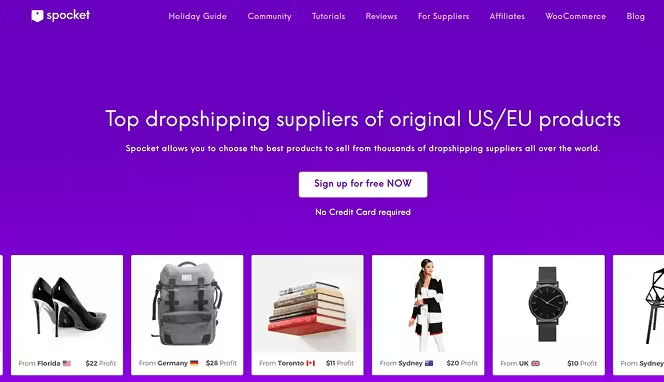
- Spocket (US and EU suppliers with verified products, 24/7 support, no MOQs, free trial)
To Manage Operations
- Google Workspace (email, sheets, docs)
- Airtable or Notion (databases, workflows)
- Stripe or PayPal (payments)
To Market
- Mailchimp or ConvertKit (email)
- Buffer or Later (social scheduling)
- Linktree (link management)
To Track Money
- QuickBooks or Wave (accounting)
- Google Analytics (traffic)
You can start with free or cheap versions of most of these. Don't overspend on tools before you have customers.
How Much Money Can You Actually Make From Your Online Business?
This depends on your business model and niche. But here's the reality:
If you sell digital products at $99, you need 10 sales per month to hit $12k annually. If you sell at $997, you need 10 sales annually. Scale to 100 sales, and you're at $100k per year.
Service-based businesses can charge more. A digital business manager can charge $3,000–$5,000 per month. A course creator can make $10k–$100k+ per launch. A consultant charging $200/hour can make $100k with 500 billable hours per year.
Passive income businesses (like digital products or subscriptions) take time to ramp but scale faster once they do.
How to Streamline and Scale Your Online Business
Once you have customers and revenue, scaling means removing yourself as the bottleneck.
If you're doing services, document your process and hire help. A digital business manager can hire virtual assistants. A course creator can hire community managers. A content creator can hire editors and designers.
If you're selling digital products, automate everything: email sequences, order fulfillment, customer onboarding. Tools like Zapier connect your apps so work happens without you.
If you're running a community, bring in moderators and community managers. Real connection requires human touch, but it doesn't have to be you managing every conversation.
Best Niches to Focus On for Online Businesses in 2026
Here are some niches with real demand right now:
For Services
- ADHD productivity tools and coaching
- Personal finance for Gen Z
- Business automation for small business owners
- Mental health and wellness coaching
- Sustainable product sourcing
For Products
- Templates for specific software (Notion, Figma, Canva)
- Aesthetic design systems
- Niche hobby products (gaming, fitness, eco-friendly)
- Personalized items
- Eco-friendly alternatives
For Communities
- Digital nomads
- Female entrepreneurs
- Specific hobbies (crochet, gaming, gardening)
- Career changers
- Sustainability-focused groups
The best niche is one where you have some expertise or real passion. You'll be living in this space for years. Pick something you actually care about.
Directories and Resources to Use Before Starting
Before you launch, check these out:
- Statista (market data)
- Google Trends (search demand)
- Sprout Social (social media insights)
- Upwork and GlassDoor (freelance rates and demand)
- G2 (software reviews)
- ProductHunt (new product trends)
- Reddit communities (real customer pain points)
- YouTube channels in your niche (see what works)
Mistakes to Avoid When Starting Your Online Business
Here are the biggest pitfalls:
- Picking a generic niche. You'll compete with thousands. Pick specific.
- Building before validating. Don't spend months building something nobody wants. Validate first.
- Underpricing. Most people charge too little. Use the formula: (cost + labor) × 2 × 2 = price. Then adjust based on market research.
- Not understanding your customer. Who are they? What's their biggest frustration? If you can't answer this, your marketing will fail.
- Giving up too soon. Businesses take time. You won't make money in month one. Expect to invest 3–6 months before real traction.
- Trying to do everything yourself. Hire help early. Your time is your most valuable asset.
- Not marketing. You can build the perfect product and nobody will find it. Marketing is non-negotiable.
- Copying competitors without differentiation. If you're just copying someone else's business, you'll always be playing catch-up and competing on price.
How to Validate Your Online Business Idea Before Launch
You don't need a finished product to validate. You need proof that people want what you're offering.
- Step 1: Talk to your target customer. Interview 20 people. Ask what their biggest problem is. Ask what they'd pay to solve it. Ask if they'd buy from you.
- Step 2: Create a landing page. Show your product idea. Collect emails. If you can get 100 emails, there's demand.
- Step 3: Pre-sell. Offer your product or service before you build it. If five people buy, you have real demand.
- Step 4: Look at your competitors. Are they making money? How can you be different? If there are no competitors, there might be no market.
- Step 5: Check search volume. Use Google Ads Keyword Planner. Is anyone searching for your solution? If not, nobody's looking for it.
Start Now, But Start Smart
2026 is the year to start your online business. The tools are cheap, the demand is high, and the market is still growing. But don't fall for the generic trap. Don't build until you've validated. Don't compete on price.
Instead, pick a specific niche, understand your customer, find your competitive edge, and build something that actually solves a real problem. Start small, move fast, and iterate based on customer feedback. Scale when you have proof it works.
The best time to start was yesterday. The second-best time is today. Stop planning and start building.
Note: If you're interested in e-commerce or dropshipping, consider platforms like Spocket, which offers US and EU verified suppliers with 24/7 VIP support. Spocket provides 7-day free trials, no MOQs, Print-on-demand services, automated inventory management, and one-click product imports across Wix, Amazon, and other platforms. Over 500,000 entrepreneurs use Spocket to launch and scale their stores.
Conclusion
Starting an online business in 2026 doesn't require huge capital or years of experience. It requires clarity on who you're serving, what problem you're solving, and why you're the best person to solve it. The market is there. The demand is real. Businesses that win are specific, customer-focused, and willing to iterate. Stop waiting for the perfect moment. Validate your idea, pick your niche, and launch. Your online business is waiting.
Start your dropshipping business today
How to Start an Online Business in 2026 FAQs
How much money do I need to start an online business in 2026?
You can start with under $500. A domain ($10–$15/year), hosting ($50–$200/month), and basic tools (many free versions exist) are all you need to launch. If you're doing services, you might need less. If you're doing e-commerce, budget for inventory. Most people overspend on tools before they have customers. Start lean.
What's the easiest online business to start right now?
Service-based businesses are easiest because you don't need inventory. Freelancing (writing, design, coding, virtual assistance) lets you start immediately. You already have the skills—just package them and find customers. Content creation is another option if you're comfortable on camera or behind a microphone.
How long does it take to make money from an online business?
Most people see their first sale in 3–6 months. Real traction (consistent revenue) takes 12–18 months. This timeline depends on your marketing effort and market fit. Some businesses hit faster; others take longer. Don't expect passive income overnight. Real businesses require real work.
Should I start an online business while working my current job?
Yes. Most successful entrepreneurs start their business on the side. Use your current income to fund your business without stress. Once you hit consistent revenue, you can make the switch. This reduces risk and lets you validate your idea before going all-in.
Can I really make six figures with an online business?
Yes, but it's not easy. A $100 product needs 1,000 sales per year. A $500 service needs 200 clients. A $2,000 course needs 50 sales. It's achievable, but requires good marketing, real customer fit, and consistent execution. Most six-figure businesses spend their first year building to that level.
What's the #1 reason online businesses fail?
Lack of differentiation. Too many generic offers competing on price. The second reason: underestimating how important marketing is. You can build a great product and still fail if nobody knows about it. Spend as much time on marketing as you do on building.


Launch your dropshipping business now!
Start free trial.avif)


Related blogs
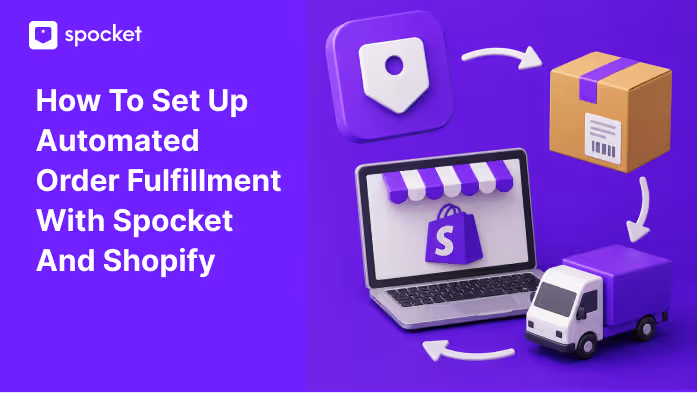
How to Set Up Automated Order Fulfillment With Spocket and Shopify
Set up a smoother Shopify dropshipping workflow with Spocket by connecting your store, importing products, processing orders, syncing tracking, and reducing manual fulfillment tasks.

How to Open a Business Bank Account for Your Dropshipping Store
Set up your dropshipping finances the right way with a dedicated business bank account built for payouts, supplier payments, taxes, and long-term store growth.
Spocket vs Dropified: Which Tool Is Better for Multi-Store Scaling?
Compare Spocket and Dropified for multi-store dropshipping, supplier quality, automation, fulfillment, product sourcing, and scaling across ecommerce platforms.