How to Make Money with Print-on-Demand in 2026
Start making money with Print-on-demand services. Learn what it takes, how to get started, and get access to resources.


Imagine turning your signature writing or art into custom merch. What if you could slap your name on a water bottle and make your name your personal brand? How about making a sketch of your face and turning it into a sticker or an avatar that can be used on posters? That's what we call print-on-demand, and it's a very profitable niche.
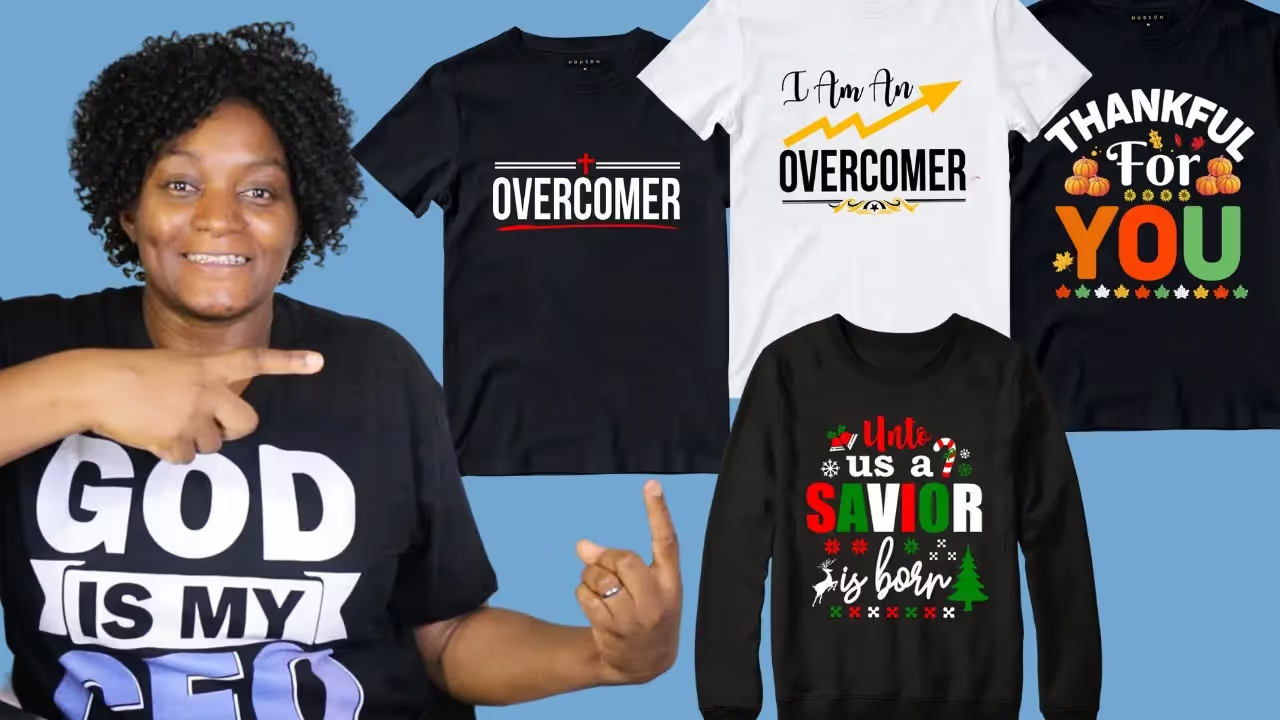
It's because print-on-demand is easy to design, and you can customize it on everyday items and sell them online. If you've had thoughts on how to make money with print-on-demand services, then this is your guide. We are going to break down everything you need to know on how to get started, make some extra cash, or even build a full-time career and be your own boss. Let's start.
How is the Global Print-on-Demand Market?
According to Grandview Research, the global print-on-demand market size is forecasted to reach USD 57.49 billion by 2033. It will grow at a CAGR of 23.3% from 2025 to 2033. That's good news for you because there will be a huge demand for customized and personalized print-on-demand products. This ranges from accessories, home decor, drinkware, footwear, and other changing consumer preferences for custom-made gifts and goods.
North America will continue to dominate the print-on-demand market and will be the largest holder due to its high level of e-commerce penetration. Print-on-demand platforms like Spocket will provide multiple customizable dropshipping options. Artisan merchants who own print-on-demand businesses can connect their stores and create new ones using AI store builders.
There are also many service providers that are offering custom software solutions like APIs and design-making tools to make growing a print-on-demand business much easier. So if you are not tech-savvy and you need help with managing your store, that's good news for you. The Gen Z customers are constantly looking for custom and unique products. So if you are marketing to younger audiences, you'll make a lot of sales.
How to Make Money with Print-on-Demand Services: 7 Easy Steps
Print-on-demand isn't some get-rich-quick scheme, but it does work and is a low-risk entry point for many e-commerce entrepreneurs. You'll find plenty of print-on-demand success stories online, but they are just a handful out of the whole crowd. It will take some time for you to see the fruits of your labor, but if you make a good plan and stick to it, then it's just a matter of time before you eventually experience success.
Now here is what we recommend if you want to make money with a print-on-demand business:
1. Come up with a good business idea
A good business idea is something that connects with your audience and is also validated by your market. It has a demand that is clear and you have tons of pain points which you can address. Good market research will be the bedrock of coming up with your business idea. Don't just target your audience randomly. Think about their ages, demographics, industries, lifestyles, etc. You'll also want to look at popular trends, customer feedback online, popular items, and see what attracts potential buyers.
2. Study competitors and customers
Besides looking at your customers, you should also examine and study your competitors to get insights into potential market gaps. There will be something they are currently not doing which is your new opportunity. You can use surveys to collect feedback and use social media engagement tools to gather insights from existing and potential shoppers. You'll have to continuously adjust your studying strategy based on who you target and how you research them. But once you have a fair clear idea in place, you can then move on to deciding or working on your product line.
If you are looking for custom apparel products to sell like t-shirts and hoodies, then the good news is these are some of the best-selling items all year round. You should check out our t-shirt dropshipping guide if you want to start a clothing dropshipping business.
Another high profitable category is home and garden products. You can sell home essentials like drinkware, aprons, towels, wall art, throw pillows, and blankets. There's just so much room to explore here. If you're a sports fan and want to target those who are interested or lead active lifestyles, then you should also check out activewear categories.
3. Choose your Print-on-Demand partner carefully
Who you work as your print-on-demand partner is equally important. Because they will determine the quality of your products, your brand's reputation, and overall customer satisfaction.
When you're choosing a print-on-demand services partner, consider the following. Do they have automatic order forwarding options and can they speed up order fulfillment? Can you customize your product listings, set pricing, and manage product variations? Do they offer room for customization and other integration possibilities? Do they also offer analytics and reporting tools so you can get access to in-depth insights about sales, trends, customer sentiments, and behaviors?
Try Dropshipping Directories
Sometimes you also want to look for good print-on-demand suppliers and you might not be happy with the choices you get online. This is where we recommend using a good dropshipping directory. A directory contains a list of global suppliers you can refer to at a glance and you can even find multiple third-party sellers for different locations. You can think of it like a digital shopping mall where numerous vendors set up their shops under one roof. Worldwide Brands and BrandsGateway are two directories we recommend. You can check out our free dropshipping directories guide for more info.
Why Use Spocket?
Spocket is trusted by 500k plus entrepreneurs and has a growing catalog of more than 100 million plus dropshipping products. It ships orders fast worldwide and has some of the best US and EU dropshipping suppliers. If you want branded invoicing and 24x7 VIP customer support, then you can consider checking out the app. Spocket also integrates with major e-commerce platforms like Wix, Amazon, and more.
4. Design your products
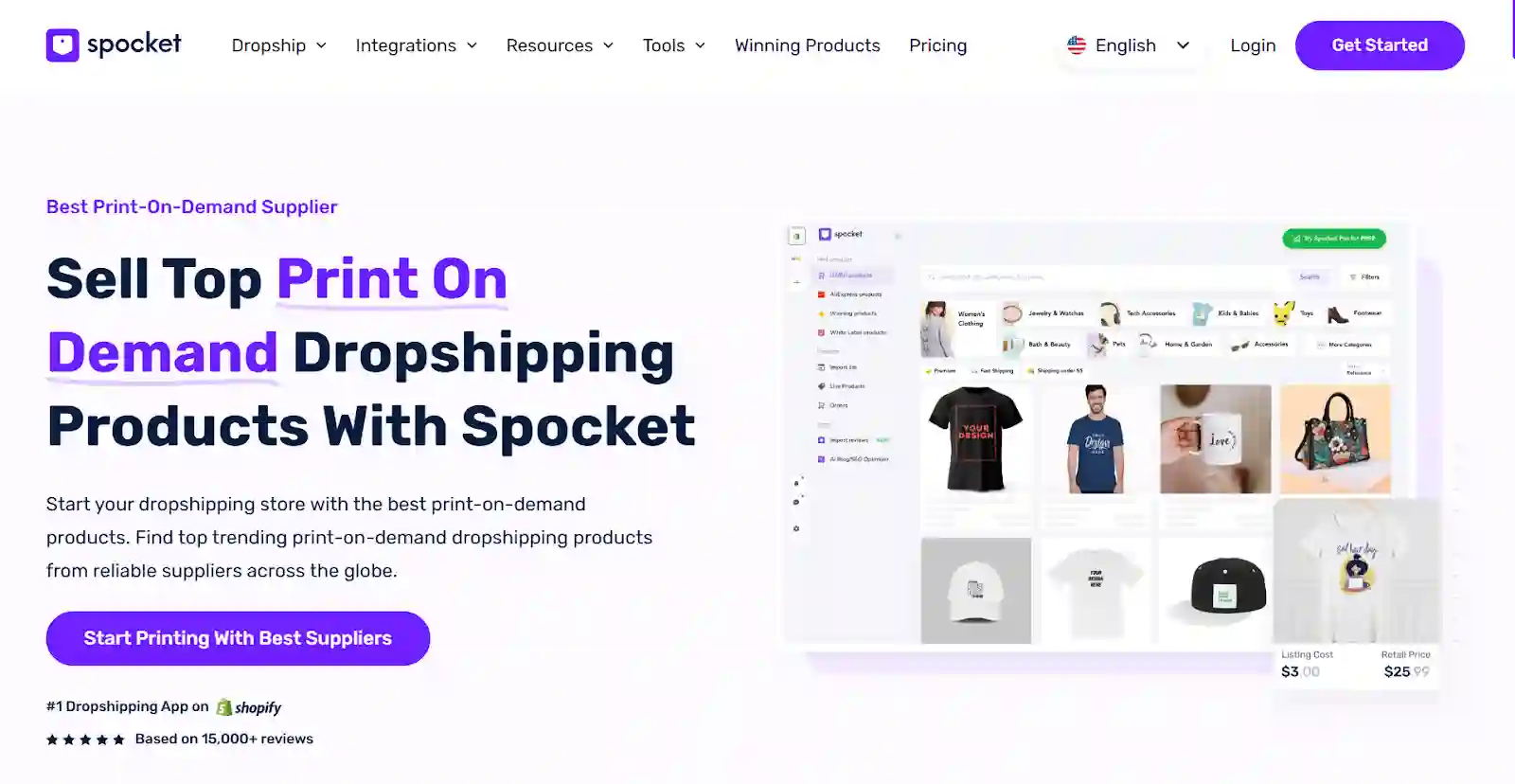
With Spocket, you can put your custom design on premium dropshipping products. You can access its design tools like Logome, templates and try out its other resources to make ready-made customizable designs, download branding guides, and so much more.
Spocket can help you set up a print-on-demand dropshipping store. You can preview and download your mock-ups, finalize designs and check how your designs fit on all-over print products. Spocket also offers multiple printing options like sublimation printing, heat transfer, DTF, etc.
You can also use open source design software to create custom designs and then forward them or upload on Spocket's platform to use on your products. When you make your print-on-demand products, another good tip is to check the quality of samples. Spocket has zero MOQs and you can order samples before deciding to buy in bulk and sell. This will help you test out your entire shopping experience from browsing to delivery.
Plus, you can take photos for your website and social media profiles which can help market your products better. We also recommend using mock-up generators to showcase product models online whenever you use print-on-demand services.
5. Build your Print-on-Demand dropshipping store.
The next natural move is to build your print-on-demand dropshipping store because without a store you can't market and sell to your customers, and that's pretty obvious. Now there are two ways you can go about this. You can either create a custom website from scratch or build your store on top of an existing e-commerce platform or website. This will depend on your business goals, resources, how much control you want, and how much time you have.
One of the biggest benefits of building your custom site is that you own everything, including the existing or underlying infrastructure. But the downside is it will require technical know-how, a lot of time, a huge learning curve, and you will be responsible for everything that goes on with your site. If something goes down, you'll have to figure it out. This is why we recommend using AI store builders.
The good news is there are some good options. You can use DropGenius to build your store with AI. It gives you an AI Shopify store for free in just two minutes, and it fully optimizes your Shopify store with winning products, ready-to-sell pages, and free dropshipping courses. And it creates stores with premium themes that are tailored perfectly for different categories.
6. Promote your online store
Once you've set up your store and you're ready to make money with your print-on-demand dropshipping business, it's time to market it because without any visibility, you can't get sales. And if nobody knows about you, then who is going to buy from you? So one of the best ways to do that is by engaging with social media followers. Create a TikTok and X account. Start posting reels on Instagram. Also, you can make posts at least twice a week. Engage with your followers. Reply to comments in your niche and target who you're replying to. There's a high chance your brand visibility will improve. Keep doing this consistently every day and you'll see some measurable real-time improvements in your online engagement.
Start Email Marketing and Influencer Collaborations
You don't have to invest in any paid ads until you grow a good enough following. Advertising can give you good returns on your investment, but we don't recommend splurging on ads just yet, not until you gain some initial traction. You can also use advanced targeting options to reach potential customers based on interests and behaviors.
Another pro tip we recommend is taking advantage of influencer collaborations. Social media influencers can help you add credibility and boost your revenue. Add credibility and boost your reach, especially micro and nano influencers, if you partner with trusted voices in your niche. You should also try out email marketing, which can help you out with targeted messaging.
It's a cost-effective investment, provides decent results, and is excellent for building and maintaining ongoing customer relationships. Email marketing is also recommended because it keeps your audience in the loop, informs them about upcoming offers, promos, and news.
7. Improve your offerings and keep creating listings
Just selling isn't enough, you have to upgrade what you offer. Just like inflation, you also want to analyze the performance of your existing products and see how you can hike prices. Don't just increase prices, improve the value of your products and services. One of the best ways to do this is identify best sellers, collect feedback from customers to see what's working and what isn't, and then upgrade them.
Use the data you collect to refine your current offerings and consistently work towards improving your offerings for upcoming lineups. You'll have to consistently iterate your product listings. Schedule regular updates based on feedback and sales data. Experiment with different features and designs to see what clicks and doesn't, and then create new ones and edit the old ones accordingly.
If you're struggling with making viral ads or need some help, you should use Dropshiptool. It can give you insights about what your competitors are doing and help you craft high-performing viral ads. You can steal your competitors' strategy without them knowing about it, spin it and make it your own.
Pros and Cons of Print-on-Demand Selling
Print-on-demand looks easy from the outside, but it comes with trade-offs. Before you dive in, it’s important to understand both the upsides and the limits so you know what you’re signing up for.
Pros of Print-on-Demand
- Low upfront investment and risk. You don’t need to buy inventory in bulk or rent a warehouse. You only pay for products after your customers place an order.
- Huge product variety without stocking anything. You can sell t‑shirts, hoodies, mugs, posters, home decor, and more without ever touching the product.
- Easy to test and pivot quickly. If a design flops, you can remove it and launch a new one the same day without being stuck with dead stock.
- Location‑independent business model. As long as you have Wi‑Fi and your store is running, you can manage your print-on-demand brand from anywhere in the world.
- Scales without heavy operational overhead. Your fulfillment partner handles printing, packing, and shipping while you focus on marketing, branding, and customer acquisition.
- Great for building a niche or personal brand. You can create designs for very specific audiences, turning inside jokes, quotes, or aesthetics into merchandise your niche can’t find anywhere else.
Cons of Print-on-Demand
- Lower profit margins compared to bulk buying. Since you’re paying per item, your base costs are higher than traditional wholesale, which eats into your profits.
- Limited control over fulfillment and quality issues. If print quality, packaging, or delivery timelines slip, your brand takes the hit even though you’re not the one shipping.
- Slower shipping times in some regions. Depending on where your customers are and where your suppliers are located, shipping can feel slow compared to Amazon‑style delivery speeds.
- Highly competitive and trend‑driven. Many niches are saturated with similar designs, so weak branding or generic ideas will struggle to stand out and convert.
- Dependence on third‑party platforms and policies. If your print partner changes pricing, product catalog, or integrations, you’ll have to adapt your entire pricing and operations.
- Marketing is non‑negotiable. You can’t just upload designs and wait. Without consistent content, ads, or collaborations, your store will stay invisible and sales will be inconsistent.
How Much Money You Can Make with Print-on-Demand?
How much you make with print-on-demand depends on your niche, pricing, and how seriously you treat it as a business. On average, new sellers who are testing designs and learning marketing might see anywhere from a few hundred dollars to $1,000 per month in revenue once they start getting some traction. Established stores with validated niches, strong branding, and consistent traffic can realistically scale to $3,000–$10,000+ per month in revenue, but that usually requires reinvesting profits into ads, influencers, and content. Your margins will often sit in the 20–40% range after product costs, fees, and discounts, so you’ll need to move volume to hit meaningful income numbers.
For timelines, expect the first 1–3 months to feel like groundwork: researching, designing, setting up your store, and testing offers. Months 3–6 are typically where you might see your first consistent profits if you’re actively optimizing your listings and marketing. For many sellers, it can take 6–12 months of steady effort to reach reliable, meaningful monthly profits, especially if you’re starting from scratch and learning everything on the go.
Conclusion
Print-on-demand is not magic, but it is a real business model with real potential. If you’re willing to experiment, learn from your data, and keep tweaking your designs and messaging, you can carve out a space for yourself in this market. Focus on building a brand, not just uploading products. Start small, stay consistent, and improve something every week—your store, your offers, your content. Over time, the skills you build in design, marketing, and customer understanding will compound. That’s where the long-term wins come from. Use Spocket to start Print-on-demand product dropshipping today!
Start your dropshipping business today
How to Make Money with Print-on-Demand FAQs
Do you need design skills to start a print-on-demand business?
You don’t need to be a professional designer to get started, but you do need an eye for what your audience likes. Many successful sellers use templates, AI design tools, and simple typography‑based designs to launch their first products. You can also hire freelancers for complex artwork. What matters more is how well your designs match your niche’s identity, humor, or pain points—not how “arty” they look.
How do you choose a profitable niche for print-on-demand?
A profitable niche is specific, passionate, and easy to target with content or ads. Instead of “fitness,” think “powerlifting moms,” “yoga teachers,” or “rock climbers.” Look for communities that already exist on TikTok, Reddit, Facebook groups, or X. Pay attention to their language, inside jokes, and recurring themes. If you can instantly think of five design ideas that would make them say, “That’s so me,” you’re probably on the right track.
What are the biggest mistakes beginners make with print-on-demand?
Beginners often try to sell to everyone, upload random designs, and expect organic sales without any marketing. Another common mistake is underpricing, which leaves no room for promotions or ad spend. Some sellers ignore product samples and only realize quality issues after customers complain. A smarter approach is to start with one niche, order samples, set healthy margins, and commit to testing creatives and offers instead of chasing overnight success.
Is it better to sell on marketplaces or your own website?
Selling on marketplaces like Etsy can help you tap into existing traffic, but you’re competing side‑by‑side with similar products and are dependent on their rules. Running your own website (for example, on Shopify or Wix) gives you more control over branding, pricing, and customer data. Many successful sellers start on a marketplace to validate demand, then build their own store in parallel so they’re not fully reliant on one platform long term.
How important are product photos and mock-ups in print-on-demand?
Your mock-ups and product photos are often the deciding factor between a scroll and a click. Even if your design is good, poor visuals will kill conversions. Use high‑quality mock-ups that show your product in real‑life scenarios your audience relates to—like a hoodie in a streetwear setting or a mug on a cozy desk. Consistent, on‑brand visuals make your store look professional and help customers imagine owning the product.
Can you run print-on-demand alongside a full-time job?
Yes, print-on-demand can be built as a side hustle if you manage your time and expectations. Many sellers handle research, design, and content creation during evenings and weekends while automation takes care of fulfillment. You’ll need to batch tasks, schedule social posts, and possibly use templates for emails and creatives. As your store grows and you see consistent sales, you can decide whether to keep it as a side income stream or scale it into a bigger business.


Launch your dropshipping business now!
Start free trial


Related blogs
Top WordPress eCommerce Themes for 2026
Explore the best WordPress eCommerce themes for 2026. Compare WooCommerce themes by speed, design, features, and dropshipping potential.


Saba Mohebpour Didn't Stop at Spocket: His New $50M Fund, ILA Capital, Is Buying Up Shopify and Amazon Apps
After building Spocket into a major ecommerce platform, Saba Mohebpour is launching ILA Capital with a $50M strategy to acquire Shopify and Amazon apps powering modern ecommerce.


Top Trendsi Alternatives for Fashion Dropshipping
Explore the best Trendsi alternatives for fashion dropshipping, fast shipping, branding, Shopify integration, and reliable suppliers.