Best Dropshipping Suppliers for Shopify in 2026
The best dropshipping suppliers for Shopify in 2026, compared by shipping origin and cost, plus a test-order scorecard and margin math to pick the right one.


The best dropshipping suppliers for Shopify in 2026 are the ones that ship from close to your customers, connect to Shopify through a working app, and survive a test order. For most US and European stores that means a supplier marketplace with local stock (Spocket, Shopify Collective, Syncee), backed by a China-based option for cheap testing (CJ Dropshipping, Zendrop, or AliExpress through DSers or AliDrop), plus a print-on-demand partner if you sell your own designs.
This guide sorts the main Shopify dropshipping suppliers by type, shows what each one costs to start, and gives you a test-order scorecard and margin math so you can pick on evidence rather than on a list.
Best dropshipping suppliers for Shopify at a glance
| Supplier | Type | Main ship-from regions | Cost to start | Best for |
|---|---|---|---|---|
| Spocket | Supplier marketplace | US, EU and other regions | Plans start at $39.99/month, 7-day trial | Fast delivery to US/EU buyers without holding stock |
| Shopify Collective | Native Shopify brand network | Supplier's own store location | Free for eligible stores | Selling established Shopify brands |
| CJ Dropshipping | Sourcing agent + warehouses | China, plus US and EU warehouses | Free, optional plans from $15.99/month | Sourcing specific products and low-cost testing |
| Zendrop | Catalog + fulfillment | China and US | Paid plans from $29/month | Custom branding and one-company fulfillment |
| Syncee | Supplier marketplace | Varies by supplier | Free for 25 products, paid from $39.99/month | Large multi-region catalog |
| AliExpress (via DSers or AliDrop) | Open marketplace | Mostly China | DSers has a free plan | Widest product range at the lowest cost |
| Printful | Print on demand | Printful's own facilities | Free to install | Consistent quality on custom designs |
| Printify | Print on demand network | Partner print providers | Free to install | Lower POD base costs and provider choice |
Prices are from each company's Shopify App Store listing or pricing page in October 2026 and change regularly, so confirm them before you commit.
Suppliers vs apps: what you're actually choosing
A lot of "best supplier" lists mix up two different things. A supplier holds the stock and ships the parcel. An app moves product data and orders between that supplier and your Shopify store. AliExpress is a marketplace of thousands of suppliers; DSers is an app that connects you to them. AutoDS is an automation app that works across many suppliers. Spocket, CJ and Zendrop are a bit of both: they run their own supplier network and the Shopify app that connects it.
The distinction matters because the app decides how much manual work you do, but the supplier decides delivery time, product quality and what your customer thinks of you. Pick the supplier first, then the app that serves it best.
The 8 best dropshipping suppliers for Shopify
1. Spocket: US and EU suppliers in one marketplace
Spocket is a marketplace of vetted suppliers, with many based in the US and Europe, so orders ship from the supplier's own country, typically within 2 to 7 days. You browse by category or shipping origin, import products to Shopify with your own pricing, and orders are fulfilled through the app with branded invoicing. Spocket also gives you AliExpress product access in the same dashboard, which is handy for test products, and more than 500,000 sellers have used it.
Good for: stores that compete on delivery speed and want to avoid buying inventory. Trade-off: product costs from local suppliers are higher than AliExpress, so you need margin in your pricing. Plans start at $39.99/month with a 7-day trial.
2. Shopify Collective: brands that already sell on Shopify
Shopify Collective lets you sell products from other Shopify brands inside your own store. According to Shopify's help center, it's free for eligible stores in supported countries, margins typically range from 20% to 50%, orders are forwarded to the supplier automatically, and tracking syncs back so your normal shipping emails go out.
Good for: curated stores that want recognizable, branded products rather than generic items. Trade-off: eligibility rules apply (supported countries and currencies, and you may need to verify your ID), and brands choose whether to work with you, so the catalog is narrower than a mass marketplace.
3. CJ Dropshipping: sourcing agent with its own warehouses
CJ buys from factories, inspects and ships. Its sourcing request feature lets you send a link to almost any product and get a quote, and it runs warehouses in China, the US, Poland, Germany and the UK. Using CJ is free, with optional membership plans from $15.99/month for more daily sourcing requests. To stock products in its overseas warehouses you need at least 10 units per variant and 100 in total, according to CJ's service fee page.
Good for: testing many products cheaply and getting hard-to-find items sourced. Trade-off: China shipping is slow unless you pre-stock. Our CJ Dropshipping review has the full fee breakdown.
4. Zendrop: one company for sourcing, branding and shipping
Zendrop combines its own catalog with fulfillment from China and the US, and offers custom packaging and branding. On the Shopify App Store, its free plan lets you browse but not link products; paid plans run $29, $49 and $79 a month depending on how many products you link.
Good for: sellers who want to build a brand around a small number of products. Trade-off: you'll need a paid plan before you can actually sell.
5. Syncee: a big marketplace from many countries
Syncee connects you to suppliers across many regions, some requiring approval before you can list their products. The free plan covers 25 products; paid plans are $39.99, $59.99 and $99.99 a month on the Shopify App Store.
Good for: stores that want a broad catalog with some local suppliers. Trade-off: quality and shipping times differ from one supplier to the next, so vet each supplier rather than the platform.
6. AliExpress through DSers or AliDrop
AliExpress still has the biggest range and the lowest product prices. You don't connect to it directly; you use an importer app. DSers is free to start (paid plans from $19.90/month) and adds bulk ordering and supplier swapping. AliDrop is a simpler AliExpress dropshipping app built by the Spocket team.
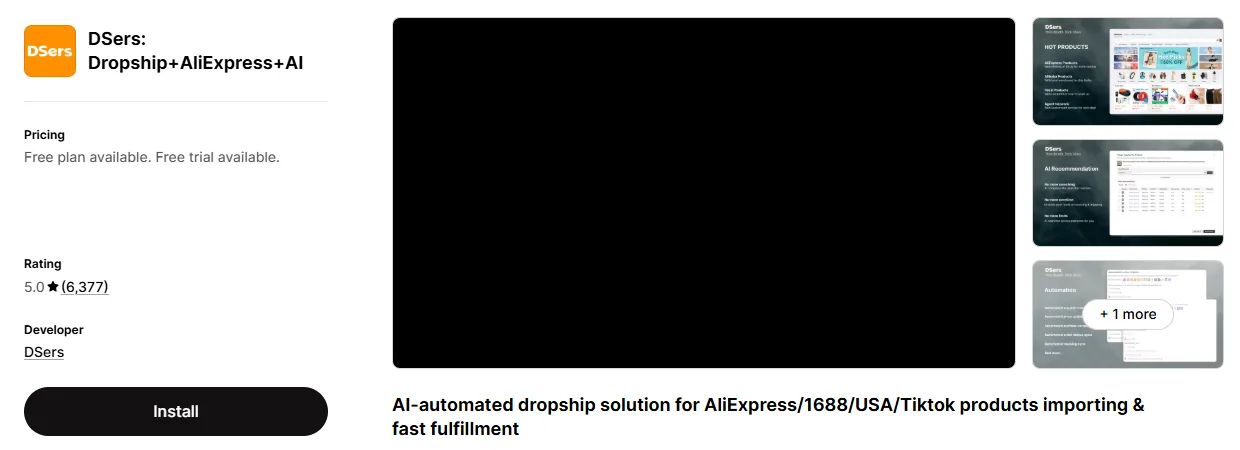
Good for: product testing and price-sensitive niches. Trade-off: delivery to the US and Europe usually takes one to two weeks or more, and quality varies by seller. If that's a dealbreaker, our AliExpress alternatives guide covers other routes.
7. Printful: print on demand with in-house production
Printful prints your designs on demand in its own facilities and ships them under your brand. The app is free to install, and you pay the product cost when an order comes in; an optional Growth plan at $24.99/month adds discounts. Good for: brands that care about consistent print quality. Trade-off: higher base costs than marketplace POD.
8. Printify: print on demand through partner printers
Printify routes your orders to a network of print providers, so you can pick one per product based on price and location. It's free to start, and Premium at $39/month lowers product costs. Good for: keeping POD base costs down. Trade-off: quality depends on which provider you choose, so order samples. Spocket also offers a print-on-demand catalog if you want POD and standard products in one app.
How to choose a dropshipping supplier for your Shopify store
Start with your customers and your price point, then narrow down:
- Map where your orders go. Check Shopify Analytics for the countries your traffic and sales come from. If 80% of buyers are in the US, a supplier that ships from the US beats a cheaper one in China for most products.
- Set your delivery promise. Decide what you'll tell customers (for example, "arrives in 3 to 7 days") and shortlist only suppliers that can meet it.
- Check the Shopify connection. Look for automatic order forwarding, tracking sync and inventory updates in the supplier's app. Read recent Shopify App Store reviews instead of trusting the star average.
- Run the margin math (example below) with the real product cost, shipping, payment fees and app fees.
- Place test orders from your top two suppliers to your own address and score them.
- Start small. List 10 to 20 products from your winner before importing hundreds.
Test-order scorecard
Use this when your samples arrive. Score each line from 1 to 5 and compare suppliers side by side.
| What to check | What a 5 looks like | Red flag |
|---|---|---|
| Processing time | Shipped within 1 to 3 business days | No tracking after 5 days |
| Delivery time | Matches the supplier's estimate | Twice the quoted time |
| Product vs listing photos | Same color, size and finish | Visibly different materials |
| Packaging | Clean, no supplier marketing or prices inside | Another store's invoice in the box |
| Tracking sync | Number appears in Shopify automatically | You have to paste it in by hand |
| Support response | Answer within 24 hours | No reply to a simple question |
Questions to ask a supplier before you list their products
Most supplier problems show up after your first busy week, when it's too late to switch quietly. Get answers to these in writing first:
- Where exactly does each product ship from? Ask per product or per variant, since one listing can mix warehouses.
- What's the processing time, separately from shipping? A "5-day delivery" promise means little if the parcel sits for four days before it leaves.
- How are returns and defects handled? Find out whether you need photos, who pays return postage, and whether a replacement or refund is the default.
- Is there any branding in the parcel? You don't want the supplier's own flyers or retail prices reaching your customer.
- What happens in Q4? Ask about cut-off dates, holiday closures and how stock is reserved during peak season.
- How are price changes communicated? If costs rise and your listing doesn't, you sell at a loss until you notice.
A supplier that answers clearly and quickly at this stage is usually the one that answers clearly when an order goes wrong.
Worked example: local vs China-based supplier
Say you sell a stainless steel water bottle at $34.99 to US customers.
- China-based option: $7.50 product + $6.00 shipping = $13.50. Before ads, you keep about $20.
- US supplier option: $12.00 product + $5.00 shipping = $17.00. Before ads, you keep about $16.
Card processing takes roughly 3% plus a fixed fee on either (check your Shopify plan's rate), so the gap stays around $4 per order. Now add what you can't see on the spreadsheet: the US option arrives in under a week, so fewer "where is my order" emails, fewer refunds and a better shot at repeat orders. And since the US ended duty-free de minimis entry for low-value parcels from all countries on 29 August 2025 (CBP notice), the China parcel may now carry duties that wipe out much of that $4. Run your own figures with a profit margin calculator.
How to connect a dropshipping supplier to Shopify
The setup is similar for every supplier app:
- Install the supplier's app from the Shopify App Store and approve its permissions.
- Set your pricing rules, such as a 2.5x markup or a fixed dollar amount, so imported products don't go live at cost.
- Import products and rewrite titles and descriptions in your own words. Copying supplier text hurts your SEO and makes your store look like every other one selling that item.
- Check variants and shipping profiles in Shopify so customers see the right delivery times at checkout.
- Add a payment method in the supplier app. Most won't ship until you pay for the order.
- Place one live test order through your own store to confirm the order forwards and tracking syncs back.
If you're building the store from scratch, our guide to starting a Shopify dropshipping store covers the steps before this one.
Red flags when choosing Shopify dropshipping suppliers
- No clear shipping origin. If a listing won't tell you where it ships from, assume it's the slowest route.
- Prices that are far below everyone else's. Usually a sign of a different product, a different material or hidden shipping costs.
- No return or defect policy. You'll end up refunding customers out of your own margin.
- Reviews that all came in the same week. Check the dates and the detail in app and supplier reviews.
- Inventory that never changes. A supplier showing "999 in stock" on every item may not track stock at all.
Where Spocket fits
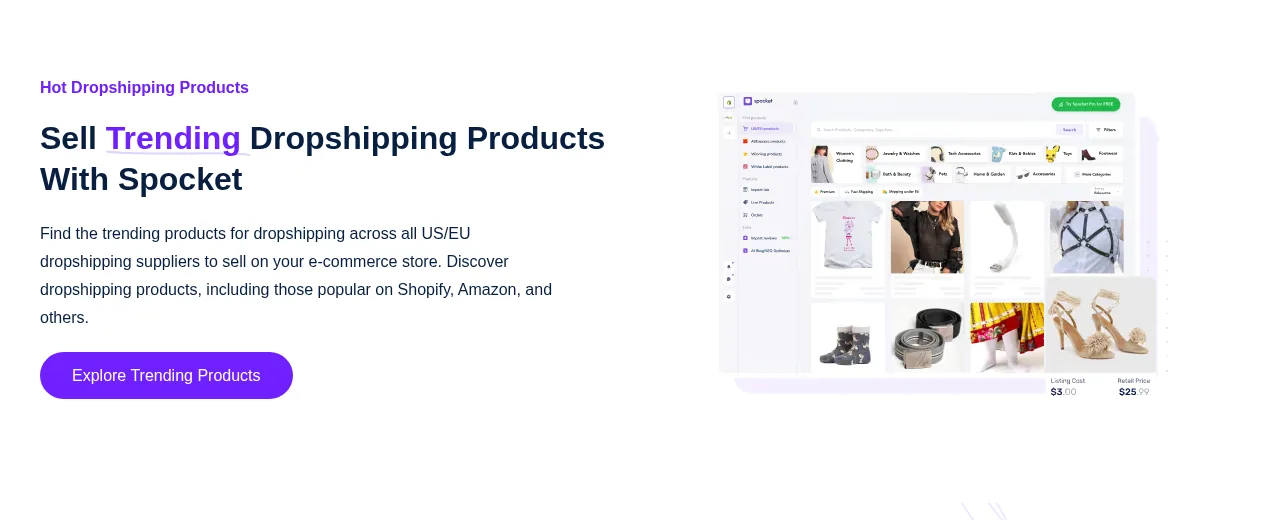
Spocket is built for the most common Shopify problem: you found a product that sells, but delivery from overseas is too slow to keep customers happy. Its marketplace focuses on vetted suppliers, many in the US and EU, with automated order fulfillment and branded invoicing, and you can still pull AliExpress products into the same dashboard for testing. You can browse trending products by category to see what's available in your niche, or start a 7-day trial and run your own test order.
For a deeper look at specific regions, see our list of US dropshipping suppliers, or our shorter app-by-app Shopify dropshipping suppliers roundup. And if you're coming from an old Oberlo setup, the Oberlo alternatives guide compares the apps that replaced it.
Final thoughts
No single supplier is best for every Shopify store. Local marketplaces like Spocket and Shopify Collective win on delivery and customer experience. CJ, Zendrop and AliExpress win on price and range. Printful and Printify win when the product is your own design. Shortlist two suppliers that match where your customers are, test-order from both, score them honestly, and only then import your catalog.
Want to compare a local supplier against what you use now? Try Spocket for 7 days. Plans start at $39.99/month.
Start your dropshipping business today
Shopify Dropshipping Suppliers FAQs
Who is the best dropshipping supplier for Shopify?
It depends on where your customers are. For US and European buyers who expect quick delivery, a marketplace of local suppliers such as Spocket or Shopify Collective usually works best. For the lowest product costs and widest range, AliExpress through an app like DSers or CJ Dropshipping is common. Many stores use one of each and decide product by product.
Does Shopify have its own dropshipping suppliers?
Shopify doesn't act as a supplier itself, but Shopify Collective lets you sell products from other Shopify brands in your store. It's free for eligible stores in supported countries, orders forward to the brand automatically, and tracking syncs back. For everything else, you install a supplier app from the Shopify App Store.
How do I find reliable dropshipping suppliers for Shopify?
Start with suppliers that publish their shipping origin, processing times and return policy, and that have a working Shopify app with recent reviews. Shortlist two or three, order samples to your own address, and score processing time, delivery time, product quality, packaging and support. Only import a full catalog from a supplier that passes that test.
Are there free dropshipping suppliers for Shopify?
Several are free to start. CJ Dropshipping has no required fee, DSers has a free plan for AliExpress, Syncee's free plan allows 25 products, and Printful and Printify charge only when an item sells. Shopify Collective is free for eligible stores. You always pay the product and shipping cost on each order, and free plans usually limit automation.
Which Shopify dropshipping suppliers ship fastest to the US?
Suppliers with stock inside the US ship fastest. Spocket's US and EU suppliers typically ship in 2 to 7 days, Shopify Collective brands ship from their own locations, and CJ and Zendrop can ship quickly from US warehouses for products stocked there. Orders shipped from China usually take one to two weeks or more.
How much does it cost to start dropshipping on Shopify?
You'll pay for a Shopify plan, any paid supplier app (from free to roughly $20 to $40 a month for entry plans), sample orders, and your first ads. Product costs are only paid when a customer orders. Spocket plans start at $39.99/month with a 7-day trial. Budget for samples from at least two suppliers before you launch.
Can I use more than one supplier on one Shopify store?
Yes, and many stores do. You might use a local supplier for best-sellers and a China-based supplier for test products. Just keep each product linked to one supplier app so prices and inventory aren't overwritten, and make sure your shipping profiles show the right delivery time for each product.


Launch your dropshipping business now!
Start free trial


Related blogs
Dropshipping Supplier Directory: Where to Find Vetted Suppliers
Browse our directory of vetted dropshipping suppliers across the US and EU, complete with niches, shipping speed, and pricing. Start your free trial today.

How to Negotiate With Dropshipping Suppliers: 9 Tactics That Actually Work
Learn how to negotiate with dropshipping suppliers on price, MOQs, and payment terms. Proven tactics and email scripts to boost your margins. Try Spocket free.

Is AliExpress Legit? A Safety Check for Buyers and Dropshippers
Is AliExpress legit? Yes, but sellers vary. See how Buyer Protection works, what the EU's 2026 fine means, customs costs, and whether it's safe for dropshipping.