Dropshipping in South Africa: How to Start in 2026
Dropshipping in South Africa is legal and low-cost. Learn the 2026 VAT change, import duty rules, local vs overseas suppliers and rand pricing before you start.


Dropshipping in South Africa is legal, cheap to start and very doable in 2026, but it works differently from the US or UK playbooks you see on YouTube. You pay in rand, your supplier usually bills in dollars or euros, SARS wants VAT and duty on most overseas parcels, and shoppers in Joburg or Durban will wait much longer for an order shipped from China than a New Yorker would. This guide covers how dropshipping in South Africa works, what you legally need to sort out, what the 2026 VAT change means for you, and how to price products in rand without losing money on the exchange rate.
How dropshipping in South Africa works
You list products in an online store, a customer pays you, and you pass the order to a supplier who packs and ships it straight to the customer. You never touch stock. Your margin is the gap between what the customer paid and what you paid the supplier, minus payment fees, ads and any returns.
The model itself is identical everywhere. What changes in South Africa is the supply side. You have two realistic options: a supplier inside South Africa, or a supplier abroad shipping into the country. Almost every decision later in this guide (pricing, tax, customer promises, returns) flows from which one you pick.
Is dropshipping legal in South Africa?
Yes. No law bans dropshipping. SARS and the consumer laws treat you like any other online retailer, whether the box ships from Cape Town or Shenzhen. In practice you need to cover five things:
- Business structure. Most people start as a sole proprietor and register a Pty Ltd through CIPC later, when volumes, suppliers or payment providers ask for it.
- Income tax. Profit is taxable. As a sole proprietor it goes on your personal return.
- VAT. Compulsory only above the registration threshold (more on the 2026 change below).
- Import duty and VAT on goods that enter the country, whoever pays them.
- Consumer and data law. The Consumer Protection Act, the cooling-off rules in the Electronic Communications and Transactions Act (ECTA, generally 7 days for distance sales), and POPIA for customer data.
Talk to a registered accountant before your first sale. A one-hour conversation costs far less than a SARS penalty.
The 2026 VAT change most guides still get wrong
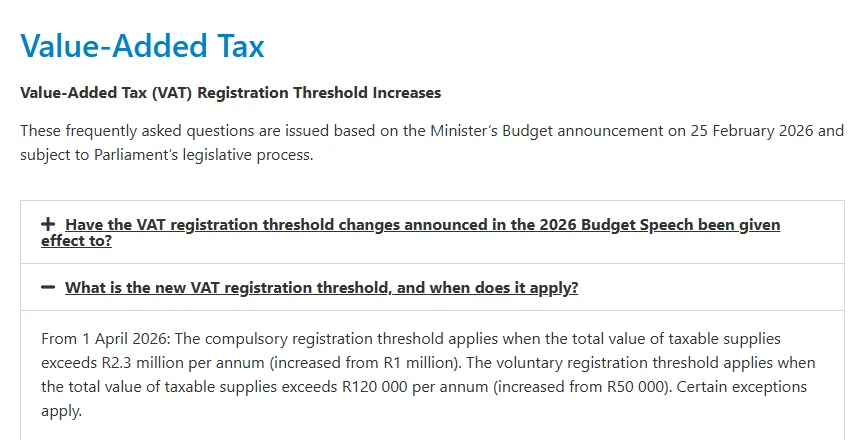
Older articles, including the previous version of this one, say you must register for VAT once turnover passes R1 million. That is out of date. In the 2026 Budget the Minister of Finance raised the compulsory VAT registration threshold from R1 million to R2.3 million, and the voluntary threshold from R50,000 to R120,000. SARS lists 1 April 2026 as the effective date.
For a new dropshipper that means you can trade for a long time without charging VAT. It also means a choice: voluntary registration lets you claim back VAT on business costs, but you then charge 15% on everything you sell, which squeezes the margin on a price-sensitive product. Check the current position on the SARS VAT page before you decide.
Customs, duty and VAT on overseas parcels
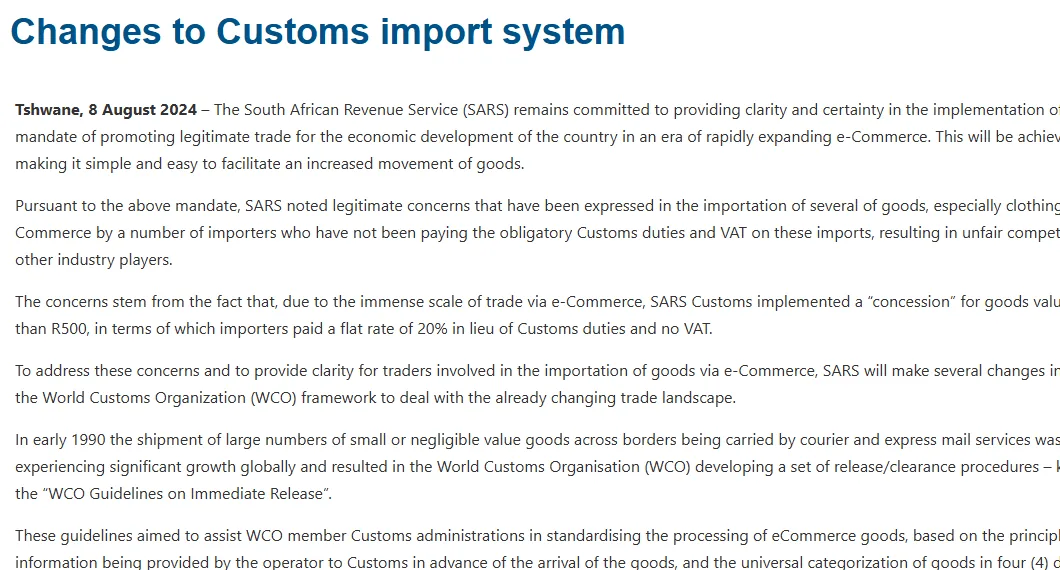
This is where overseas dropshipping gets expensive if you ignore it. Until 2024, parcels worth under R500 moved under a SARS concession: a flat 20% duty and no VAT. In August 2024 SARS announced it was tightening that, adding VAT on top of the 20% flat duty from 1 September 2024 as an interim step, with a move to a new rate structure for low-value consignments to follow.
The details of rates for different goods keep shifting, so treat any number you read, including the ones here, as a starting point and confirm it on the SARS customs announcement or with your courier. What matters for your business:
- Someone pays duty and VAT on a parcel from China. If your store does not collect it at checkout, the customer gets a surprise bill at the door, and they blame you.
- Clothing and footwear are the categories SARS has been most focused on, so those niches carry the most duty risk.
- Price duty into your product, or state it clearly on the product page. Hidden fees are the fastest route to chargebacks.
Our guide on dropshipping VAT rules for international sellers explains how this works in other markets if you plan to sell beyond South Africa later.
Local supplier or overseas supplier?
Neither is better in every case. Here is how they compare for a South African store:
| Factor | Supplier inside South Africa | Supplier abroad (China, US, EU) |
|---|---|---|
| Delivery to customer | Days, with local courier tracking | Usually weeks from China; US and EU suppliers are faster but still international |
| Duty and VAT | Already in the supplier's price | Applies at import, so you must account for it |
| Returns | Realistic, can go back to the same warehouse | Often not worth shipping back; you refund and absorb it |
| Product range | Narrower, fewer trend items | Huge, including niche and trending products |
| Wholesale cost | Billed in rand, no currency risk | Billed in USD or EUR, so the rand rate moves your margin |
| Best for | Higher-value items, gifts, anything customers need fast | Testing products and niches local suppliers do not cover |
A pattern that works: test demand with an overseas product at an honest delivery estimate, then look for a local source for whatever sells. Our list of dropshipping suppliers in South Africa is a good place to start the local search.
What it costs to start
You can launch with very little money, but not nothing. Costs fall into a few buckets, and none of them is stock:
| Cost | What to expect |
|---|---|
| Store platform | Monthly plan for Shopify, WooCommerce hosting or similar. Billed in dollars on most platforms. |
| Domain and email | Small annual cost; a .co.za domain reads as local to customers. |
| Supplier or app | Some suppliers are free to browse, others charge a subscription. Spocket plans start at $39.99/month with a 7-day trial. |
| Test ads | Your largest early expense. Decide the loss you can accept before you spend. |
| Sample orders | Order one of everything you plan to sell. Quality problems are cheaper to find at one unit. |
| Accountant | One-off consult now, then yearly. Worth it. |
Payments: what actually works in South Africa
This catches people out. South Africa is not on Shopify's list of supported countries for Shopify Payments, so a Shopify store run from South Africa needs a third-party gateway. Local options such as PayFast take cards and instant EFT, which many South African shoppers prefer over cards. Check which gateways your platform lets you connect, what each charges and how long payouts take before you build your store around one. Our comparison of payment gateways for international transactions covers the cross-border side.
How to start dropshipping in South Africa, step by step
- Pick a narrow niche. Start with a problem or a hobby, not a category. Pet accessories for small dogs beats "pet products". Browse best dropshipping niches for ideas, then check demand locally with Google Trends set to South Africa.
- Decide your supply route. Local, overseas, or both, using the table above.
- Order samples. Check quality, packaging and how long it really takes to arrive in your province.
- Register the business basics. Sole proprietor to begin, CIPC later. Sort out your tax number with SARS.
- Build the store. Follow our Shopify dropshipping store guide or use WooCommerce. Show prices in rand and state delivery times honestly.
- Connect a payment gateway that works for South African bank accounts.
- Write your policies. Shipping, returns, cooling-off period and privacy. Copying a US template without checking it against South African law is a common mistake.
- Run small ad tests. Instagram, TikTok and Facebook all reach South African shoppers. Spend a small fixed budget per product and cut anything that does not return its ad cost.
- Track every order manually for the first month so you know where parcels get stuck.
Pricing in rand: a worked example
Take a phone stand from an overseas supplier. The supplier charges $12.00 for the item plus $5.00 shipping, $17.00 in total. For illustration, assume R18 to the dollar. That is a landed cost of R306 before duty. These figures are examples, not live quotes, so plug in the current rate and your supplier's real prices.
| Line | At R18/$ | At R19.50/$ |
|---|---|---|
| Selling price in your store | R649 | R649 |
| Supplier cost ($17.00) | R306 | R332 |
| Payment fee (assumed 3.5%) | R23 | R23 |
| Ad cost per sale (assumed) | R150 | R150 |
| Profit per order | R170 | R144 |
A rand move of R1.50 against the dollar cost you R26 per order, or about 15% of your profit, and we have not added import duty yet. If you register for VAT, the picture changes again: R649 includes about R85 of VAT you owe SARS, which takes the example profit down to roughly R85 before duty. This is why overseas sellers either price with a cushion, or move to a local or rand-billed supplier once a product proves itself.
Where Spocket fits
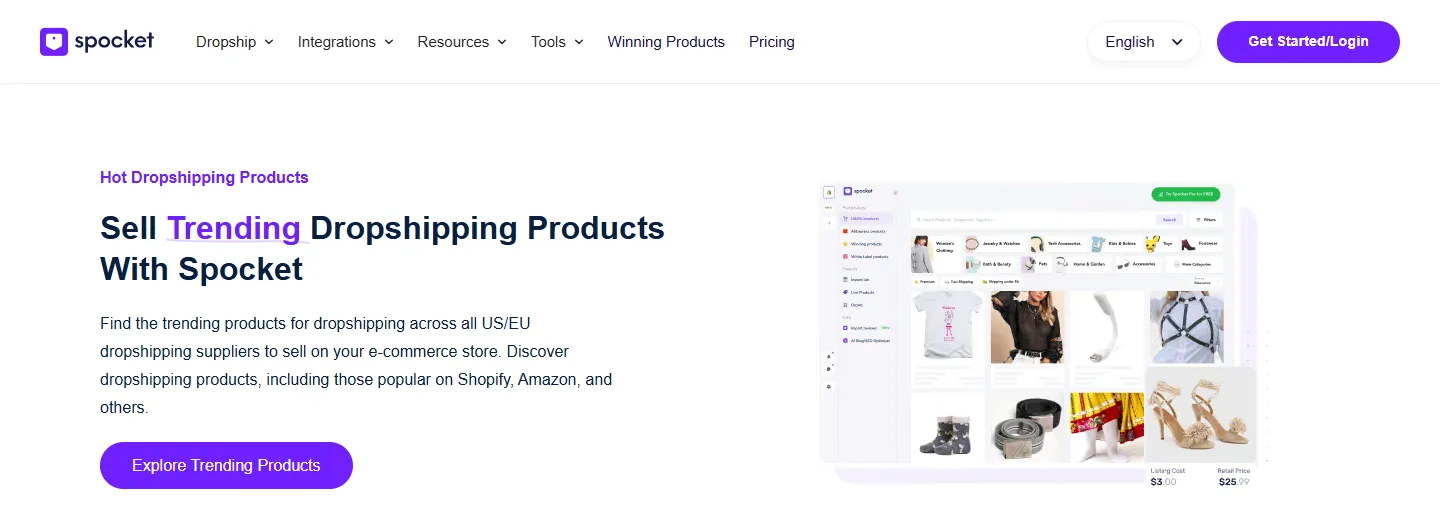
Spocket is a supplier marketplace built around vetted US and EU suppliers, with products you can import into Shopify, WooCommerce and other platforms. Its US and EU suppliers advertise processing and shipping in 2 to 7 days. Be realistic about what that means for South Africa: those times describe domestic delivery from those suppliers, and a parcel to Gauteng or the Western Cape is an international shipment with its own transit time and customs stage. Before importing any product, check the shipping options and destinations on the listing, and set your customer-facing delivery promise from a test order, not from a supplier's headline number.
Where it helps is quality and branding. Products tend to be better packed and less likely to come from a random listing, and branded invoicing helps you look like a proper store. Browse trending products or winning products to see wholesale prices, then see the Shopify integration if that is your platform. If you want to try it, you can start the 7-day trial here.
Common mistakes South African dropshippers make
- Promising 7-day delivery on a product shipped from China. Customers will wait weeks and then dispute the charge. Quote the realistic range.
- Ignoring the rand. If your supplier bills in dollars, build a buffer into every price, and reprice when the rate moves materially.
- Selling clothing and footwear without checking duty. These categories get the closest customs attention.
- Using a foreign refund policy. South African customers have cooling-off and consumer rights. A policy copied from a US store may not meet them.
- Skipping VAT planning. You may not need to register yet, but know where the R2.3 million line is and track your 12-month turnover.
- Spreading across ten products. Prove one product, then add the next.
Marketing to South African shoppers
Paid social is the usual starting point. Facebook, Instagram and TikTok all reach South African audiences, and WhatsApp is how many shoppers prefer to ask a question before they buy. Add a WhatsApp chat link to your product pages and answer fast, because a reply within the hour can be the difference between a sale and an abandoned cart.
Two timing points matter. Black Friday is a major shopping event in South Africa and ad costs rise with it, so test your products earlier in the year when clicks are cheaper. And because delivery takes longer than shoppers expect from big local retailers, say so in your ads and on the product page. Customers who know the delivery window up front rarely complain about it. Customers who find out after paying often do.
Email is the cheapest channel you will own. Collect addresses from day one with a small first-order offer, and send order updates that include tracking links. Overseas parcels spend long stretches with no scan events, and a proactive "your order has left the warehouse" message saves you a pile of support emails.
Shipping and returns policies that hold up
Write your policies for the country you sell in. A solid South African store page covers four points: the realistic delivery window by supplier route, who pays duty and VAT on imports, how a customer starts a return, and how refunds are paid. Include your cooling-off wording as well, since distance buyers in South Africa generally have a short window to cancel and return goods under ECTA.
If your supplier is overseas, be honest about returns. Sending a R300 item back to China usually costs more than the item. Many sellers refund without a return for low-value faults and keep the return process for expensive goods, then price that refund rate into their margins. Spocket's US and EU suppliers each set their own return terms, so read them on the product page before you list.
Is dropshipping in South Africa worth it?
It is worth it if you treat it as a small retail business and not a shortcut. The advantages are real: no stock, low start-up cost, and a market where many shoppers still buy products online that local shops do not stock. The costs are also real: thin margins after ads, delivery times that need honest handling, and tax and customs rules that move. If you plan carefully, test cheaply and price in rand with a buffer, it is a sensible way to learn ecommerce. If you want to see how much sellers actually earn, read how much dropshippers make.
Ready to test a product with suppliers that ship from the US and EU? Start your 7-day Spocket trial and check the shipping options on each listing before you import.
Start your dropshipping business today
Dropshipping in South Africa FAQs
Is dropshipping legal in South Africa?
Yes. There is no law against dropshipping, and SARS treats a dropshipping store like any other online retailer. You still need to declare your income, register for VAT once you pass the threshold, follow the Consumer Protection Act and ECTA rules, and account for import duty and VAT on goods you bring in from abroad.
Do I need to register a company to start dropshipping in South Africa?
Not on day one. Many people trade as sole proprietors and register a Pty Ltd with CIPC later, when sales grow or a payment provider or supplier asks for company details. Either way, your profit is taxable, so ask an accountant which structure suits your plans.
What is the VAT threshold for dropshippers in South Africa in 2026?
From 1 April 2026, compulsory VAT registration applies once your taxable supplies pass R2.3 million in a year, up from R1 million. Voluntary registration is allowed from R120,000, up from R50,000. Confirm current figures on the SARS website before you decide.
Do customers pay import duty on dropshipped parcels in South Africa?
Usually yes, someone does. SARS collects duty and VAT on most imported parcels, and the old R500 concession was tightened in 2024. If your store does not collect these at checkout, your customer may get a bill on delivery. State the cost clearly or build it into your price.
How long does dropshipping delivery take in South Africa?
It depends on the supplier. Local suppliers can deliver within days using South African couriers. Overseas suppliers take longer, often several weeks from China, and customs can add delays. Order a sample to your own address and use that real timing in your delivery promise instead of the supplier's estimate.
Can I use Shopify Payments to dropship from South Africa?
No. South Africa is not on Shopify's list of supported countries for Shopify Payments, so you need a third-party gateway such as PayFast. Check which gateways your platform supports, what they charge, and how quickly money reaches your South African bank account before you commit.
How much money do I need to start dropshipping in South Africa?
You can start with a small budget because you do not buy stock. Plan for a store plan, a domain, sample orders, test ads and a supplier or app subscription. Ads are usually the biggest cost, so set a firm testing limit per product before you spend.
What is the best way to find dropshipping suppliers for South Africa?
Start with a local supplier directory for fast delivery on proven products, and use an overseas marketplace to test new niches. Whichever you choose, order samples, read the shipping and returns terms, and confirm the supplier ships to South African addresses before importing a product into your store.


Launch your dropshipping business now!
Start free trial


Related blogs
Dropshipping Supplier Directory: Where to Find Vetted Suppliers
Browse our directory of vetted dropshipping suppliers across the US and EU, complete with niches, shipping speed, and pricing. Start your free trial today.

How to Negotiate With Dropshipping Suppliers: 9 Tactics That Actually Work
Learn how to negotiate with dropshipping suppliers on price, MOQs, and payment terms. Proven tactics and email scripts to boost your margins. Try Spocket free.

Is AliExpress Legit? A Safety Check for Buyers and Dropshippers
Is AliExpress legit? Yes, but sellers vary. See how Buyer Protection works, what the EU's 2026 fine means, customs costs, and whether it's safe for dropshipping.