Dropshipping in the UK: How to Start a Business in 2026
Dropshipping in the UK explained: legal setup, VAT rules, real start-up costs, UK and EU suppliers, and how to sell AliExpress products to UK customers.



Dropshipping in the UK is legal, cheap to start and perfectly workable in 2026, but it punishes sloppy setups more than the US does. UK shoppers expect delivery in days, not weeks. They have strong statutory return rights. And HMRC has specific rules for goods that ship in from overseas, which is exactly how a lot of dropshipped stock still arrives. Get those three things right and the rest is the same store-building, product-testing grind as anywhere else.
This guide is written for someone starting a UK dropshipping business from scratch: how to set up legally, what you really pay, how VAT works on UK and imported goods, how to pick UK and EU suppliers, and how to sell AliExpress products to UK customers without a nasty surprise at the border. Every legal point links to the GOV.UK page it comes from, but treat this as a map, not tax advice. An hour with an accountant before you take your first order is cheap insurance.
How dropshipping works for a UK store
You list products on your own store, a customer pays you, and you place the matching order with a supplier who ships it straight to the customer. You never touch stock. Your margin is whatever is left after the supplier's price, payment fees, ads and refunds.
- A customer in, say, Leeds orders a £34.99 lamp from your Shopify or WooCommerce store.
- You pay the supplier their wholesale price plus delivery (say £16.50 all in).
- The supplier packs and posts it under your branding or a neutral slip.
- You send the tracking number, answer any questions, and handle the return if there is one.
That last step is what newcomers underestimate. Legally, you are the retailer. If the lamp arrives broken, the customer comes to you, not to a supplier they have never heard of. The supplier is your subcontractor, and you carry the risk.
Is dropshipping legal in the UK?
Yes. There is no licence for dropshipping as such. What matters is that you follow the rules that apply to any online retailer: register your business with HMRC, charge VAT where required, describe products honestly, and honour consumer rights.
Your customers' cancellation and refund rights
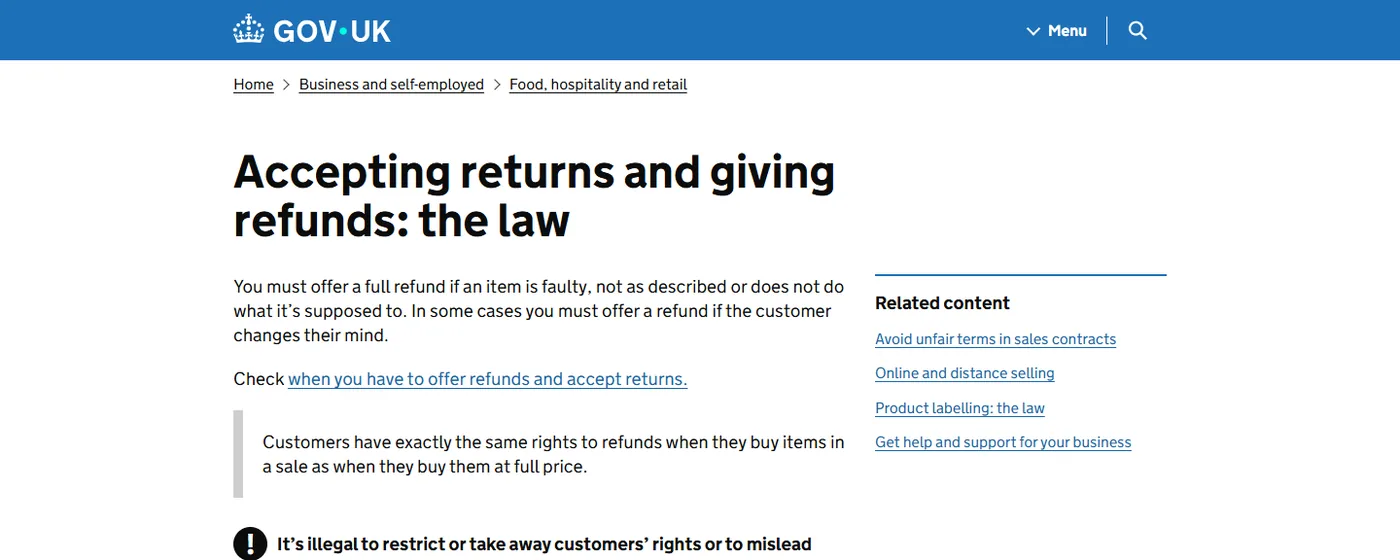
Because you sell at a distance, customers can cancel for any reason. Under GOV.UK's rules for sellers, a customer who tells you within 14 days of receiving the item that they want to cancel is entitled to a refund. They then have another 14 days to send it back, and you must refund them within 14 days of getting the item back. You can't deduct fees unless the item has been used or damaged.
In practice this means your supplier's return policy has to line up with yours. If a supplier only accepts returns to a warehouse in Guangzhou, and your customer is entitled to a refund after posting a parcel to your address, you are paying for the gap. Ask every supplier where returns go and who pays, before you sign up.
Also publish a clear returns page, delivery times and a UK contact address. If you don't tell customers about the 14-day cancellation right, GOV.UK says they can cancel for up to 12 months. Our piece on handling dropshipping returns and refunds has templates for the awkward cases.
Setting up the business: sole trader or limited company
You have two realistic options, and neither blocks you from dropshipping.
Sole trader
No setup fee. You register for Self Assessment with HMRC and report profits on your tax return. HMRC's deadline to register is 5 October after the end of the tax year in which you started trading. The downside is that your personal assets are on the hook if the business is sued, and some payment providers and suppliers take a limited company more seriously.
Limited company
Registering with Companies House costs £100 online, and the company is usually set up within 24 hours. You'll file annual accounts and a confirmation statement, and you'll need a separate business bank account. It is more admin, but it separates personal and business liability and often looks better to wholesale suppliers. Many UK sellers start as sole traders to test, then incorporate once the store has real revenue. If you're comparing the two, GOV.UK's guide to registering a limited company shows the full steps.
Open a dedicated business account either way. Mixing personal and store money makes your bookkeeping harder and your tax return slower.
VAT for UK dropshippers
This is the section that catches people out, so read it twice.
The £90,000 threshold
You must register for VAT if your taxable turnover for the last 12 months goes over £90,000. You then have 30 days from the end of the month in which you crossed it to register. You can also register voluntarily below that, which some sellers do so they can reclaim VAT on business costs. Details are on GOV.UK's register for VAT page.
Goods shipped from outside the UK
HMRC has separate rules for goods that are outside the UK when the customer buys them. For consignments worth £135 or less, the seller must charge and account for VAT at the point of sale. That means VAT is added at your checkout, and you report it to HMRC, instead of the customer paying it to a courier at the door. The £135 limit applies to the total value of the consignment, not each item. Above £135, import VAT and customs duty are normally collected at the border.

Whether you personally need to register on day one depends on where you and your supplier are based, so this is the point to ask an accountant. The principle to remember is that you, as the seller, own the VAT problem, not your supplier. If your supplier ships from a UK warehouse, the normal domestic rules and the £90,000 threshold apply to you.
Customs duty on cheap imports is changing
Today, parcels worth £135 or less come in without customs duty. The government has announced that this relief will be removed. In its July 2026 consultation response on reforming the customs treatment of low value imports, it said it is bringing the new arrangements forward by six months, to October 2028 at the latest. Until then the duty-free relief stays. After that, cheap overseas parcels will carry duty and more paperwork, and the cost advantage of very cheap long-haul shipping shrinks. It is another reason to build your store around suppliers that are close to your customers. Our Brexit and UK dropshipping guide covers the older post-2021 changes.
What it costs to start
You can launch for a few hundred pounds. Here are the real line items, with the ones I can price exactly and the ones that vary:
| Cost | Rough guide | Notes |
|---|---|---|
| Companies House registration | £100 | Only if you set up a limited company |
| Store platform | Varies by plan | Check Shopify UK pricing or use WooCommerce on your own hosting |
| Supplier app | Spocket plans start at $39.99/month | Includes a 7-day trial |
| Domain and email | A small annual fee | Buy a .co.uk or .com that matches your brand |
| Product samples | £30 to £150 | Order 2 to 3 samples of your hero product before ads |
| Test ad budget | £10 to £30 a day | Budget two weeks of testing before judging a product |
| Accountant (optional) | Varies | One setup call is usually enough to start |
Keep a cash cushion for refunds. If you sell 50 orders in your first month at £35 and 6 are returned, that is £210 you give back while ad spend is already gone. Many first-time sellers get hurt by exactly that, not by lack of sales.
A worked pricing example with VAT
Say you're VAT registered and sell a lamp for £34.99 including the standard 20% rate. VAT is one sixth of the gross price, so £5.83 goes to HMRC and you keep £29.16. The supplier charges £16.50 including delivery. If you assume payment processing takes around 3% of the sale (check your own provider's rate), that's about £1.05. You're left with roughly £11.61 before ads, packaging inserts and refunds. If the same lamp costs you £10 per sale in ads, you've made £1.61. That's why UK sellers who skip the VAT line in their spreadsheet feel rich for a month and then get a bill.
The fix is boring but works: price every product from the net figure upwards, and check the result against our profit margin calculator before it goes live.
Choosing UK and EU suppliers over long-haul ones
Delivery speed is where UK dropshippers win or lose. Our own post on dropshipping suppliers in the UK lists options, but here is how the three main sourcing routes compare.
| Route | Delivery to UK customers | Cost per item | Main risk |
|---|---|---|---|
| UK-based suppliers and wholesalers | Usually the fastest option, depends on the courier you choose | Higher, but margins hold on higher-priced goods | Smaller catalogue, some have minimum order values |
| EU suppliers (via a marketplace like Spocket) | 2 to 7 days with US and EU suppliers on Spocket | Mid-range | Customs paperwork on EU to UK parcels |
| China-based suppliers (AliExpress and similar) | Varies widely, check each listing | Lowest | Slow delivery, VAT handling, returns that never arrive |
A simple test: ask each supplier three questions. Where does stock ship from? Who pays for returns? Will you send tracking within 24 hours? A supplier who can't answer those clearly will cost you more than the discount saves.
Dropshipping from AliExpress to UK customers
A lot of people searching for "AliExpress dropshipping UK" want to know if it still works. It does, with caveats.
- VAT. For orders of £135 or less that ship from outside the UK, HMRC expects VAT to be charged at the point of sale. Build UK VAT into your pricing and checkout, rather than hoping the customer sorts it out on delivery.
- Delivery times. AliExpress shows an estimated delivery date on each listing. Treat the slow end of that window as your real promise. If you advertise "5 to 10 days" and it takes 18, you will be refunding chargebacks.
- Duty. The £135 duty relief still applies today, but the government has said it is going. Don't build a business whose only edge is duty-free cheap shipping.
- Quality. Order samples. Photos on AliExpress are not always the product you get.
If you do go this way, read our walkthrough of the AliExpress Dropshipping Center for research, and use it to find items that ship from warehouses closer to the UK. The better long-term play is to test with AliExpress and move winners to UK or EU suppliers, which is where a marketplace like Spocket fits.
Where Spocket fits for UK stores
Spocket is a supplier marketplace focused on vetted US and EU suppliers, with shipping typically in 2 to 7 days, which matches what UK buyers expect. You can import products to Shopify, WooCommerce and other platforms, and orders can be fulfilled through the app. Our trending products page is a good starting point for finding items worth testing.
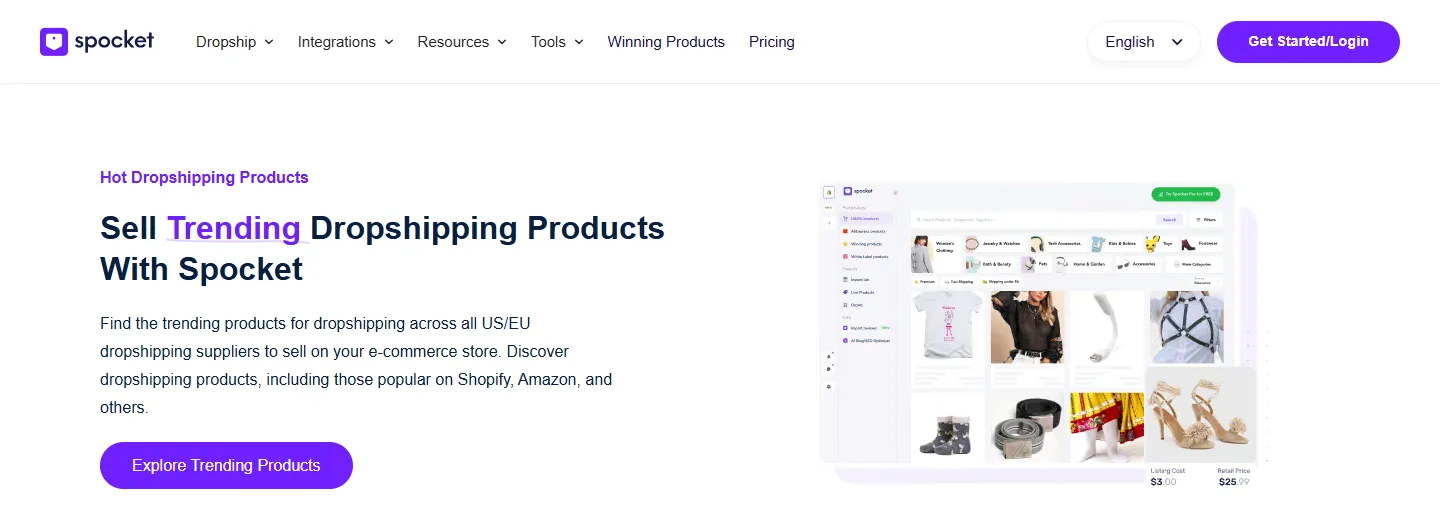
If you want to test the idea without committing, you can start a 7-day trial on Spocket and browse before you pay for anything else. Plans start at $39.99/month.
Step by step: launching your UK dropshipping store
- Pick a niche you can describe in one sentence. "Eco-friendly kitchen products for UK renters" beats "home products." Use our list of best dropshipping niches to shortlist.
- Choose your business structure. Sole trader to test, limited company when revenue is real.
- Find 10 to 20 products from suppliers with UK or EU stock. Check shipping times and return terms first.
- Order samples of your top 2 or 3. Time the delivery to your own door.
- Build the store. Prices in GBP, a returns page that matches GOV.UK rules, and a UK-friendly checkout with VAT shown clearly.
- Set up payments and tracking. Use a business bank account, and send tracking numbers automatically.
- Test traffic with a small budget. Judge a product after two weeks and at least a few hundred clicks.
- Keep records. Save invoices, supplier receipts and VAT records for your accountant.
Our broader how to start dropshipping guide covers store building and ads in more detail.
Common mistakes UK dropshippers make
- Quoting supplier delivery times as your own. Add a buffer, and promise less than you deliver.
- Ignoring VAT until the first bill. Work out your price including VAT from day one.
- Using a supplier's product copy word for word. It hurts search ranking and can include claims you can't back up.
- Selling branded items you aren't authorised to sell. That is how stores get takedown notices.
- Falling for fake supplier directories. Read our guide to avoiding common dropshipping scams in the UK before you pay for anything.
Is dropshipping still worth it in the UK?
It's worth it if you treat it as a retail business and not a shortcut. Margins are thin on commodity products, customers are demanding, and the cheap-imports advantage is being squeezed by new VAT and customs rules. But a small store with a clear niche, UK or EU stock and honest delivery promises can still turn a profit. Start small, test properly, and put your first profits into better suppliers and customer service. If you want a place to start, try Spocket's 7-day trial and see which UK-friendly products are available for your niche.
Start your dropshipping business today
UK Dropshipping FAQs
Is dropshipping legal in the UK?
Yes. There's no special licence, but you must register your business with HMRC, charge VAT where it applies, describe products honestly and respect consumer rights. Because you're the retailer, customers can cancel within 14 days of receiving an item and you must refund them within 14 days of getting it back, even if a supplier shipped it.
Do I need to register for VAT to dropship in the UK?
You must register once your taxable turnover over the last 12 months passes £90,000, and you can register earlier voluntarily. Separately, HMRC says the seller must charge and account for VAT at the point of sale on goods worth £135 or less that ship from outside the UK. Ask an accountant how that applies to your supply chain.
Can I start dropshipping in the UK as a sole trader?
Yes. Sole traders don't pay a setup fee and report profits through Self Assessment, but your personal assets are exposed if something goes wrong. A limited company costs £100 to register online and separates personal and business liability. Many sellers start as sole traders and incorporate once the store has steady revenue.
How much does it cost to start a dropshipping business in the UK?
Plan for a few hundred pounds: a store platform, a supplier app (Spocket plans start at $39.99/month), a domain, product samples and a test ad budget. Add £100 if you form a limited company. Keep extra cash back for refunds, because returns and ad testing are what drain first-month budgets.
Can I dropship from AliExpress to UK customers?
Yes, but check three things. VAT on orders of £135 or less must be charged at your checkout, delivery times from China can be slow, and the government plans to remove the duty relief on low value imports by October 2028 at the latest. Many sellers test products on AliExpress, then move winners to UK or EU suppliers.
Who handles returns in UK dropshipping?
You do. Customers have a legal right to return most online purchases, and the contract is with your store, not the supplier. Before you list a product, confirm where returns are sent, who pays postage and how fast the supplier refunds you, so you aren't left covering refunds you can't recover.
What are the best dropshipping suppliers in the UK?
The best suppliers are the ones that ship from the UK or EU, give tracking within a day, and have clear return terms. UK wholesalers and EU suppliers on marketplaces like Spocket usually deliver faster than long-haul options. Order samples and time the delivery yourself before you run any ads.


Launch your dropshipping business now!
Start free trial


Related blogs
Dropshipping Supplier Directory: Where to Find Vetted Suppliers
Browse our directory of vetted dropshipping suppliers across the US and EU, complete with niches, shipping speed, and pricing. Start your free trial today.

How to Negotiate With Dropshipping Suppliers: 9 Tactics That Actually Work
Learn how to negotiate with dropshipping suppliers on price, MOQs, and payment terms. Proven tactics and email scripts to boost your margins. Try Spocket free.

Is AliExpress Legit? A Safety Check for Buyers and Dropshippers
Is AliExpress legit? Yes, but sellers vary. See how Buyer Protection works, what the EU's 2026 fine means, customs costs, and whether it's safe for dropshipping.