Dimensional Weight in Dropshipping: Is the Product Too Bulky?
Bulky boxes can eat your margin through dimensional weight. Test any product with packed dimensions, a worked margin example and a go, caution or no-go table.
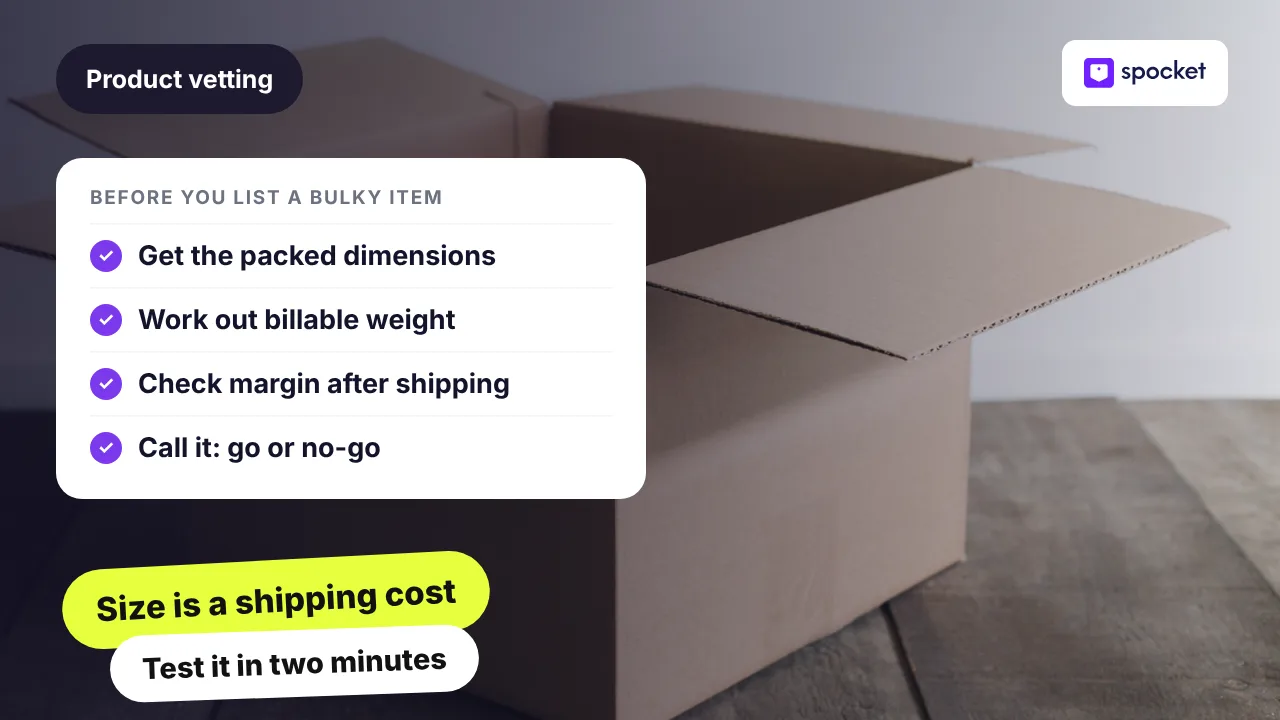


Two products can sell for the same $60 and cost the same $24 from the supplier, yet one leaves you a 45% margin and the other 29%. The gap comes from the box, and a quick dimensional weight dropshipping check before you list will show it. Otherwise it is easy to miss until an order arrives with a shipping line you did not plan for. This guide gives you a quick test you can run on any product page before you import it, with the numbers worked out for two $60 products.
Why the carrier bills for space, not just weight
A truck or a plane fills up on volume long before it hits its weight limit. So carriers compare two numbers for every parcel: what it actually weighs, and what a box of that size would weigh if it were packed densely. You pay for whichever is bigger. The second number is the dimensional weight, often shortened to DIM weight.
The US Postal Service spells out its version for Priority Mail in the Domestic Mail Manual, section 123. You measure length, width and height in inches and round each one up to the next whole inch. Multiply the three. If the result is above 1,728 cubic inches (one cubic foot), divide by 139 and round up to the next whole pound. That is the dimensional weight, and postage is based on it when it beats the actual weight. If it comes out above 70 pounds, the 70 pound price applies. The rule only sets the billable weight. The price itself comes from the rate card and the zone, which for a dropshipper means your supplier's rates.
Other carriers run the same idea with their own rules, and Shopify has a plain-language walkthrough in its dimensional weight guide. Divisors and thresholds differ by carrier and by service level, so 139 is the divisor in this USPS rule, not a universal constant. When a supplier quotes you a rate, ask which divisor sits behind it. For any carrier other than USPS, look up its divisor and size threshold, then run the same steps.
The number you need from the supplier: packed dimensions
Product listings usually show the size of the item, not the size of the box it ships in. A set of woven baskets might measure 12 inches across, yet ship as three separate pieces in a 22 inch box. Ask the supplier for three things before you do any math: the packed length, width and height, the packed weight, and the shipping rate for that package to your main customer zone.
If a supplier cannot give you packed dimensions, treat that as a flag on its own. A product you cannot cost is a product you cannot price, so ask for the numbers in writing. If a supplier charges one flat fee per order instead, ask what package size and carrier that fee assumes, and check your margin at the real rate for a bulky item.
| Packed box (in) | Cubic inches | Billable weight |
|---|---|---|
| 14 x 12 x 10 | 1,680 | Actual weight |
| 12 x 12 x 12 | 1,728 | Actual weight |
| 16 x 12 x 10 | 1,920 | 14 lb |
| 20 x 14 x 10 | 2,800 | 21 lb |
| 22 x 16 x 9 | 3,168 | 23 lb |
| 30 x 20 x 12 | 7,200 | 52 lb, plus a nonstandard fee |
A box under two feet long can already bill like a 23 pound parcel. A product that weighs 4 pounds inside it still gets charged as 23.
A worked example: the skillet and the basket set
Say you are comparing two products, both retailing at $60 with a supplier cost of $24. The first is a 10 inch cast-iron skillet. The second is a set of three woven storage baskets. Assume the supplier's rate card works out to $4.00 handling plus $0.55 per billable pound, and your payment processor takes 3% plus 30 cents, which comes to $2.10 on a $60 sale. The rate card stands in for one customer zone.
| Line | Cast-iron skillet | Basket set |
|---|---|---|
| Retail price | $60.00 | $60.00 |
| Supplier cost | $24.00 | $24.00 |
| Packed box (in) | 12 x 11 x 3 | 22 x 16 x 9 |
| Actual weight | 5 lb | 4 lb |
| Billable weight | 5 lb | 23 lb |
| Shipping | $6.75 | $16.65 |
| Payment fee | $2.10 | $2.10 |
| Leftover | $27.15 (45%) | $17.25 (29%) |
The skillet is the heavier product and the cheaper one to ship. The baskets weigh less than a bag of flour and cost about two and a half times as much to move. Nothing about the baskets is wrong. The price just does not carry the freight, and a reship costs another $16.65 in freight plus the $24 product, far more than the $17.25 you kept.
Repricing is the quickest fix to test. To keep roughly a 35% margin after shipping and fees, the baskets would need to sell around $66.99. At that price the payment fee is $2.31 and the leftover is $24.03, about 36%. Whether a shopper will pay $66.99 for them is a different question, and one you can test with a small budget before you commit. The guide on pricing your dropshipping products covers how to read that response.
Turn the math into go, caution and no-go calls
Running a full calculation for every product gets old fast. Two quick checks do most of the work. The first is margin after shipping and fees, as a share of the retail price. The second is billable weight divided by actual weight. When the second number climbs past 3, the box is mostly air and the carrier is billing you for it. If the two columns disagree, take the worse call.
| Margin after shipping | Billable vs actual | Call |
|---|---|---|
| 35% or more | Up to 1.5 times | Go, list it |
| 25% to under 35% | Over 1.5 to 3 times | Caution, reprice or test |
| Under 25% | Over 3 times | No-go |
Apply it to the earlier example. The skillet sits at 45% with a ratio of 1, an easy go. The baskets at $60 sit at 29% with a ratio of about 5.8, so the margin says caution and the ratio says no-go. Taking the worse call, they fail. Raising the price to $66.99 fixes the margin column but not the ratio, which is why a returned or reshipped basket set still costs you the full space-based freight. Only a smaller box moves that number.
If you want a fuller view of what margin actually means once every cost is in, the post on calculating your real profit margin in dropshipping lines up the other costs this table leaves out.
Other ways size shows up on the invoice
Dimensional weight is the headline cost, but it is not the only way size shows up on an invoice. The same USPS section lists a nonstandard fee on Priority Mail pieces that measure more than 22 inches long, or more than 2 cubic feet (3,456 cubic inches). Other carriers have their own oversize and handling surcharges. If a product has one long side, such as a tripod, a rug or a shelf board, check the length rule before you check the volume.
Rounding also bites. Each dimension rounds up to the next whole inch, so a box listed as 12.2 by 12.2 by 12.2 inches is treated as 13 by 13 by 13, which is 2,197 cubic inches and bills at 16 pounds instead of its actual weight. The supplier's figure might be correct to the decimal and still cost you more than you expected.
Shipping settings on your side matter too. If you offer a flat rate or free shipping on everything, a few bulky items can quietly eat the margin you earn on every compact one. Shopify lists your options in its help article on setting up shipping rates. For bulky products, a separate rate or a higher price is usually safer than hoping the average works out.
A pre-listing checklist for any bulky product
Run through these five checks before you import a product. A single fail does not always mean no, but it tells you what to fix.
- The supplier gave packed length, width, height and weight, not just the product size.
- Billable weight, worked out with the carrier's own rule, is under 3 times the actual weight.
- Margin after shipping and payment fees is 35% or more at your planned price, or 25% to 35% with a plan to test.
- No side of the box is long enough to trigger an oversize or nonstandard fee.
- You know the shipping cost to your two biggest customer zones, not just the nearest one.
The last check matters because rates move with distance, and carrier rates are zone based, so a parcel crossing the country usually costs more than a short hop. To run this test on real products, you can start the 7-day free trial, browse US and EU suppliers in your niche and ask each one for packed dimensions before you list anything. Spocket gives you 2 to 7 day shipping from those suppliers, so one near your main customers helps both the zone cost and the delivery promise.
What to do with a product that fails
A failed check points to one of four fixes. Ask the supplier whether a flat-packed or nested version of the item ships in a smaller box. Raise the price to restore the margin, knowing it will not change the ratio. Bundle the bulky item with a compact add-on so the order value covers the freight. Or drop the product.
Dropping is a fair outcome. A listing that sells at a 5% margin and generates support tickets costs you more than an empty slot in your catalog.
Start your dropshipping business today
Dimensional Weight and Bulky Products FAQs
Does dimensional weight apply to every carrier?
Most major carriers use some form of it, but the divisor, the size threshold and the services it applies to differ. USPS publishes its Priority Mail rule in DMM 123, and other carriers publish their own. Ask your supplier which carrier and divisor sit behind each rate you are quoted.
Does a bigger box always cost more to ship?
Not below the carrier's size threshold. Under the USPS Priority Mail rule, a parcel at or under 1,728 cubic inches is priced on actual weight. Above it, the larger of actual and dimensional weight applies, so a big, light box is where the surprise sits.
Do returns of bulky items cost more?
A return label is priced on the parcel's size and weight like any other label, and a bulky box does not get smaller on the way back. Ask the supplier what a return costs for large items before you list them, and decide up front who pays for it.
What if a supplier has no packed dimensions?
Ask once more, and if you still get nothing, order a single unit to your own address and measure the box. That one order costs a little and tells you the real size and weight. If the supplier will not share the data, you will have trouble costing the product reliably.


Launch your dropshipping business now!
Start free trial


Related blogs
Shopify Shipping Profiles for Dropshipping With Multiple Suppliers
Shopify adds shipping from each profile at checkout. Learn three setups for multiple dropshipping suppliers, the margin each leaves and a five-cart test.

How to Promise a Delivery Date in Dropshipping (and Hit It)
Build an arrival window from your own last 40 orders: measure processing and transit, add a buffer, publish it, then check the on-time rate and adjust.


Dropshipping Supplier Cancelled Your Order? What to Do
Your supplier cancelled after the customer paid. Use a five-line triage, a margin ceiling for rerouting, and the US and EU notice rules to choose refund, reroute or wait.