What is Customer Lifetime Value (CLV) and How to Calculate It
Learn what customer lifetime value CLV is, how to calculate it step by step, and proven ways to increase it for long-term ecommerce growth.
.avif)

If you’re running an ecommerce or dropshipping business, it’s easy to get caught up in daily sales. You track revenue, conversions, and ad performance—but there’s one metric that quietly determines whether your business will truly grow or not: Customer Lifetime Value (CLV).
CLV is what separates short-term wins from long-term success. It tells you how much a customer is actually worth to your business—not just from a single purchase, but across their entire journey with your brand.
This shift in thinking is powerful. Instead of constantly chasing new customers, you begin focusing on building relationships, increasing repeat purchases, and improving customer experience.
In this guide, we’ll break down what CLV is, why it matters, how to calculate it step by step, and how you can use it to scale your ecommerce or dropshipping business effectively.
What is Customer Lifetime Value (CLV)?
Before diving into calculations, it’s important to clearly understand what CLV represents and why it’s such a critical metric for any business.
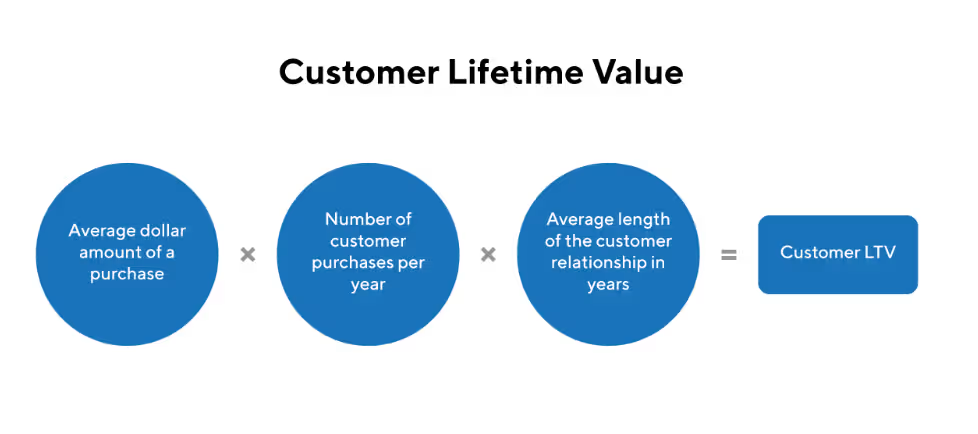
Customer Lifetime Value (CLV) refers to the total revenue a business can expect from a single customer throughout their entire relationship with the brand. It goes beyond one-time purchases and focuses on the cumulative value a customer brings over time.
Understanding CLV in Simple Terms
Let’s simplify it. Imagine two customers:
- Customer A buys once for $2,000 and never returns
- Customer B buys $1,000 worth of products every month for a year
Even though Customer A spent more initially, Customer B is far more valuable. That’s because Customer B keeps coming back and generates consistent revenue over time.
Customer B’s total value = $1,000 × 12 = $12,000
This is what Customer Lifetime Value (CLV) is all about—measuring how much a customer is worth to your business over the entire relationship, not just a single purchase.
CLV vs Immediate Revenue
This is where many businesses go wrong.
- Immediate revenue focuses on one transaction
- CLV focuses on the entire customer journey
If you only focus on single purchases, you may overlook opportunities to grow revenue through retention and loyalty.
Why Customer Lifetime Value Matters
Understanding CLV is not just about analytics—it directly influences how you make decisions across your business. When used correctly, CLV becomes a guiding metric for marketing, pricing, retention, and growth strategies.
Helps You Make Smarter Marketing Decisions
One of the biggest advantages of CLV is that it helps you understand how much you can spend to acquire a customer. For example:
- If your CLV is $15,000
- Spending $2,000 to acquire a customer is reasonable
Without CLV, you might either overspend or underinvest in marketing.
Encourages a Focus on Retention
Acquiring new customers is expensive. In fact, acquiring a new customer can cost up to five times more than retaining an existing one. CLV naturally shifts your focus toward:
- Repeat purchases
- Customer loyalty
- Long-term engagement
Supports Sustainable Growth
CLV helps you build a business that grows consistently over time. Instead of relying on one-time buyers, you:
- Build relationships
- Increase repeat sales
- Create predictable revenue
Key Components of Customer Lifetime Value
Understanding the key components of Customer Lifetime Value is essential before you attempt to calculate or improve it. CLV is not a single metric—it’s built from multiple factors that together determine how much value a customer brings over time.
By breaking it down into elements like average order value, purchase frequency, and customer lifespan, you gain a clearer picture of what drives revenue in your business. This section will help you understand each component in detail so you can identify areas to optimize and increase overall customer value.
- Average Order Value (AOV): This represents the average amount a customer spends per purchase. You can calculate it by dividing total revenue by the number of orders.
- Purchase Frequency: This measures how often customers buy from you. It tells you how frequently a customer returns to make a purchase.
- Customer Lifespan: Customer lifespan refers to how long a customer continues to buy from your business. This could range from a few months to several years.
- Profit Margin: While many businesses calculate CLV based on revenue, including profit margin gives a more realistic picture. After all, revenue doesn’t equal profit.
How to Calculate Customer Lifetime Value
Calculating Customer Lifetime Value might seem complex at first, but once you break it down into clear steps, it becomes much easier to understand and apply. By combining key metrics like average order value, purchase frequency, and customer lifespan, you can estimate how much revenue each customer brings to your business over time.
Having a structured approach to calculating CLV not only gives you better financial clarity but also helps you make smarter decisions around marketing, retention, and growth. In this section, we’ll walk through the process in a simple and practical way so you can confidently calculate and use CLV for your business.
Basic CLV Formula
CLV = (Average Order Value×Purchase Frequency)×Customer LifespanCLV = (Average\ Order\ Value \times Purchase\ Frequency) \times Customer\ LifespanCLV=(Average Order Value×Purchase Frequency)×Customer Lifespan
This formula gives you the total revenue generated by a customer over time.
Step-by-Step Example
Let’s break it down:
- Average order value = $1,500
- Purchase frequency = 4 times per year
- Customer lifespan = 3 years
CLV = $1,500 × 4 × 3 = $18,000 This means each customer contributes $18,000 over their lifetime.
Advanced CLV Formula (Including Profit)
CLV=(AOV×Frequency×Lifespan)×Profit MarginCLV = (AOV \times Frequency \times Lifespan) \times Profit\ MarginCLV=(AOV×Frequency×Lifespan)×Profit Margin
This helps you calculate actual profitability instead of just revenue.
Subscription-Based CLV
For recurring businesses:
CLV=Revenue per CustomerChurn RateCLV = \frac{Revenue\ per\ Customer}{Churn\ Rate}CLV=Churn RateRevenue per Customer
This is useful for subscription-based models.
Types of Customer Lifetime Value
Customer Lifetime Value is not measured in just one universal way. Depending on your business model, available data, and goals, CLV can be viewed through different approaches that offer different levels of insight. Some methods focus on the value customers have already generated, while others aim to predict how much they may be worth in the future.
Understanding these types is important because it helps you choose the right way to measure customer value for your business and make more informed decisions based on both past performance and future potential.
Historical CLV
This is based on past customer data. It tells you:
- How much customers have already spent
Best for quick analysis.
Predictive CLV
This estimates future value based on behavior patterns. It helps you:
- Forecast revenue
- Identify high-value customers
- Improve targeting
How to Calculate CLV for Ecommerce Businesses
Calculating Customer Lifetime Value for ecommerce businesses requires a slightly more practical and data-driven approach, since customer behavior can vary based on products, pricing, and purchase cycles. Unlike subscription models, ecommerce relies heavily on repeat purchases and customer retention, making it important to accurately measure how often customers return and how much they spend over time.
By breaking CLV into clear steps using real store data, you can gain better insights into customer value and make more informed decisions to improve profitability and long-term growth.
Practical Calculation Approach
Follow these steps:
- Calculate average order value
- Determine purchase frequency
- Estimate customer lifespan
- Multiply all values
Example for Ecommerce
- AOV = $2,000
- Frequency = 3 purchases/year
- Lifespan = 2 years
CLV = $2,000 × 3 × 2 = $12,000
Why CLV is Crucial for Ecommerce
Most ecommerce revenue comes from repeat customers. This makes CLV a key driver of profitability.
How to Use CLV to Grow Your Business
Understanding Customer Lifetime Value is useful, but its real impact comes from how you apply it to grow your business. CLV gives you a clearer view of which customers are most valuable, how much you can afford to spend on acquisition, and where to focus your efforts to increase retention and profitability.
Instead of making decisions based only on short-term sales, you can use CLV to build smarter marketing strategies, improve customer relationships, and create more sustainable growth over time. This section explores how to turn CLV insights into practical business actions that drive better results.
Optimize Customer Acquisition
Compare CLV with Customer Acquisition Cost (CAC).
- If CLV is higher → profitable
- If CLV is lower → unsustainable
Improve Customer Experience
Better experience leads to:
- Higher retention
- More repeat purchases
- Increased CLV
Segment High-Value Customers
Identify your best customers and focus on them. You can:
- Offer exclusive deals
- Personalize marketing
- Build loyalty programs
Strategies to Increase Customer Lifetime Value
Increasing Customer Lifetime Value is not about one single tactic—it’s the result of consistently improving multiple parts of your customer journey. From the first purchase to post-sale engagement, every interaction plays a role in whether a customer returns or leaves.
By focusing on strategies that enhance experience, build trust, and encourage repeat purchases, you can gradually increase the value each customer brings to your business. In this section, we’ll explore practical and actionable ways to strengthen customer relationships and maximize long-term revenue.
Enhance Product Quality
Customers return when they trust your products. Consistency in quality is key to building that trust, as it ensures every purchase meets their expectations and reinforces their decision to stay loyal to your brand.
Create Loyalty Programs
Encourage repeat purchases with:
- Rewards
- Discounts
- Points systems
Use Email Marketing
Stay connected with customers through:
- Follow-ups
- Recommendations
- Promotions
Upsell and Cross-Sell
Increase order value by:
- Suggesting related products
- Offering upgrades
Improve Post-Purchase Experience
Customer experience doesn’t end after checkout. Focus on:
- Delivery
- Packaging
- Support
Common Mistakes When Calculating CLV
Avoiding mistakes is just as important as using the right formula.
- Ignoring Profit Margins: Revenue alone doesn’t show true value. Always consider costs.
- Using Incomplete Data: Accurate data is essential for meaningful CLV calculations.
- Treating All Customers Equally: Different customers have different values. Segment your audience for better insights.
CLV vs CAC: Understanding the Relationship
Comparing CLV with CAC is essential because it reveals the true health of your business. If the cost to acquire a customer exceeds the value they bring over time, your model is unsustainable; however, a high CLV relative to CAC ensures that your marketing investments drive long-term profitability and scalable growth.
Ideal CLV to CAC Ratio
A healthy business aims for:
- 3:1 ratio
This means:
- You earn ₹3 for every ₹1 spent
Why This Ratio Matters
It helps you:
- Measure profitability
- Optimize marketing
- Scale efficiently
CLV in Dropshipping and Ecommerce
For dropshipping businesses, CLV is even more important due to tighter margins.
Why CLV Matters in Dropshipping
- Reduces reliance on ads
- Increases profitability
- Builds long-term revenue
Role of Supplier Quality
Customer experience depends heavily on product quality and delivery. Working with reliable supplier ecosystems like Spocket helps:
- Improve product consistency
- Reduce returns
- Increase repeat purchases
This directly boosts CLV.
Best Practices for Tracking CLV
To make CLV actionable, follow these best practices.
Leverage Advanced Analytics Tools
Utilize robust data platforms to monitor customer behavior, identifying key purchase patterns and engagement trends that inform your CLV calculations.
Implement Strategic Customer Segmentation
Categorize your audience into distinct groups to tailor your retention efforts more effectively:
- Spending habits
- Frequency
- Engagement
Maintain Data Accuracy with Regular Updates
Since customer preferences and market conditions evolve, it is vital to refresh your CLV data frequently to ensure your strategies remain relevant and accurate.
Future of Customer Lifetime Value
CLV is becoming more important as businesses move toward data-driven strategies. Future trends include:
- AI-based predictions
- Personalized marketing
- Advanced customer segmentation
Businesses that focus on CLV will stay ahead of the competition.
Conclusion
Understanding and improving Customer Lifetime Value is one of the smartest ways to grow your business. It helps you make better decisions, optimize marketing spend, and build stronger customer relationships.
Customer Lifetime Value is not just a metric—it’s a strategy. It changes how you think about customers, marketing, and growth. Instead of chasing one-time sales, you build long-term relationships that drive consistent revenue.
When combined with reliable systems and supplier ecosystems like Spocket, you can enhance customer experience, increase retention, and maximize profitability over time. In a competitive ecommerce landscape, focusing on CLV gives you a clear edge.
Start your dropshipping business today
FAQs About Customer Lifetime Value
What is customer lifetime value in simple terms?
Customer Lifetime Value (CLV) represents the total revenue a business can expect from a single customer throughout their entire journey with the brand. It shifts focus beyond a single purchase to the cumulative value a customer brings over time. This metric is crucial because it separates short-term wins from a sustainable, long-term success strategy.
How do you calculate CLV quickly?
The basic formula for calculating CLV is the product of three key components: Average Order Value, Purchase Frequency, and Customer Lifespan. This calculation provides the total revenue generated by a customer over their time with your business. For a more advanced view of profitability, you can multiply this result by your profit margin.
Why is CLV important for ecommerce?
CLV is a key driver for sustainable ecommerce growth because most revenue comes from repeat customers. It helps businesses optimize marketing spend by setting a ceiling for Customer Acquisition Cost (CAC). By focusing on CLV, you shift to building relationships, ensuring more predictable revenue, and increasing long-term profitability.
What is a good CLV value?
A "good" CLV is relative and heavily depends on your specific industry and business model. The most crucial factor is ensuring your CLV is significantly higher than your Customer Acquisition Cost (CAC). A healthy business generally aims for an ideal CLV to CAC ratio of 3:1, meaning you earn ₹3 for every ₹1 spent on acquisition.
How can I increase customer lifetime value?
You can strategically increase CLV by focusing on multiple parts of the customer journey. Core strategies include enhancing product quality to build trust and offering loyalty programs to encourage repeat purchases. Furthermore, you can use techniques like upselling, cross-selling, and improving the post-purchase experience (delivery, support) to maximize order value and retention.


Launch your dropshipping business now!
Start free trial


Related blogs
Dripshipper Reviews: Is This Coffee Dropshipping Platform Worth It?
Read this detailed Dripshipper review covering features, pros, cons, pricing, customer feedback, profitability, and better dropshipping alternatives.

Is BigBuy Legit? Honest Review for Dropshipping Businesses
Find out if BigBuy is a reliable dropshipping supplier, including its features, pros, cons, pricing concerns, reviews, and alternatives for ecommerce sellers.
What is Micromarketing and How to Use it Effectively
Learn what micromarketing is, how it works, its benefits, examples, and how ecommerce businesses can use it to target niche customers effectively.