13 Best AI Agents for Customer Service in 2026
Check out the best AI agents for customer service to get your business more organized. Respond faster to clients, strengthen compliance, and win hearts!


Your customers don't wait. They message you at 2 AM about a delayed order, and if nobody responds, they move on to a competitor. That's 2026 for you. AI agents for customer service are now stepping in - handling account inquiries, order status updates, and support tickets without anyone lifting a finger. No, not the clunky old chatbots that frustrate people with canned replies. We're talking about AI that actually closes issues end-to-end, learns from every conversation, and gets sharper with each one. If you want lower costs, faster response times, and a support team that isn't constantly buried, you need to pick the right AI setup. There are a lot of options out there. Here are 12 of the best ones.
What Are Customer Service AI Agents?
A customer service AI agent is software that handles customer conversations without a human stepping in every single time. You could think of it as a support rep that's always on, never overwhelmed, and never needs a break. But it goes a lot further than that.
These AI agents use large language models (LLMs), natural language processing (NLP), and machine learning to read what a customer is asking, understand what they need, and actually do something about it — not just shoot back a FAQ link. A solid AI customer support system can check order statuses, update account data, issue refunds, and route complex cases to a human rep, all without breaking stride. And they do all of it across chat, email, voice, and social media at the same time.
What makes 2026 AI agents different from the chatbots of five years ago is that AI agents learn from your past tickets. They pull from your knowledge base, business data, and past conversations to give answers that fit your specific business — not a generic template. Unlike scripted bots, customer service AI agents sharpen themselves with each new interaction. Gartner predicts AI will resolve more than 80% of customer service interactions without human involvement in the near future. If you're running a dropshipping store, a SaaS company, or any online business handling a high volume of support tickets, that number should get your attention. For more context on how this plays out in online retail, check out these e-commerce AI agents that are already automating support at scale.
Types of AI Agents for Customer Service
Not all AI agents are built the same. There are a few core categories worth knowing before you pick one for your business. Here's a breakdown of the main types, what they do, and who they work best for.
Conversational AI Agents
Conversational AI agents are built to talk to customers in a natural, human-like way. You'll know one when you see it — it responds to questions, follows up naturally, and keeps the conversation going without sounding like it's reading from a card. These agents use NLP and LLMs to understand context, so if a customer types "I haven't gotten my package yet," the agent knows what they mean and pulls up relevant order data right away.
These work great for businesses handling high volumes of simple to mid-level queries — shipping questions, live chat support interactions, and product FAQs. They can handle hundreds of chats simultaneously, which no human team can do at that scale. Conversational AI agents are the most common type you'll find across customer support platforms in 2026, and for good reason.
If you've read about AI chatbots for e-commerce, a lot of those fall into this category. The difference between a basic chatbot and a conversational AI agent is that the latter can hold a multi-turn conversation, remember context, and adapt based on what the customer says in real time.
Autonomous Action-Taking AI Agents
These go well beyond conversation. Autonomous action-taking AI agents don't just talk — they get things done inside your systems. Think issuing refunds, updating orders, changing subscription tiers, resetting passwords, and pushing data into your CRM, all without waiting for human approval on every action.
Customer service in dropshipping is full of repetitive requests — order status, returns, lost packages. Autonomous agents handle all of that without your team spending hours every day on the same types of tickets. If you're using Spocket for your dropshipping store, pairing it with one of these agents cuts down on manual touchpoints and gets customers to a resolution faster.
These agents connect to your internal systems via APIs and integrations, which means they can actually go in and make changes. Decagon, Sierra, and a few others on this list fall into this category. The setup takes more time than a basic chatbot, but the payoff is worth it — especially for businesses handling thousands of tickets a month.
Hybrid AI Agents
Hybrid agents combine conversational AI with action-taking capabilities, and they're also designed to hand off to a human agent when things get too complex or emotionally sensitive. You get the speed and scale of AI with the judgment of a person when it actually counts.
Most enterprise platforms in 2026 are moving toward hybrid setups. AI agents automate the routine stuff, and humans take over for the nuanced, high-stakes conversations. Designing an AI agentic system for customer support this way gives you the best of both worlds without compromising on customer experience. The handoff is usually triggered by sentiment analysis, keyword detection, or when the AI hits a low confidence threshold. For stores selling trending dropshipping products during peak seasons, a hybrid setup means you can absorb a spike in support volume without scrambling to hire a bunch of extra agents.
How Do AI Agents for Customer Service Work?
The short answer: they connect to your data, learn your business, and handle customer requests without waiting for instructions at every step. Here's a more detailed breakdown.
- They pull from your knowledge base and past tickets. AI agents learn from your help center articles, historical tickets, FAQs, and product documentation. When a customer asks something, the agent retrieves the most relevant answer and delivers it in plain language. The more you feed the system, the sharper its responses become with each interaction.
- They use NLP to understand intent. Natural language processing lets AI agents figure out what a customer actually means — not just what they literally typed. If someone writes "my order is messed up," the agent reads this as a likely complaint about an order issue and routes it accordingly, whether that's checking shipping status, pulling order data, or flagging it for a human. This is a big part of how AI agents help in customer support.
- They connect to your backend systems. The best AI agents don't just answer questions — they take action. Through integrations with your CRM, order management system, and helpdesk, AI agents can check order status updates, issue refunds, update account details, and close tickets on their own, without a human approving each move.
- They handle multi-channel conversations. AI agents respond to customers across chat, email, voice, SMS, and social media from one unified system. A customer who starts a chat on your website and later sends an email gets a response that knows the full context of the prior conversation — no repeating themselves required.
- They escalate when needed. Good AI knows its limits. When a conversation gets too complex, emotionally charged, or outside the agent's confidence zone, it passes the case to a human agent with the full conversation history, intent data, and relevant account info. The customer doesn't start over.
- They learn and improve with each interaction. When a human agent resolves a case the AI couldn't, that resolution feeds back into the training loop. The agent gets better at handling similar cases without you having to manually retrain it every time. This is exactly what people mean when they say AI agents learn from your past tickets — it's an active feedback loop, not a one-time setup.
- They monitor for quality and compliance. Most enterprise AI agent platforms now include built-in quality assurance tools that flag low-confidence responses, unusual patterns, and potential compliance issues in real time. This is especially important in regulated industries where every customer interaction needs to be traceable and accurate.
Cost of AI Agents for Customer Service
Pricing for AI agents varies wildly depending on the platform, the features you need, and how much volume you're pushing through. Here's a realistic look at what you can expect to pay:
- Free plans exist, but they come with real limits. You can start with a free tier on platforms like Freshdesk or Tidio. Freshdesk has a free plan for up to 10 agents, and Tidio includes 50 Lyro AI conversations per month in their free tier. These are good for testing, but if you're handling any real support volume, you'll hit the ceiling fast. Think of free plans as a trial, not a long-term solution.
- Per-resolution pricing is one of the most common models. Some of the most recognized AI agents charge only when the AI actually resolves a conversation. Fin by Intercom charges $0.99 per resolution. Zendesk AI charges around $1.50 per resolution. Gorgias charges $0.60 to $1.27 per automated resolution depending on your plan. The upside is you don't pay for conversations that fail and escalate to a human.
- Per-session and per-conversation models are another route. Salesforce Agentforce charges $2 per conversation, or you can use their Flex Credits model at $500 per 100,000 credits, where standard actions cost 20 credits each. Freshdesk's Freddy AI uses session-based pricing at $0.10 per session. This can be cheaper than per-resolution pricing if your automation rates are low, but it adds up fast at scale.
- Enterprise platforms require custom quotes. Sierra, Ada, and Decagon don't publish pricing. Sierra reportedly starts at $150,000+ per year, with year-one deployment costs often hitting $200,000 to $350,000+. Decagon contracts are estimated to range from $95,000 to $590,000+ annually. If you're running a small dropshipping business or a lean e-commerce store, these platforms are overkill and beyond budget.
- Watch out for stacked platform fees. Some AI agents require you to already be paying for their parent platform. Agentforce needs Salesforce Service Cloud, which starts at $175/user/month. Zendesk AI layers on top of Zendesk Suite plans ($55–$169/agent/month) plus a $50/agent/month AI add-on. These stacked costs are easy to underestimate and can hit you in the budget before you even process a single AI conversation.
- Implementation costs are real and often overlooked. Enterprise platforms can charge for professional services, setup, and onboarding. Sierra has reported setup fees of $50,000 to $200,000. A 10-person Agentforce deployment can hit $140,000 in year one when you factor in licensing, setup, and training. For Print-on-demand sellers or small e-commerce businesses, a lighter and more affordable option will serve you much better from the start.
- Free AI agents for customer service are entry-level, not production-grade. Platforms like Tidio and Freshdesk have free starting plans, but the volume limits and feature gaps make them hard to use at any meaningful scale. If you're not ready to pay enterprise rates, a mid-tier plan from Tidio or Freshdesk can handle solid volume for under $100/month — which is a reasonable place to start.
12 Best AI Agents for Customer Service in 2026
Here's our full list of AI agents for customer service, from the most enterprise-grade to the most beginner-friendly. Every tool here has been researched for accuracy in 2026:
1. Fin by Intercom
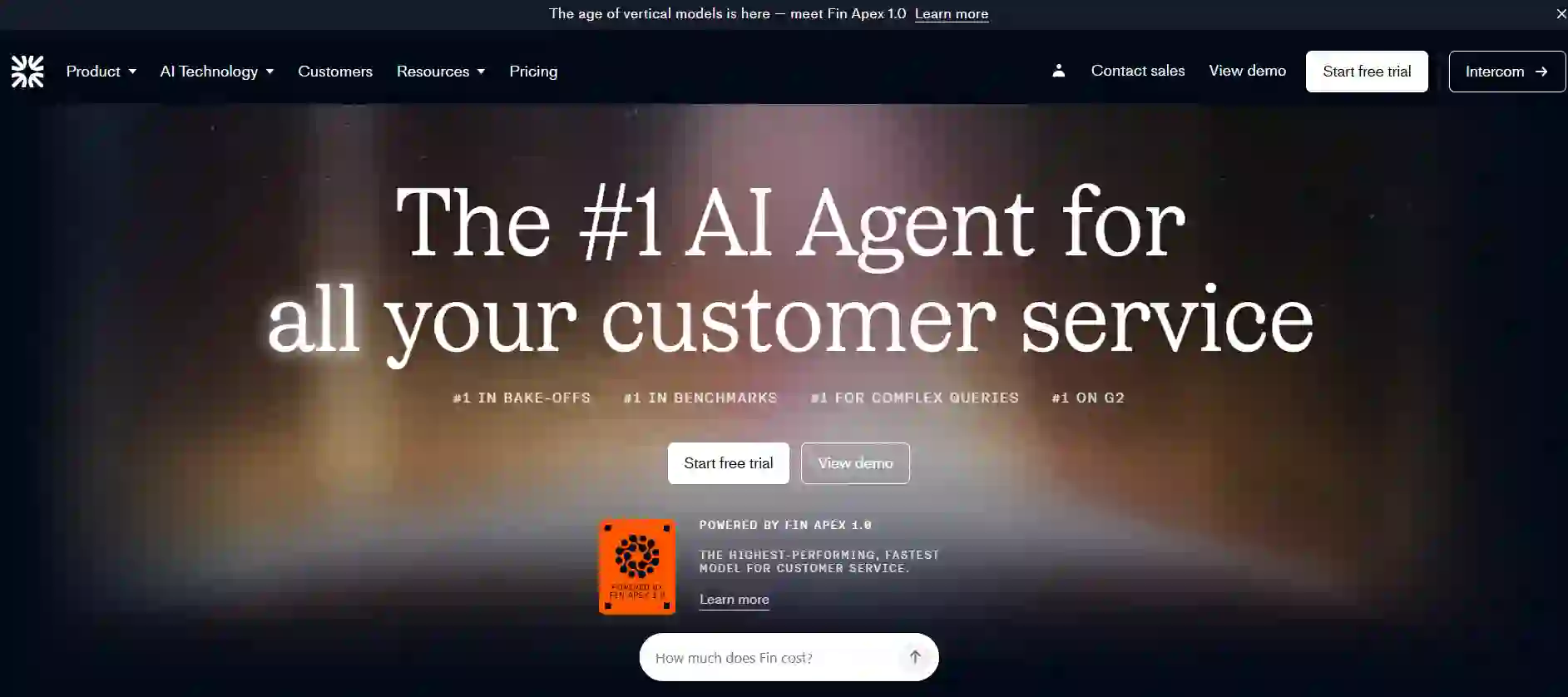
Fin by Intercom is one of the most widely recognized AI customer support chatbot options on the market right now, and it's rated the top-performing AI agent for customer service on G2 — which means something when there are hundreds of tools competing. Unlike most AI features that get bolted onto existing helpdesk platforms, Fin was built from the ground up as an AI-first support agent. It uses Intercom's proprietary Fin Custom Model alongside leading LLMs to answer complex questions, run multi-step workflows, and hand off to human agents with full context attached. The $0.99 per resolution pricing means you only pay when the AI actually closes a case — not for attempts or escalations.
Fin works across chat, email, voice, SMS, WhatsApp, and social channels from one unified system. It doesn't require you to abandon your existing helpdesk — it integrates with Zendesk, Salesforce, HubSpot, and others at no integration fee. If you want to go all-in on Intercom's ecosystem, the base Helpdesk plan starts at $29/seat/month on top of the per-resolution fee. For mid-market and enterprise teams that want clean, outcome-based pricing with wide channel coverage, Fin is one of the most trusted AI customer service agents on the list.
Key Features
- Works with any existing helpdesk, no migration needed. Fin integrates directly with Zendesk, Salesforce, HubSpot, and dozens of other platforms. You don't need to rebuild your entire support stack. Your team keeps working in the tools they already know, and Fin layers on top.
- Fin Vision for image-based support. Fin can read and interpret images that customers upload — error screenshots, product photos, packaging photos. This is active by default at no additional cost, and it means customers don't have to describe visual problems in words.
- Simulations for pre-deployment testing. Before Fin goes live, you can run Simulations that test how the agent responds to hundreds of real-world scenarios. This catches bad responses and tunes performance before actual customers are involved — something most platforms skip entirely.
- Procedures for complex multi-step workflows. Fin isn't limited to Q&A. You define multi-step workflows using Procedures, and the agent follows them consistently across every conversation. Think: check order status, verify eligibility, process refund, close ticket — all in one interaction.
- CX Score for conversation-level analytics. Fin includes an AI-powered analytics tool called CX Score that rates conversation quality, tracks resolution rates, and surfaces customer sentiment trends. This helps you spot where Fin is underperforming before it shows up in your CSAT numbers.
- Omnichannel deployment from a single AI layer. Fin handles customer conversations across every major channel from one unified system. A customer who starts on chat and follows up via email or voice gets responses that know the full prior context.
- No feature gating behind higher tiers. Every Fin capability — Procedures, Vision, Simulations, Voice, CX Score — is included at $0.99 per resolution with no feature tiers to navigate. You get the full product without paying more for core functionality.
2. Decagon

Decagon is built for enterprise teams that need serious AI firepower. Trusted by Notion, Duolingo, Chime, Rippling, Dropbox, and Substack, Decagon hit a $4.5 billion valuation in January 2026 after raising $250 million in new funding. That's not a coincidence — it's a sign that large-scale businesses are betting on this platform. At the heart of Decagon is its Agent Operating Procedures (AOPs) system, which lets CX teams define agent behavior using natural language instructions that compile into structured, precise agent logic. No coding, no rigid decision trees.
Decagon covers voice, chat, and email from a single intelligence layer, with cross-channel memory so customers don't have to repeat themselves. Clients report 75 to 80% ticket deflection from day one of deployment. Pricing is custom, usage-based, and enterprise-focused — either per-conversation or per-resolution. Annual contracts typically start in the six-figure range, which makes Decagon a match for large operations rather than small businesses.
Key Features
- Cross-channel memory across voice, chat, and email. If a customer starts on chat and calls in later, the voice agent already knows the full conversation history. No re-explaining needed, no lost context — the experience picks up exactly where it left off.
- Watchtower for real-time quality assurance. Watchtower monitors AI behavior continuously, flagging low-confidence responses, unusual patterns, and compliance risks. You can see exactly why the agent said what it said, which is essential for regulated industries and high-stakes customer interactions.
- Proactive AI agents (launched early 2026). Decagon introduced proactive agent functionality in 2026. These agents reach out to customers before issues escalate — for things like shipment delays, payment failures, or account anomalies. Instead of waiting for a complaint, the AI gets ahead of it.
- Agent Assist for human agents. When an AI escalation happens, Agent Assist gives human agents the full context, intent analysis, and relevant account data before they even type the first reply. Handoffs don't create friction because humans walk in fully prepared.
- AOP-based workflow iteration without engineering. CX operators can update and change agent behavior through AOPs in natural language — no engineering sprint needed for every workflow tweak. New policies, new products, or changed rules get reflected in the agent fast.
- Git-based versioning for agent logic. Decagon stores AOP versions in Git, which means you can track changes, roll back to previous behavior, and test new workflows in staging before they hit production. This level of control is rare in no-code AI agent platforms.
3. CloudTalk
.avif)
CloudTalk is an AI agent built specifically for the phone channel rather than chat widgets. Its AI Voice Agents and AI Receptionist handle inbound and outbound calls autonomously, 24/7: answering routine questions, qualifying leads, booking appointments, covering after-hours calls, sending payment reminders, and escalating to a human agent with context when a conversation needs one. The agents speak 60+ languages and accents and pull from your CRM data to personalize each call, so callers get relevant answers instead of a generic script.
Unlike most tools here, CloudTalk runs support over voice, not text, which makes it the natural fit for businesses where customers still pick up the phone — high call volumes, reception, and support lines. AI Voice Agents are priced on usage: pay-as-you-go at $0.50/minute, or monthly plans starting at €350/month for 1,000 minutes (Build), €750/month (Scale), and €1,250/month (Scale Plus), with overage from €0.35/minute and volume discounts down to €0.15/minute. The agents run on top of CloudTalk's calling platform, which starts at $25/user/month. The trade-off to know: CloudTalk is voice-centric, so it's best as the phone layer of your support stack rather than a single tool for chat, email, and social.
Key Features
- Autonomous inbound and outbound voice calls, 24/7. CloudTalk's AI Voice Agents pick up and place phone calls without a human, answering common questions, qualifying leads, and booking appointments around the clock — including after-hours coverage when your team is offline.
- 60+ languages and accents. The voice agents converse in over 60 languages and accents, so global support lines don't need a separate agent or number for each market. Callers get answered in their own language automatically.
- Human handoff with full context. When a call falls outside the agent's scope or gets complex, CloudTalk routes it to a live agent along with the call details, so customers don't have to repeat themselves and reps step in already informed.
- CRM-personalized conversations and 35+ integrations. The agents connect to Salesforce, HubSpot, Zendesk, Pipedrive, and 35+ other CRMs and help desks, pulling live customer data into each call and logging the interaction back automatically.
- Built-in conversation intelligence. Every call is recorded and transcribed, with AI summaries and notes, sentiment analysis, topic extraction, call scoring, and talk/listen ratio, giving managers QA and coaching data without listening to full recordings.
- Usage-based pricing with local numbers in 160+ countries. You pay per minute (from $0.50, dropping with volume) rather than per seat, and can run agents on local numbers across 160+ countries, useful for scaling call volume up or down without per-agent costs.
4. Sierra

Sierra was founded in February 2023 by Bret Taylor — former Salesforce co-CEO and co-creator of Google Maps — and Clay Bavor, who spent 18 years at Google leading products like Lens and Workspace. It's not a plugin or an add-on. Sierra is a standalone "Agent OS" designed from the ground up for customer experience AI. Today, Sierra is used by 40% of the Fortune 50 and counts Nordstrom, Cigna, Rocket Mortgage, SiriusXM, and Wayfair as clients. It crossed $150 million in annual recurring revenue by early 2026 and sits at a $10 billion valuation.
What makes Sierra different is its hybrid reasoning architecture — generative AI for fluid, natural conversations, and deterministic logic for high-stakes actions like refunds, cancellations, or subscription changes. In March 2026, Sierra released "Ghostwriter," an AI agent that builds other AI agents from plain English, audio recordings, or even whiteboard photos. Pricing starts at roughly $150,000 per year, with year-one deployment costs often hitting $200,000 to $350,000+ for full enterprise rollouts.
Key Features
- Ghostwriter — builds agents from plain English (released March 2026). Ghostwriter lets CX teams write new agent behaviors, update workflows, and create new deployment scenarios using natural language — including from audio recordings or photos. No engineering resources required for major workflow changes.
- Agent OS — not a helpdesk plugin. Sierra connects to your CRM, order management systems, and data warehouse via APIs. Because it's a dedicated agent platform rather than a helpdesk add-on, you get a more consistent, controlled customer experience across every channel.
- Voice AI with natural barge-in handling. Sierra's voice agents handle real-time phone conversations with barge-in support — if a customer interrupts mid-sentence, the AI stops and listens immediately. This is what separates a voice agent that actually feels like talking to a person from one that just reads answers off a script.
- Outcome-based pricing — pay per successful resolution. You only pay Sierra when the agent completes a task — a resolved support conversation, a saved cancellation, or a completed transaction. If the AI doesn't deliver a real outcome, there's no charge.
- Simulation-based testing before live deployment. Sierra's Voice Sims feature, launched in September 2025, lets teams test voice agents in simulated real-world conditions before a single customer conversation happens. This catches edge cases and tuning issues before they hit your customer base.
- Customer data-driven personalization. Sierra pulls real-time context from conversation history, CRM records, and your data warehouse. Responses reflect the actual customer's account, history, and preferences — not a generic playbook. This is what personalized AI customer service looks like at enterprise scale.
5. Salesforce Agentforce
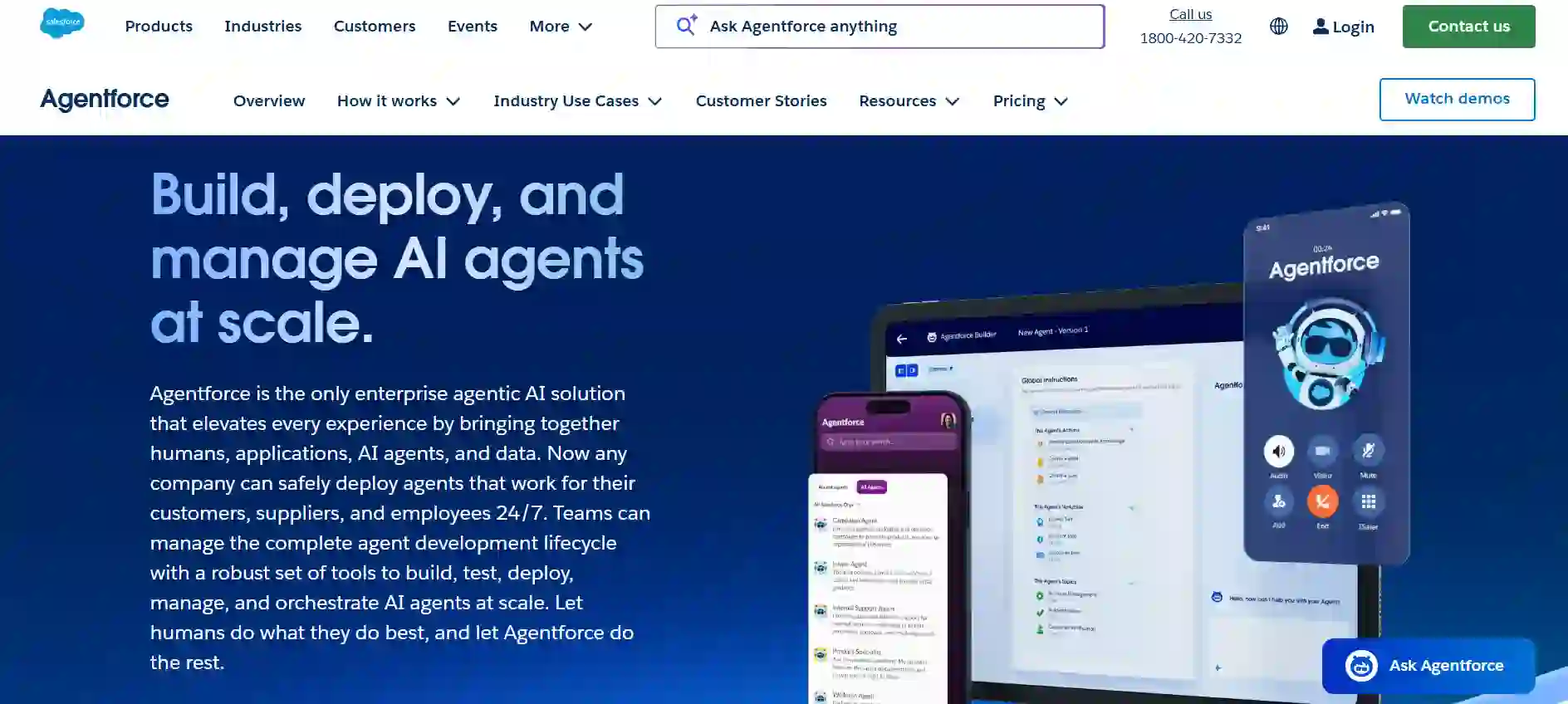
Agentforce is Salesforce's AI agent layer built directly into the Service Cloud ecosystem. It launched publicly in 2024 and has been one of the most discussed AI agent platforms in enterprise circles since. If you're already deep in the Salesforce ecosystem, Agentforce is the natural AI extension — it has direct access to Sales Cloud, Service Cloud, and Data Cloud without needing external API calls. The Atlas Reasoning Engine powers it, breaking down complex customer requests into discrete tasks, reasoning through each one, and executing them autonomously.
Agentforce went through three pricing models in its first 18 months. As of 2026, it runs on Flex Credits ($500 per 100,000 credits, with standard actions at 20 credits each), a $2/conversation model, and per-user licenses from $125/user/month. A full deployment for a 10-person team can hit $140,000 in year one when you include implementation, training, and licensing. Agentforce Contact Center became generally available in February 2026 — a fully native CCaaS offering with voice, IVR, and human agent workspaces all in one screen.
Key Features
- Atlas Reasoning Engine for multi-step task execution. Agentforce doesn't just generate a reply — it breaks down complex customer requests into smaller tasks, reasons through each step, and executes them in sequence. This is what allows it to check an order, verify eligibility, and process a return all in one uninterrupted conversation.
- Native Salesforce data access. Because Agentforce lives inside Salesforce, it has live access to your CRM records, customer history, and product data without custom connectors. This is a major advantage for companies already running their operations on Salesforce infrastructure.
- Agentforce Contact Center (GA February 2026). A fully native CCaaS solution with built-in voice, IVR, AI-powered intelligent voice agents, and a unified workspace for human agents and supervisors — all on the Salesforce platform without third-party telephony integrations.
- Agentforce Script — hybrid deterministic and LLM reasoning. Agentforce Script pairs strict, sequential business logic with LLM-powered natural language handling. Required steps always run in order; the LLM handles conversational nuance around them. This is critical for regulated industries where some decisions can't be left entirely to AI judgment.
- Three pricing models running simultaneously. Flex Credits, per-conversation billing, and per-user licenses are all available at the same time. Enterprise teams can pick the model that fits their volume, use case, and CFO's preferred contract shape.
- Low-code security guardrails and anti-hallucination controls. Agentforce ships with default security guardrails and hallucination reduction settings that CX teams can configure without code. Admins manage compliance requirements through a visual interface rather than engineering support.
6. Zendesk AI
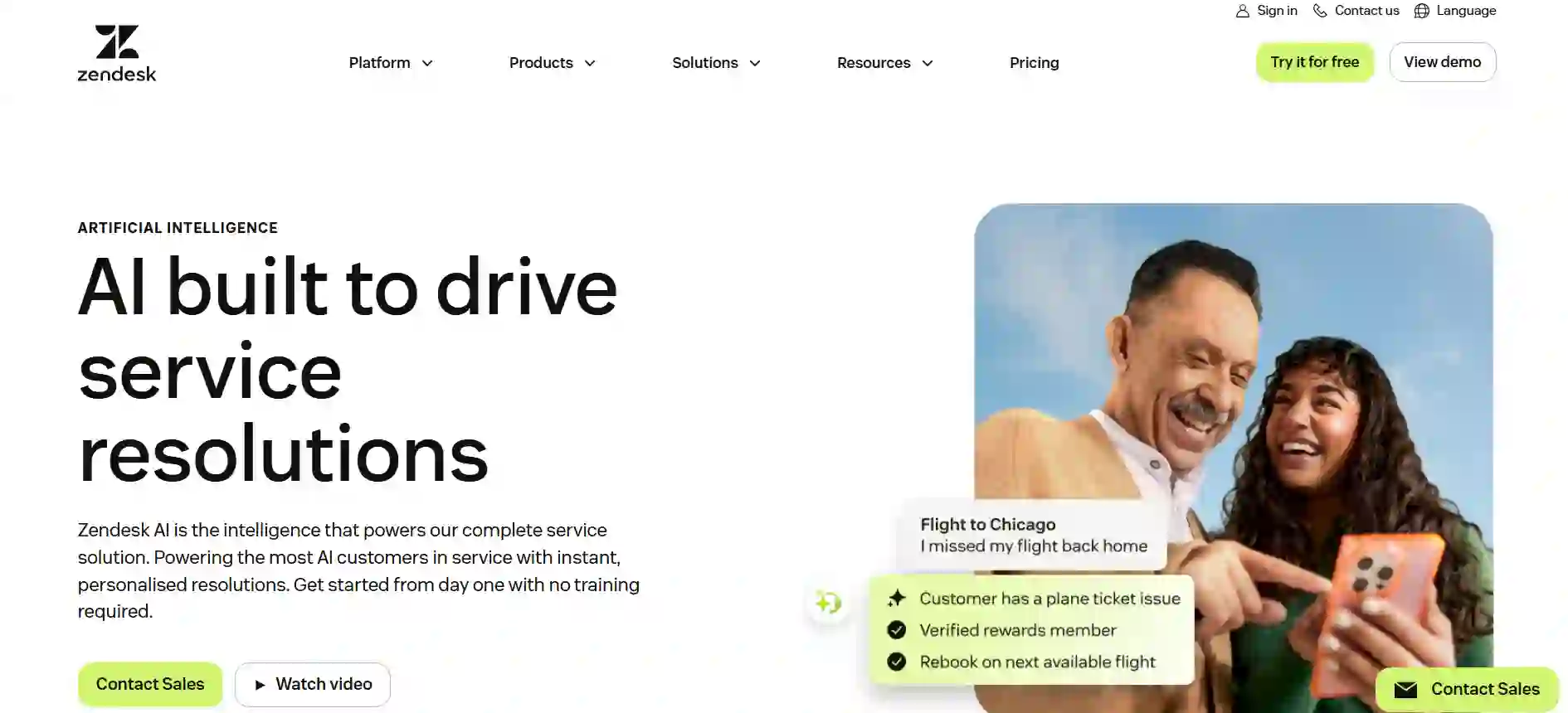
Zendesk AI is the AI layer built into the Zendesk Suite, and if your team is already on Zendesk, it's the most logical upgrade path. Zendesk has been in customer service for over 15 years, and its AI capabilities in 2026 have grown well past basic ticket tagging or canned auto-responses. Zendesk AI agents now handle end-to-end resolution across chat, email, voice, and messaging, with businesses reporting automation rates as high as 80% when they have a well-structured knowledge base. Resolution-based pricing sits at around $1.50 per automated resolution.
Suite plans run from $55/agent/month (Team) to $169/agent/month (Enterprise), with a $50/agent/month AI add-on for copilot features on top. It's not the cheapest option, but the depth of Zendesk's reporting, integrations, and admin tooling makes it a dependable choice for mid-market and enterprise teams. Zendesk also connects with platforms like Wix and WooCommerce for e-commerce use cases.
Key Features
- Agent Copilot for human team productivity. Beyond customer-facing automation, Zendesk AI includes a Copilot feature that assists human agents with suggested replies, next-best actions, and knowledge article recommendations during live conversations. Your team closes tickets faster even when the AI doesn't handle the full resolution autonomously.
- Advanced triage and intelligent routing. Zendesk AI classifies incoming tickets by intent, sentiment, and urgency, then routes each case to the right bot or human team automatically. This cuts down first-response time across the board without needing a manual dispatcher.
- AI-powered QA scoring and conversation summaries. Zendesk's analytics layer adds automated quality scoring, conversation summaries, and trend detection on top of its existing reporting dashboards. Managers can catch performance issues without manually reviewing hundreds of ticket threads.
- Outcome-based AI resolution pricing. You're billed only when the AI fully resolves a ticket without human intervention. At scale, the $1.50/resolution cost adds up — but it keeps billing tied to actual value delivered.
- Mature integration ecosystem with e-commerce reach. Zendesk integrates with hundreds of apps, CRMs, and e-commerce platforms. If you're running a store on eBay or BigCommerce, Zendesk has direct connectors that let your AI agent pull live store data during customer conversations.
- Established compliance and security certifications. Zendesk holds SOC 2 Type II, ISO 27001, GDPR, HIPAA, and FedRAMP compliance certifications. For enterprises in healthcare, finance, or government sectors, these certifications matter for procurement and reduce the compliance review cycle.
7. Ada CX
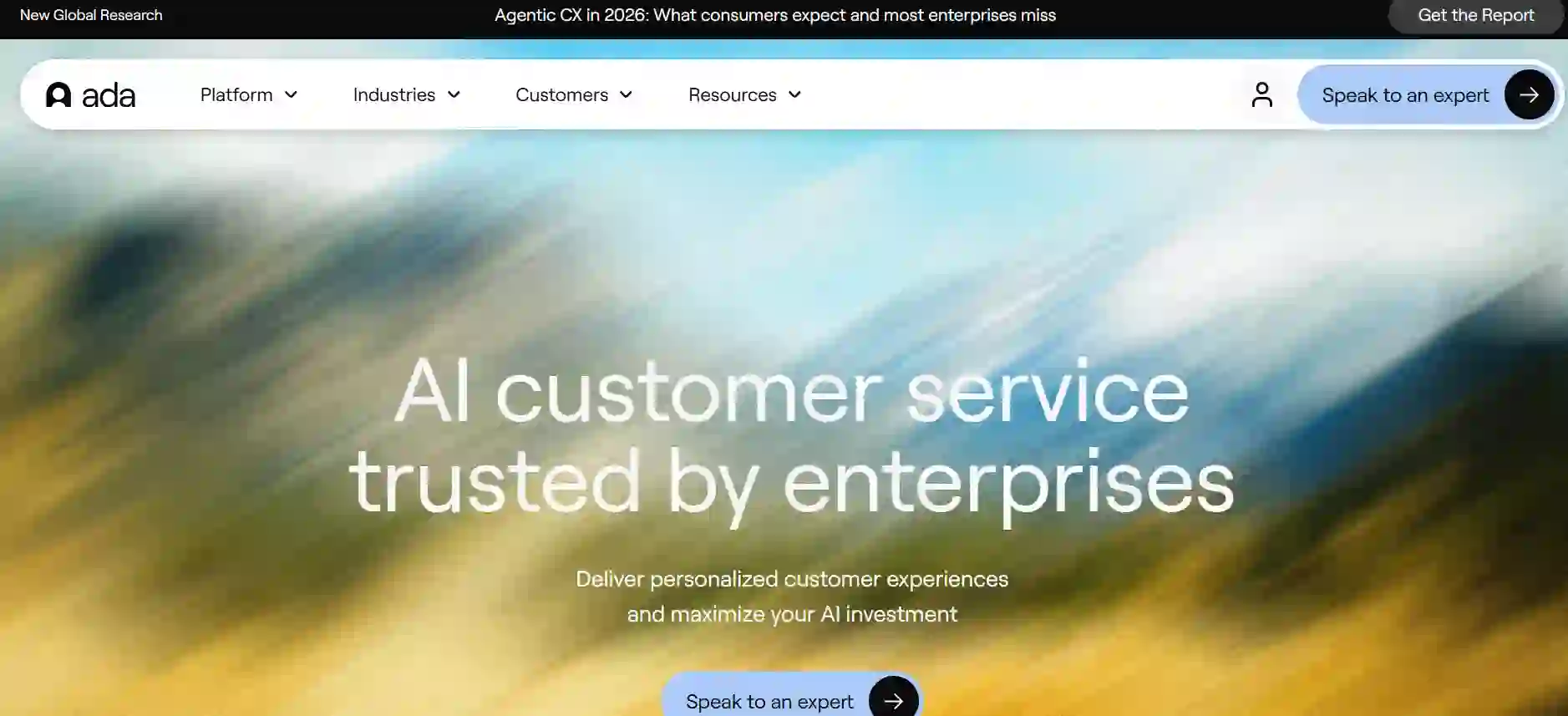
Ada positions itself as an AI employee — not a chatbot or a plugin — and it's built for enterprise teams handling high volumes across multiple regions and languages. It runs on a no-code builder that CX teams can manage without engineering support, covering chat, email, voice, and social in 50+ languages. Clients include Zoom, Square, and Meta, which gives you a sense of the scale Ada is designed for. The platform's long-term goal is letting AI handle the majority of customer interactions without compromising on service quality.
Ada doesn't publish pricing publicly. Enterprise contracts are estimated to start at around $30,000/year and scale significantly based on volume, channels, and integrations. One thing to keep in mind: Ada requires a separate helpdesk for human agent workflows. It's an AI-first layer that sits on top of your existing stack. That said, its no-code interface is one of the cleaner tools for non-technical teams to manage ongoing changes without waiting for developer cycles.
Key Features
- No-code visual agent builder for CX teams. Ada's drag-and-drop interface lets CX managers create, update, and deploy AI workflows without touching code. New conversation flows, updated policies, or seasonal changes can go live without filing an engineering ticket.
- Bring-your-own-model (BYOM) flexibility. Ada supports connecting your own LLM to power the agent. This gives enterprise teams control over model behavior, data handling, and compliance posture — which is especially important for companies in regulated industries that can't use off-the-shelf model outputs without vetting.
- 50+ language support across all channels. Ada handles customer conversations in over 50 languages with tone and regional adaptation, not just word-for-word translation. For global support operations where language quality directly affects brand perception, this depth of language support is actually worth the enterprise pricing.
- Proactive outreach triggered by customer behavior. Ada can initiate outbound conversations based on account triggers or behavioral signals — like messaging a customer who's been browsing the cancellation page for three minutes. This shifts Ada from reactive support into territory that can actually retain customers before they leave.
- Autonomous backend action execution. Ada agents connect to your internal systems via API and can perform real actions — processing refunds, resetting accounts, updating subscription tiers — without waiting for a human to approve each step.
- Segmented performance analytics. Ada's analytics layer lets you break performance down by language, channel, or use case. You can see where automation rates are high, where containment is dropping, and where the AI needs tuning without wading through a single combined report.
8. Freshdesk Freddy AI
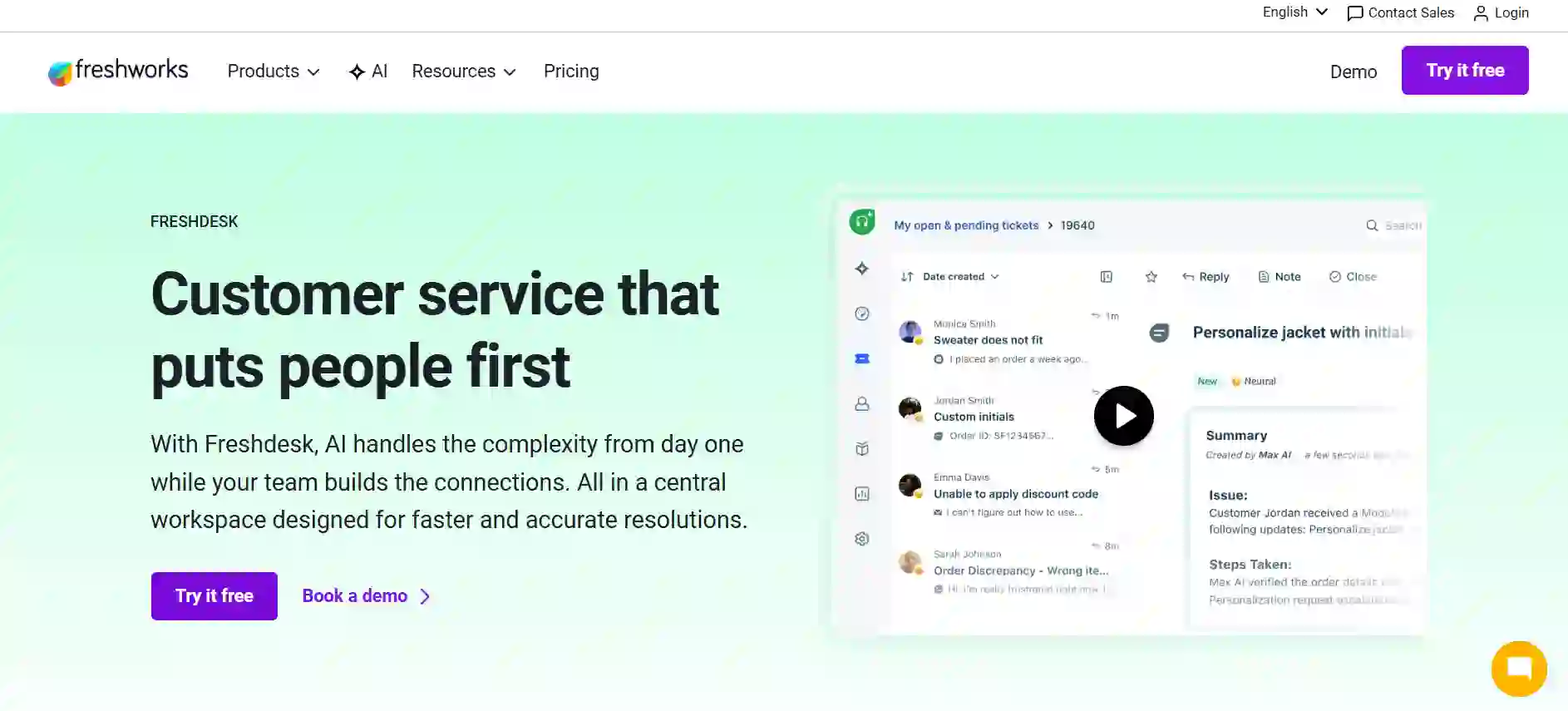
Freshdesk is the customer service platform from Freshworks, and Freddy AI is its built-in AI layer that makes AI customer service more affordable than almost any other option on this list. Freshdesk plans start at $15/agent/month on the Growth plan, there's a free plan for up to 10 agents, and Freddy AI Agent sessions run at $0.10 per session. The Freddy AI Copilot for human agents is an additional $29/agent/month add-on — still reasonable compared to what enterprise-tier platforms charge for equivalent features.
That said, Freddy AI has real limitations worth knowing. It only works on Freshchat-supported channels — not email or phone. You also can't run Freddy AI Agent and a custom answer bot simultaneously; it's one or the other. So while the pricing is attractive, AI in customer service on Freshdesk works best for teams primarily handling chat-based support rather than omnichannel workflows. For small to mid-size businesses looking for a solid, affordable AI customer support chatbot, Freddy is hard to beat on value.
Key Features
- Session-based pricing at $0.10 per session. This is one of the cheapest AI pricing models in the market. At $0.10 per session, even moderate-to-high-volume support operations can run Freddy AI without worrying about massive per-resolution bills piling up at the end of the month.
- Freddy AI Copilot for human agent productivity. The Copilot version gives human agents real-time reply suggestions, ticket summaries, multilingual translation, and relevant knowledge article recommendations mid-conversation. It's a strong productivity layer for teams handling complex cases that AI can't fully automate.
- Auto-triage and ticket categorization. Freddy automatically tags, classifies, and routes incoming tickets based on intent and urgency. This cuts manual triage time significantly and means the right team gets each case without a human dispatcher managing the queue.
- Free plan for up to 10 agents. Freshdesk's free tier lets you test both the helpdesk and basic AI features on real customer traffic before committing money. If you're evaluating whether AI works for your support volume, the free plan is a no-risk starting point.
- Auto-resolution of common queries. Freddy AI Agent handles incoming chat queries by pulling answers from your knowledge base and prior ticket data. Common questions — order status, return policies, account access — get answered without a human agent ever seeing them.
- Multilingual response handling. Freddy handles conversations in multiple languages with built-in translation. For businesses with international customer bases where queries come in across different languages, this means you don't need separate agents or separate bots for each language market.
9. Tidio Lyro
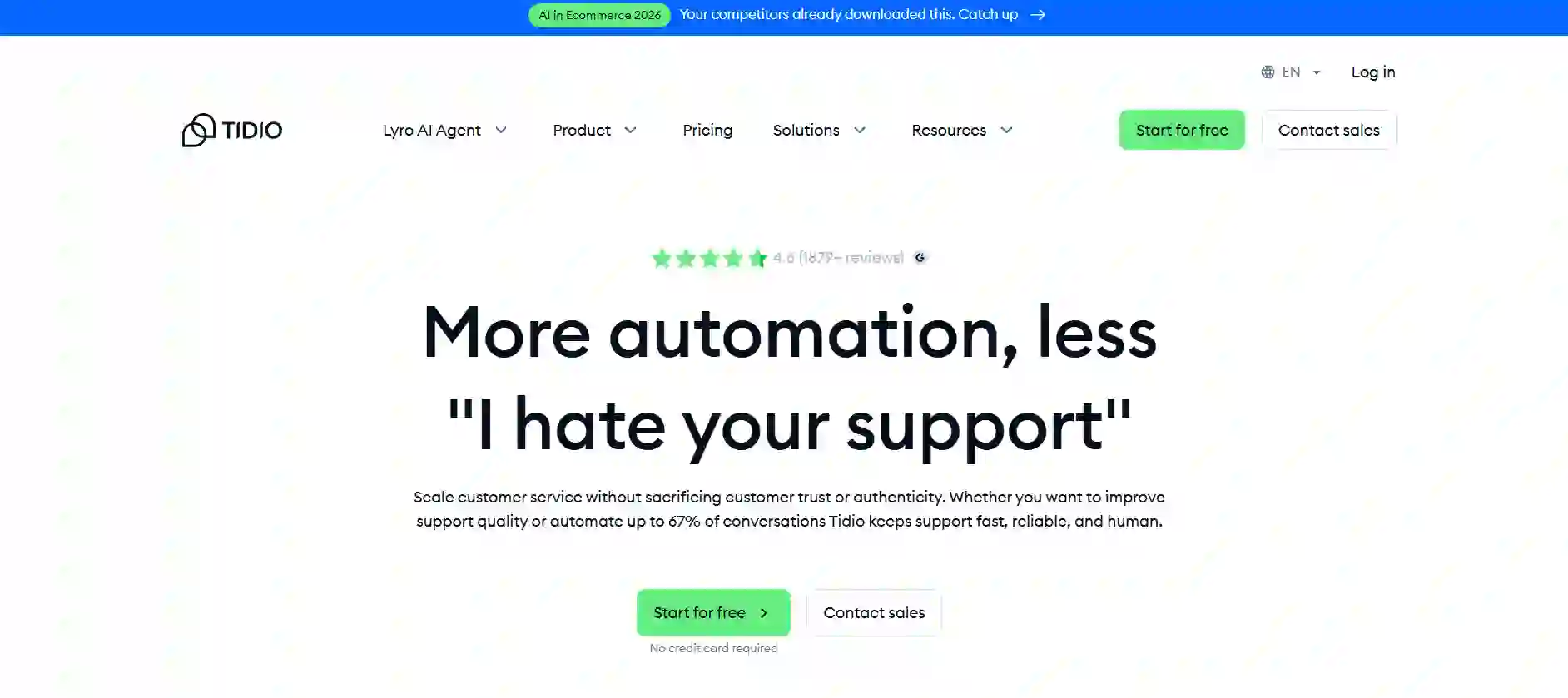
Tidio is the go-to for small businesses and e-commerce stores that want AI-powered customer service without a heavy price tag or a months-long onboarding process. Its AI agent, Lyro, is powered by Anthropic's Claude model and automatically resolves up to 67% of customer questions. You can be live in hours, not weeks. Tidio has a free plan, paid tiers start at $24.17/month, and Lyro is included in the Plus plan at $749/month with higher volume limits and more advanced features.
Lyro pulls answers directly from your existing knowledge base, so it stays grounded in your actual business data. It works across website chat, WhatsApp, Instagram, and Messenger. For stores on Shopify or WooCommerce, Lyro can check real-time order statuses, handle basic returns queries, and make product recommendations. If you're just getting into AI-powered support or looking for some of the best free AI agents for customer service entry points available right now, Tidio is one of the most beginner-friendly options in the market.
Key Features
- 67% average auto-resolution rate. Lyro resolves about 67% of incoming customer queries without human involvement. For a platform at this price point, that's a strong performance number that puts it in the same range as much more expensive tools.
- Powered by Anthropic's Claude model. Lyro runs on Claude, which gives it stronger language comprehension and more natural conversation handling than many competing AI agents at the SMB price tier. Customers get responses that feel more like talking to a person and less like reading a FAQ page.
- Zero-code setup for non-technical teams. Tidio is built for businesses without dedicated developers. You connect it to your data sources, set up basic flows through a visual interface, and it's live. No APIs to configure, no complex training pipelines, no technical dependencies to manage.
- Free plan with 50 Lyro conversations per month. Tidio's free tier gives you Lyro access with 50 AI conversations monthly — enough to test it on real customer traffic and see the resolution rate before committing to a paid plan.
- E-commerce integrations with real-time order data. Lyro connects with Shopify, WooCommerce, and other major e-commerce platforms, pulling live order and product data into conversations. Customers can ask about their orders and get a real answer — not a "check your email" redirect.
- Multichannel inbox — one place for everything. Conversations from website chat, WhatsApp, Instagram, and Facebook Messenger all flow into Tidio's unified inbox. Your team manages everything from one screen, and Lyro handles the first-line responses across all those channels simultaneously.
10. Gorgias AI
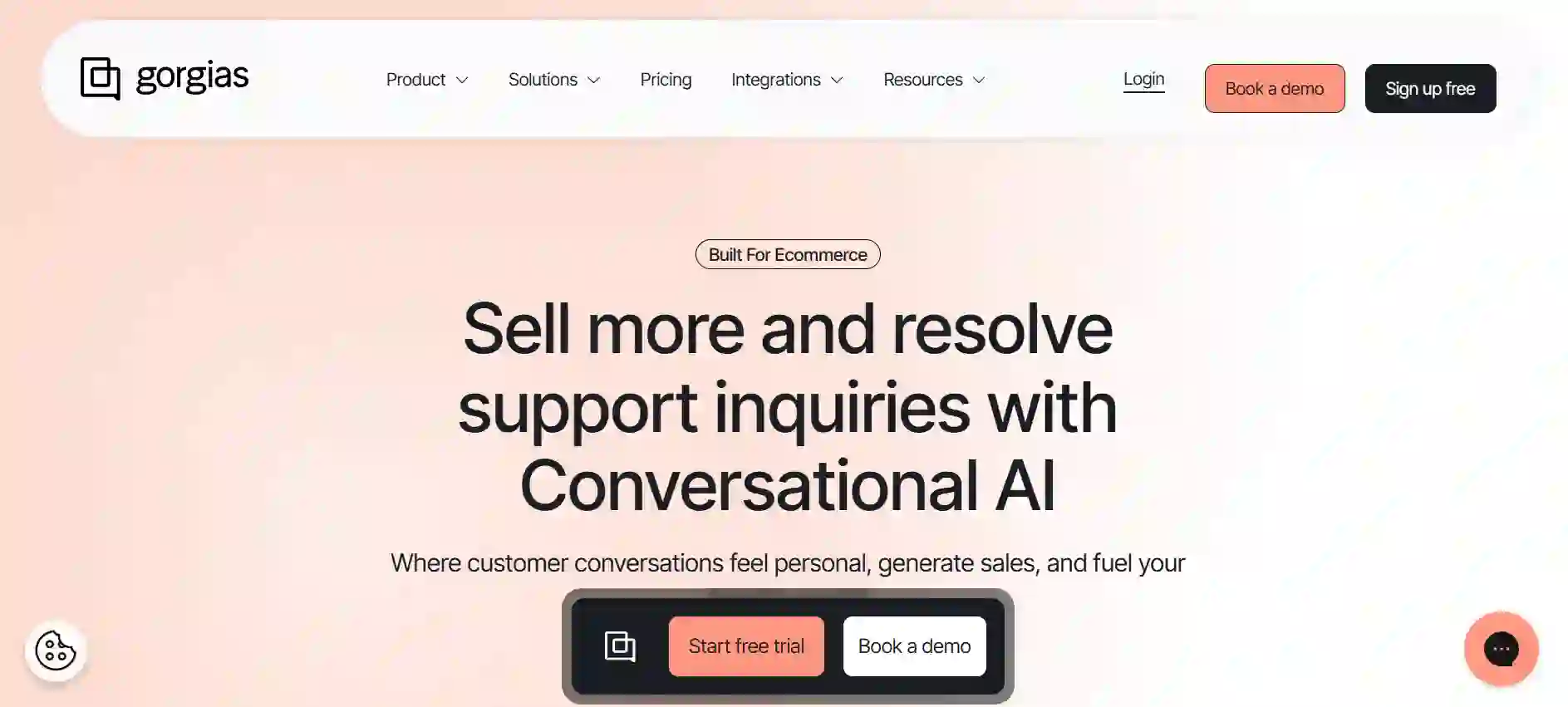
If your business runs on Shopify, Gorgias is probably already on your radar. It's one of the most popular customer service platforms for direct-to-consumer and e-commerce brands, and its AI layer in 2026 has grown significantly beyond basic auto-responses. Gorgias AI categorizes tickets, drafts replies, processes routine e-commerce requests, and handles returns — tuned specifically for retail and DTC workflows. The platform charges $0.90 per resolved AI conversation, which makes it predictable for high-volume e-commerce operations. Plans range from $10/month for a Starter plan (0–50 tickets) to $750/month for Enterprise (2,001–5,000 tickets).
If you're also selling Print-on-demand products or running a catalog through Spocket with no MOQ requirements, Gorgias gives your store a centralized support hub that handles the customer side of order management without adding headcount. The main limitation is platform dependency — its AI features are strongest for Shopify merchants, and WooCommerce or Magento stores won't get the same depth of integration.
Key Features
- Deep Shopify integration with live store data. Gorgias connects directly to your Shopify store, pulling real-time order info, customer history, and product details into every AI-generated reply. Agents and the AI both work from the same live data without switching tabs or copy-pasting order IDs.
- Revenue attribution per support conversation. Gorgias tracks revenue tied to support interactions — you can see which conversations led to a purchase or a saved cancellation. Very few support platforms actually measure this, and it makes the ROI of AI visible in a way that helps justify the cost.
- Context-aware AI-drafted replies. Instead of generic templates, Gorgias AI drafts replies using the specific customer's order history and situation. You can set it to auto-send for low-risk, common scenarios or review-before-send for anything that needs a human check.
- Per-resolution pricing at $0.90. You're only charged when Gorgias AI fully handles a conversation without human involvement. For stores with high-volume, repeat customer inquiries, this pricing model keeps costs tied to actual performance.
- Automation rules for routine tasks beyond AI conversations. Beyond AI-generated responses, Gorgias includes rule-based automation for closing spam tickets, tagging orders, sending shipping confirmations, and other repetitive tasks that don't even need AI judgment — which keeps your AI conversation budget focused on real customer issues.
- Omnichannel inbox for email, chat, and social. Gorgias pulls conversations from email, live chat, social media, and SMS into a single inbox. Your team manages everything from one screen, and Gorgias AI handles routing and initial responses before a human ever sees the ticket.
11. Forethought AI
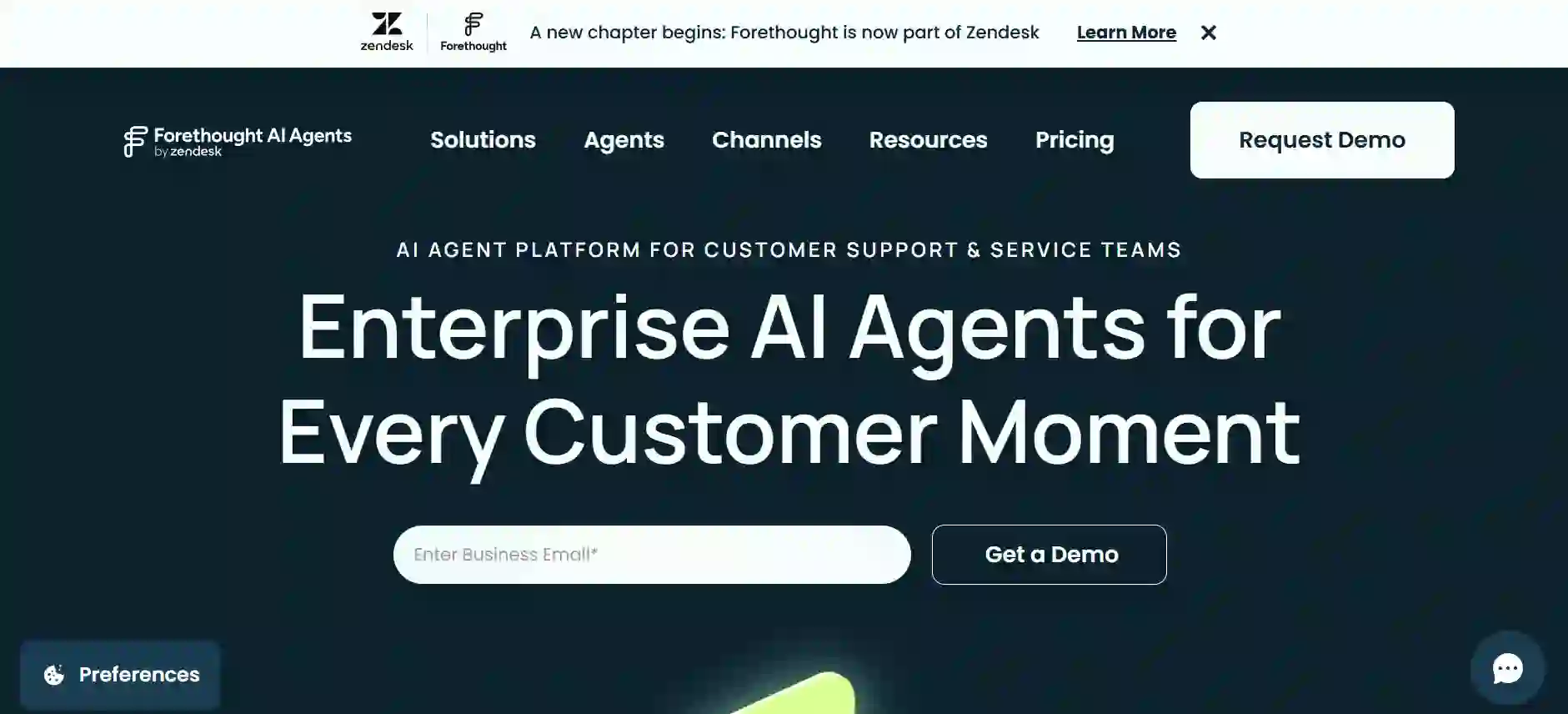
Forethought takes a different angle than most tools on this list. Rather than replacing your helpdesk, it sits on top of your existing platform — Zendesk, Salesforce, Intercom, or Freshdesk — and adds AI automation across the full ticket lifecycle. If you're happy with your current helpdesk but want smarter triage, auto-responses, ticket summarization, and agent assist without migrating your entire stack, Forethought is designed for exactly that.
The platform uses a multi-agent AI system where different specialized AI agents handle different parts of the workflow — one for triage, one for routing, one for drafting responses, and one for agent assist. It also includes a predictive layer that flags tickets likely to escalate before they actually do. Pricing is custom and contact-sales based; mid-market teams should budget for several thousand dollars per month depending on volume and features.
Key Features
- Augments your existing helpdesk rather than replacing it. Forethought adds AI capabilities on top of Zendesk, Salesforce, Intercom, and Freshdesk. You don't need to migrate your support stack or retrain your team on new software — the AI enhancement goes on top of what you already have running.
- Specialized multi-agent AI system. Different AI agents handle triage, routing, response drafting, and agent assist independently. Each agent is optimized for its specific job in the workflow rather than one general-purpose agent trying to handle every stage at once.
- Predictive ticket intelligence. Forethought's AI can predict which incoming tickets are likely to escalate or result in low satisfaction scores — before the human agent even opens the ticket. Teams can get ahead of problem cases before they blow up into escalations or complaints.
- Ticket summarization for faster human handoffs. Forethought summarizes long conversation threads and customer histories into concise notes. When a human agent picks up an escalated case, they get a clear brief instead of scrolling through a wall of messages — which cuts down time-to-resolution.
- Pre-support proactive intervention. Forethought can detect likely incoming support contacts based on user behavior patterns and push help content or trigger a proactive conversation before the customer submits a ticket. This is one of the AI in customer service examples where the technology saves customers the hassle of even having to ask.
- Custom deployment on top of major helpdesks. Forethought installs inside your existing Zendesk or Salesforce instance. Your agents stay in the same interface they've always used; Forethought adds AI suggestions, auto-responses, and triage enhancements as a layer they interact with inside that familiar environment.
12. Kustomer AI
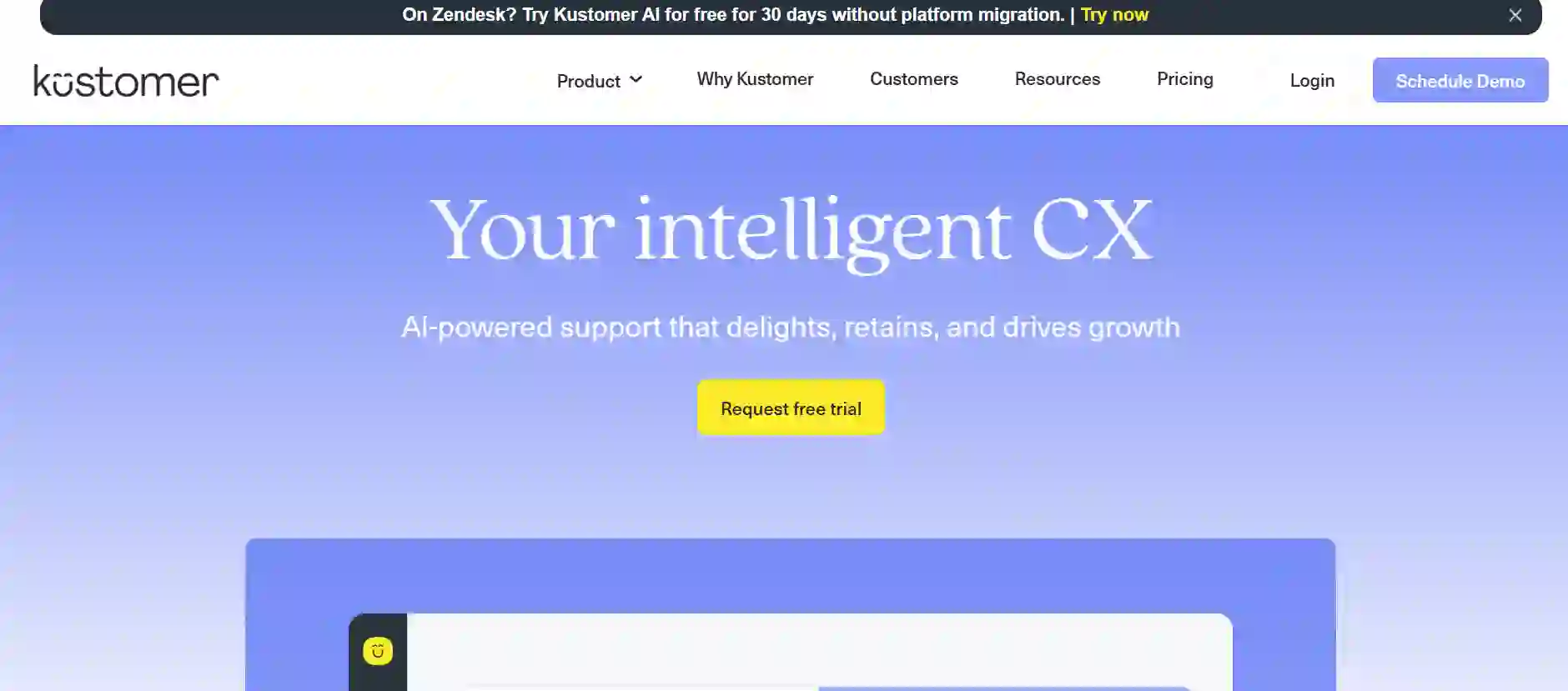
Kustomer isn't just a helpdesk — it's a CRM-first customer service platform with AI built into the core of how it works. Every AI-powered interaction starts with the customer's full record — purchase history, prior support tickets, lifetime value, and account status — already loaded in. That context-first architecture is what makes Kustomer's AI feel more targeted and less generic than what you get from most standalone AI agents.
In 2026, Kustomer's AI handles automated conversations, intelligent ticket routing, proactive outreach, and human agent assist. It connects to major e-commerce platforms, CRMs, and data sources to keep the customer record current in real time. Pricing is enterprise-focused, starting at around $89/agent/month for the Enterprise plan. For brands running high-touch customer operations where history and context matter — subscription businesses, high-average-order-value e-commerce stores, and loyalty-focused brands — Kustomer AI delivers what trusted AI customer service agents should actually look like in practice.
Key Features
- CRM-native AI with full customer timeline. Every AI interaction has the customer's complete purchase history, prior ticket context, and account data loaded in from the start. This is what makes responses feel targeted and relevant rather than generic — the AI actually knows who it's talking to.
- Real-time sentiment analysis during live conversations. Kustomer's AI reads the emotional tone of each message as the conversation unfolds. If a customer's frustration level spikes, the system can flag it, adjust escalation priority, and surface response guidance for the human agent who takes over.
- Proactive outbound messaging. Kustomer can trigger AI-initiated outbound conversations based on order events, customer lifecycle signals, or behavior triggers. If an order is delayed, the AI reaches out before the customer does — which changes the customer experience from reactive to proactive.
- Intelligent routing by customer value and issue type. Kustomer routes tickets based on customer lifetime value, issue complexity, urgency, and agent skill — not just a simple FIFO queue. High-value customers and complex cases get to the right agents faster without manual prioritization.
- Omnichannel unified timeline. Chat, email, SMS, social media, voice, and WhatsApp all feed into a single customer timeline. The AI and human agents both work from the same view, which means nothing falls through the gaps when a customer switches channels.
- Broad integration library including WooCommerce. Kustomer connects with Shopify, Salesforce, Stripe, Klaviyo, and many other platforms. For stores running on WooCommerce or managing multi-platform operations, Kustomer's integration coverage handles most of the data connections your support team needs.
13. Zoho Desk AI (Zia)
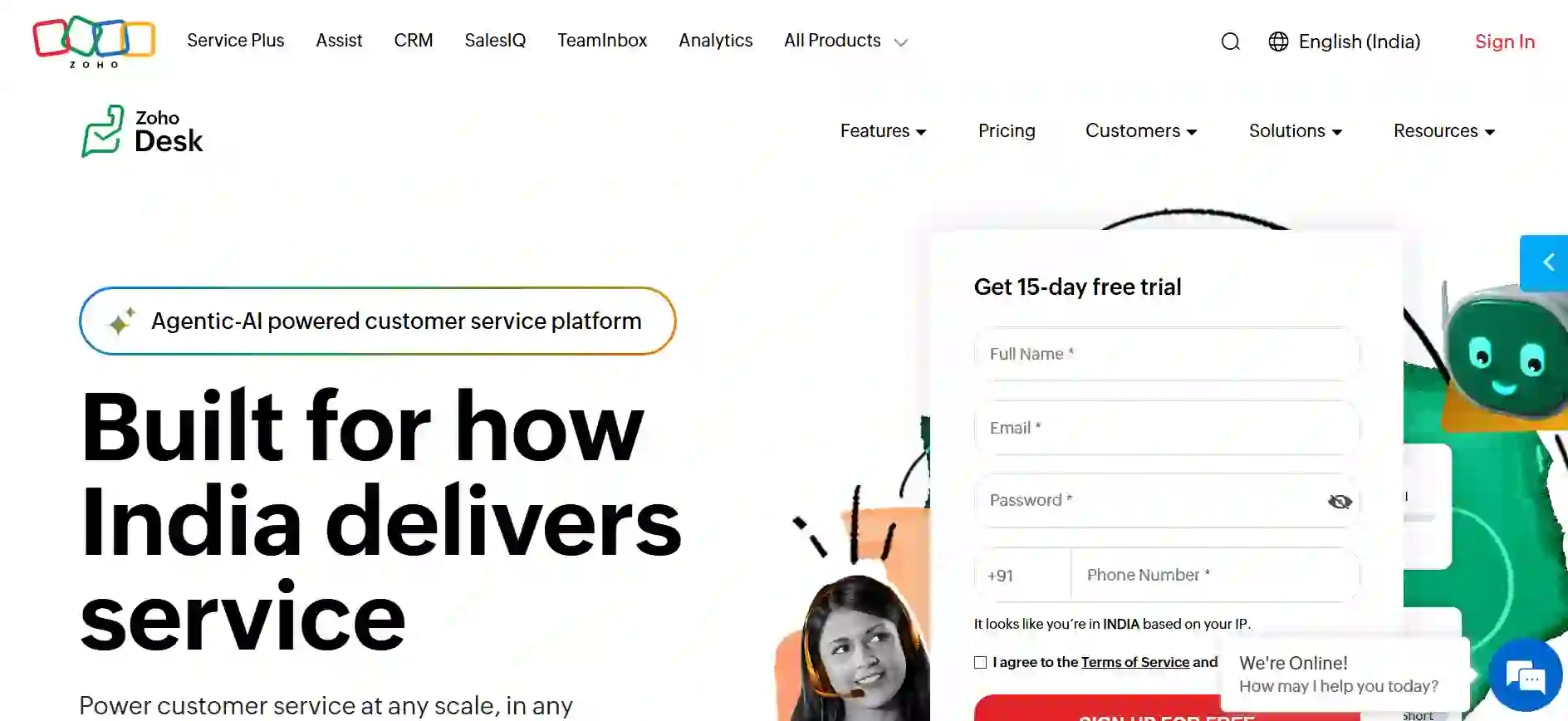
Zoho Desk is one of the more underrated customer service platforms in 2026, and Zia is its built-in AI that covers everything from sentiment detection to automated replies and anomaly alerts. If you're already inside the Zoho ecosystem — Zoho CRM, Zoho Books, or Zoho Commerce — Zia shares data across the full suite without custom API work. It's also one of the most affordable reliable AI customer service agents on this list, which is why a lot of small to mid-size businesses keep landing on it.
Zoho Desk plans start at $7/agent/month (Standard) and go up to $40/agent/month (Enterprise), where Zia is fully active. It handles ticket triage, auto-response drafting, ticket summarization, and real-time agent guidance. It won't match Decagon or Sierra for complex enterprise automation, but for teams that want solid AI agents in customer service without a six-figure price tag, Zia and Zoho Desk deliver more than most expect at this price point.
Key Features
- Real-time sentiment detection on every incoming ticket. Zia reads each ticket for emotional tone before a human agent even opens it. Agents see a live sentiment indicator that helps them prioritize urgent, emotionally charged cases before they spiral into cancellations or complaints.
- Anomaly detection across the support queue. Zia monitors your ticket queue in real time and flags unusual patterns — a sudden spike from a specific region, a new complaint cluster, or a response-time anomaly. This is useful for catching product issues or service outages before they turn into PR problems.
- Auto-response suggestion based on knowledge base and past resolutions. Zia reads incoming tickets and drafts suggested responses grounded in your knowledge base and historical ticket data. Agents can send, edit, or discard each suggestion — it speeds up replies without removing human judgment from the loop.
- Cross-Zoho ecosystem data sharing. Zia pulls from Zoho CRM, Zoho Commerce, and other Zoho apps automatically. If a customer has a recent large purchase in Zoho Commerce, Zia factors that in when generating a priority score or a response suggestion — without any custom API integration required.
- Knowledge base auto-suggestions during live conversations. When agents are handling a ticket, Zia surfaces relevant knowledge base articles in real time based on what the customer is asking. Agents get the right information faster and deliver consistent answers even for questions that don't come up often.
- Affordable Enterprise pricing at $40/agent/month. At $40/agent/month for the Enterprise plan where Zia is fully active, Zoho Desk is significantly cheaper than Zendesk, Salesforce, or Intercom for teams that need AI in customer support without a large budget to work with.
Conclusion
AI agents for customer service aren't a trend coming in the future — they're closing real tickets for real businesses right now in 2026. The tools on this list range from entry-level options any small business can set up today to full enterprise platforms that require six-figure investments and months of onboarding. There's no single answer that works for everyone. If you're running a lean store, start with something affordable and scalable. If you're an enterprise, look at platforms that offer deep integrations, compliance controls, and omnichannel coverage. What's clear is that AI customer service agents are becoming a core part of how businesses respond to customers — and 2026 is the year most businesses stop testing and start committing.
Start your dropshipping business today
Best AI Agents for Customer Service FAQs
What are AI agents for customer service?
AI agents for customer service are software systems that handle customer conversations and support tasks without a human stepping in every time. They use large language models and natural language processing to understand what a customer needs, pull from your knowledge base and business data, and respond or act on it autonomously. A solid customer service AI agent can resolve order issues, respond to customers about account questions, process refunds, and route complex cases to a human agent when needed. Think of them as a support rep that's always on, never overwhelmed, and gets sharper with each conversation.
How do AI agents help in customer support?
AI agents automate the high-volume, repetitive tasks that eat up your support team's time — things like order status updates, password resets, FAQ responses, and account inquiries. They respond to customers instantly, around the clock, without wait times or staffing limits. They also handle multiple conversations at once, which no human team can match at scale. The best platforms let AI agents learn from your past tickets and improve their responses without manual retraining every time something changes. The result is a faster, more consistent experience for customers and a lighter workload for your team.
What does it cost to use AI agents for customer service?
Costs vary a lot by platform and pricing model. Free entry-level plans exist on platforms like Freshdesk and Tidio. Fin by Intercom charges $0.99 per resolution. Gorgias charges $0.90 per AI-resolved conversation. Zendesk AI starts at around $1.50 per resolution plus seat-based plan fees. Enterprise platforms like Sierra and Decagon start at $95,000 to $150,000+ per year on custom contracts. If you're looking for free AI agents for customer service to start with, Freshdesk's free plan supports up to 10 agents, and Tidio's free tier includes 50 Lyro AI conversations per month.
What is the best AI agent for customer service in 2026?
The best AI agents for customer service depend on your size, stack, and budget. Fin by Intercom is a top choice for mid-market teams that want clean, per-resolution pricing and wide helpdesk compatibility. Decagon and Sierra are built for large enterprises needing complex workflow automation and high-volume ticket deflection. Tidio Lyro and Freshdesk Freddy AI are the best starting points for small businesses on a tight budget. If you're already on Salesforce, Agentforce is the logical fit. There is no single top AI agent for customer service that works for every business — pick based on your volume, team size, and existing tech stack.
Can AI agents handle complex customer service issues?
Yes, depending on the platform. Basic AI customer support chatbots are best for FAQs and simple queries. More advanced platforms — like Decagon, Sierra, and Agentforce — are built for complex, multi-step workflows: processing refunds through multiple systems, handling subscription cancellations with retention offers, managing returns involving third-party logistics. The more clearly you define your workflows and train the agent on your specific business policies and data, the better it handles complex cases. Most enterprise platforms also include escalation pathways so complex cases go to a human with full context already attached.
What does it mean to design an AI agentic system for customer support?
Designing an AI agentic system for customer support means building a structure where AI agents handle tasks autonomously, make decisions within defined rules, and escalate to humans when those boundaries are reached. You'll need to decide which tasks the AI owns, what actions it can take inside your backend systems, what triggers an escalation, and how the agent keeps improving with new data. Platforms like Sierra use an "Agent OS" where you define goals and guardrails; Decagon uses Agent Operating Procedures — natural language instructions that compile into structured agent logic. Good AI agents in customer service are shaped around your specific business policies, not off-the-shelf playbooks.


Launch your dropshipping business now!
Start free trial.avif)


Related blogs
Dropshipping Supplier Directory: Where to Find Vetted Suppliers
Browse our directory of vetted dropshipping suppliers across the US and EU, complete with niches, shipping speed, and pricing. Start your free trial today.

How to Negotiate With Dropshipping Suppliers: 9 Tactics That Actually Work
Learn how to negotiate with dropshipping suppliers on price, MOQs, and payment terms. Proven tactics and email scripts to boost your margins. Try Spocket free.

Best Clothing Dropshipping Suppliers: The 2026 Guide
Compare the best clothing dropshipping suppliers for 2026 — US/EU shipping speeds, pricing, and product quality — and find the right fit to launch your store.