


Zero-Waste Dropshipping in Quebec: How Isabelle Charbonneau Built a CAD $27K Brand by Speaking Her Customers' Language
A store owner tapped a forgotten market by speaking her customers' language. Her Quebec zero-waste brand now pulls 18K monthly visitors and 68% repeat buyers. Learn how.
"You can't fake this stuff. Quebec customers can tell when a brand is actually from here versus just pretending. The language, the packaging, the shipping timelines. It all adds up. And Spocket helped me throughout the journey."
-Isabelle Charbonneau
★ Organic traffic: 0 → 18K/month (French keywords)
★ CAD $27K revenue in 8 months
★ 0 competitors ranking in French for her top 5 keywords
★ 68% returning visitors
Isabelle Charbonneau was sitting in her kitchen in Quebec City, scrolling through zero-waste blogs like she did most nights. She'd been into sustainable living for years. Reusable produce bags. Compost bins. Glass jars for everything. It was a lifestyle thing.
But she kept noticing the same problem.
Every time she searched for zero-waste household products in French, the results were either in English or felt like an afterthought. Poor translations. Clunky product descriptions. Websites that clearly weren't built for Quebec customers.
"English-first brands just slapped a French translation on their site and called it a day," Isabelle says. "But that's not how Quebec works. Bilingual isn't just a legal requirement here. It's cultural. If your brand feels like it's pretending to speak my language, I notice."
She saw a gap that nobody else was filling. A market that English-only dropshippers were ignoring entirely.
The Problem: A Market Waiting for Someone Who Actually Spoke the Language

Isabelle started Zéro Déchet Maison in early 2025. She wanted to sell zero-waste products to French-Canadian customers who were tired of buying from impersonal, English-first stores.
But she hit a wall immediately.
Her first suppliers were based in China. Standard dropshipping stuff. Low prices. Decent product photos. But the packaging was all in English. The labels didn't meet Quebec's bilingual labeling requirements. And the shipping took four to 6 weeks.
"Nobody in Quebec is going to wait a month for a bamboo toothbrush," Isabelle says. "And they're definitely not going to buy something that doesn't have French on the box."
She tried sourcing from US and UK eco-brands instead. Better quality. Faster shipping. But they weren't set up for Quebec's language laws. The packaging was English-only. Returns were complicated. Customs added another layer of friction.
Isabelle's store launched with 20 products. She got a handful of orders from friends and family. But organic traffic was basically zero. She was ranking for zero French keywords. Nobody was finding her.
"I knew the demand was there," she says. "I could see the search volume. People in Quebec were looking for zero-waste options. But they weren't finding me."
She spent weeks trying to figure out how to source products that were actually compliant with Quebec's language laws. She emailed dozens of suppliers. Most didn't respond. A few said they'd consider bilingual packaging "someday." Nobody had it ready.
The Solution: Finding Suppliers Who Already Spoke Her Language
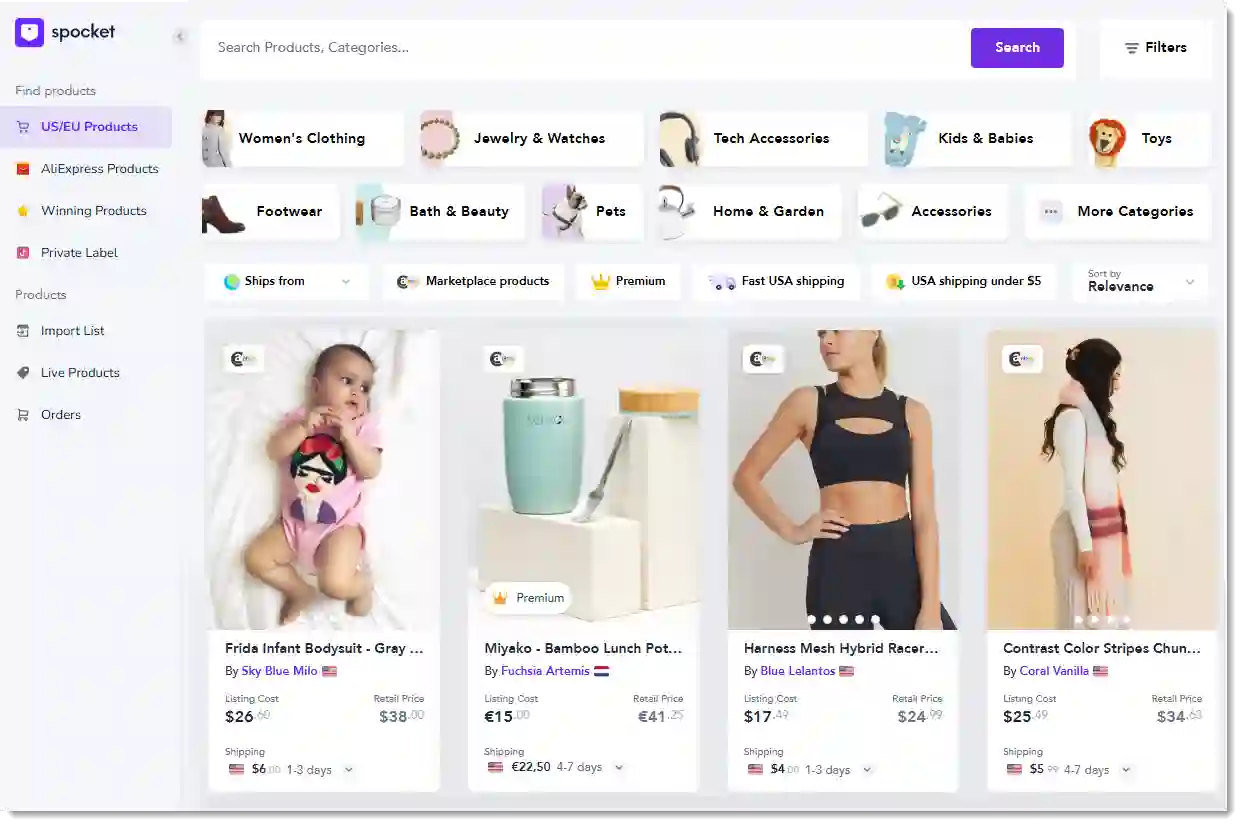
Isabelle found Spocket through a Facebook group for Canadian ecommerce sellers. Someone mentioned that Spocket's EU supplier network included brands with bilingual packaging options.
She signed up and started filtering.
"I was looking for two specific things," Isabelle says. "Suppliers who already had French on their packaging, and suppliers who could ship to Quebec without cross-border delays."
Spocket's EU supplier section surfaced two eco-brands that checked both boxes. One was based in France. The other was in Belgium. Both had bilingual French/English packaging already in place. Both shipped to Canada through established logistics networks
"The French supplier had been selling in Canada for years," Isabelle says. "They'd already done the work. They had the bilingual labels. They had the compliance documentation. They knew how to ship here."
She ordered samples from both suppliers. Spocket has no MOQs, which meant she didn't have to commit to bulk orders. She tested the products herself. She checked the packaging. She verified the labels were actually compliant.
"The samples were exactly what I needed," Isabelle says. "The packaging looked professional. The French translation wasn't awkward. It felt like a real French-Canadian brand."
Spocket's integration with WooCommerce made importing products simple. She could add items, set her own pricing, and start selling without dealing with complex technical setups. Spocket integrates with Wix, WooCommerce, eBay, and BigCommerce as well, but she chose to build her store on Shopify for its flexibility.
The Execution: Owning a Market Nobody Else Was Targeting

Isabelle made two strategic decisions that changed everything.
First, she built her entire website in French-first. Not English with a French translation option. French-first. The default language. Product descriptions written in Quebec French, not Parisian French. Terms her customers actually used.
"Quebec French is different," she says. "If you use European French, people notice. It sounds corporate. I wanted it to sound like a local store."
Second, she did French-language SEO from day one. She researched keywords that Quebec customers were actually searching for. Not "zero waste products." She went after "produits zéro déchet Québec." "Épicerie zéro déchet Montréal." "Alternatives au plastique au Québec."
"You'd be surprised how few people are optimizing for these keywords," Isabelle says. "I checked my top five keywords and I was literally the only person ranking for them in French. Zero competition."
She added French SEO content to every product page. She wrote blog posts in French about zero-waste living in Quebec. She made sure her meta descriptions and title tags were in French. She used Spocket's branded invoicing to send professional French-language receipts and packing slips.
"Spocket's branded invoicing made a huge difference," she says. "When customers received their orders, it didn't look like dropshipping. It looked like a real Quebec brand."
The Results: Numbers That Prove the Language Strategy Worked
8 months after relaunching with Spocket, Isabelle's numbers told a clear story.
Organic traffic went from 0 to 18,000 monthly visitors. All from French-language keywords. She wasn't buying ads. She wasn't doing influencer deals. Just showing up in search results for the exact phrases her audience was typing.
Revenue hit CAD $27,000. Not bad for a side project that started with zero budget and a handful of samples. Her profit margins were better than she expected because she wasn't competing on price. She was competing on language and trust.
Key Insights:
How Isabelle Charbonneau Built a CAD $27K Zero-Waste Brand with Spocket
Zero competitors ranking in French for her top five keywords. That's still true today. She owns those search terms completely. Anyone searching for zero-waste products in Quebec finds her store first.
68% of her customers came back for repeat purchases. Zero-waste shoppers are loyal. When they find a store that speaks their language and ships fast, they stick around.
"I didn't run a single Facebook ad after month two," Isabelle says. "Organic traffic and word-of-mouth kept growing. People tell their friends. They share my blog posts. It just kept building."
For anyone looking to start eco-friendly dropshipping, Isabelle's story shows the power of finding an underserved audience. Her zero-waste products stood out because she understood the cultural nuances of her market better than anyone else.
What Made the Difference?
Isabelle's success came down to a few things.
1. She didn't try to compete on price
She competed on language and authenticity. English-only dropshippers weren't serving the Quebec market well. She showed up in their language and built trust immediately.
2. She found suppliers who already had bilingual packaging
She didn't ask anyone to create something custom. She used Spocket's EU supplier network to find brands that had already done the compliance work.
3. She invested in French SEO early
Most dropshippers ignore SEO entirely or do the bare minimum. Isabelle went deep on Quebec-specific keywords and owned the search results.
Conclusion
Isabelle Charbonneau didn't invent a new product. She didn't find a secret supply chain hack. She spotted a market that bigger brands had ignored and showed up in the language her customers actually speak.
Spocket's EU supplier network gave her access to zero-waste brands with bilingual packaging and fast Quebec shipping. Branded invoicing made her store look legitimate. No-MOQ policies let her test products without committing to bulk orders.
The result was a CAD $27,000 brand in 8 months. A brand that owns French-language search results. A brand with 68% returning visitors. A brand built around trust, language, and authenticity.
If you're thinking about zero-waste products in Canada or any market where language matters, start with the suppliers who already get it. Don't try to fix compliance problems after the fact. Find brands that have already done the work. Build your store around the audience that's being ignored. The sales will follow.
Learn more about green dropshipping and how to build a sustainable brand that resonates with conscious consumers.
Ready to find zero-waste suppliers for your store? Start your free trial with Spocket – 7 days, no credit card required.
Explore zero-waste products and build a brand that actually speaks your customers' language.
